SBASAL3B September 2024 – June 2025 ADC3668 , ADC3669
PRODUCTION DATA
- 1
- 1 Features
- 2 Applications
- 3 Description
- 4 Device Comparison
- 5 Pin Configuration and Functions
-
6 Specifications
- 6.1 Absolute Maximum Ratings
- 6.2 ESD Ratings
- 6.3 Recommended Operating Conditions
- 6.4 Thermal Information
- 6.5 Electrical Characteristics - Power Consumption
- 6.6 Electrical Characteristics - DC Specifications
- 6.7 Electrical Characteristics - AC Specifications (ADC3668 - 250 MSPS)
- 6.8 Electrical Characteristics - AC Specifications (ADC3669 - 500 MSPS)
- 6.9 Timing Requirements
- 6.10 Typical Characteristics, ADC3668
- 6.11 Typical Characteristics, ADC3669
- 7 Parameter Measurement Information
-
8 Detailed Description
- 8.1 Overview
- 8.2 Functional Block Diagram
- 8.3 Feature Description
- 8.4 Device Functional Modes
- 8.5 Programming
- 9 Application and Implementation
- 10Device and Documentation Support
- 11Revision History
- 12Mechanical, Packaging, and Orderable Information
Package Options
Mechanical Data (Package|Pins)
- RTD|64
Thermal pad, mechanical data (Package|Pins)
- RTD|64
Orderable Information
8.3.3 Multi-Chip Synchronization
The device provides an option to achieve deterministic latency to ease synchronization across multiple devices, depending on operating mode:
- DDC Bypass mode: The device inherently already has deterministic latency. External multi-chip synchronization is accomplished by matching clock traces across devices. However, the internal RAMP test pattern can be reset using the SYSREF signal.
- DDC mode: Internal blocks related to the decimation filter (clock dividers, NCO phase, and so on) are reset to a deterministic state using the SYSREF signal. External multi-chip synchronization is accomplished by matching both clock and SYSREF signal traces (blue lines) across devices as shown in Figure 8-15.
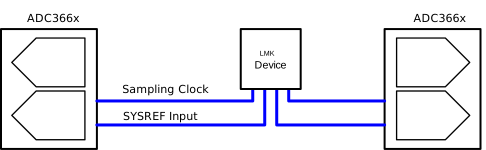 Figure 8-15 Synchronization example of 2
devices
Figure 8-15 Synchronization example of 2
devicesThe GPIO0 pin can be configured as a synchronization input. A single pulse can be applied for multi-chip synchronization as shown in Figure 8-16.
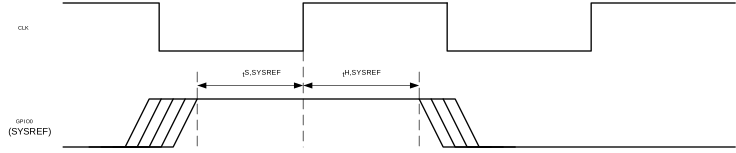 Figure 8-16 Timing: external
synchronization input
Figure 8-16 Timing: external
synchronization inputIn the SPI register map, there are several different synchronization masks available to reset only specific blocks such as the NCO phase.
Table 8-2 Example register writes for external SYSREF
config
| ADDR | DATA | DESCRIPTION |
|---|---|---|
| 0x146 | 0x00 | Configure pin GPIO0 as SYSREF input |