SLVSIN3 May 2025 ADS9117 , ADS9118 , ADS9119
PRODUCTION DATA
- 1
- 1 Features
- 2 Applications
- 3 Description
- 4 Device Comparison Table
- 5 Pin Configuration and Functions
-
6 Specifications
- 6.1 Absolute Maximum Ratings
- 6.2 ESD Ratings
- 6.3 Thermal Information
- 6.4 Recommended Operating Conditions
- 6.5 Electrical Characteristics
- 6.6 Timing Requirements
- 6.7 Switching Characteristics
- 6.8 Timing Diagrams
- 6.9 Typical Characteristics: All Devices
- 6.10 Typical Characteristics: ADS9119
- 6.11 Typical Characteristics: ADS9118
- 6.12 Typical Characteristics: ADS9117
-
7 Detailed Description
- 7.1 Overview
- 7.2 Functional Block Diagram
- 7.3 Feature Description
- 7.4 Device Functional Modes
- 7.5 Programming
- 8 Register Map
-
9 Application and Implementation
- 9.1 Application Information
- 9.2 Typical Applications
- 9.3 Power Supply Recommendations
- 9.4 Layout
- 10Device and Documentation Support
- 11Revision History
- 12Mechanical, Packaging, and Orderable Information
Package Options
Mechanical Data (Package|Pins)
- RHA|40
Thermal pad, mechanical data (Package|Pins)
- RHA|40
Orderable Information
7.3.9 ADC Sampling Clock Input
Use a low-jitter external clock with a high slew rate to maximize SNR performance. Operate the ADS911x with a differential or single-ended clock input. Clock amplitude impacts the ADC aperture jitter and, consequently, SNR. For maximum SNR performance, provide a clock signal with fast slew rates that maximizes swing between VDD_1V8 and GND levels.
Make sure the sampling clock is a free-running continuous clock. The ADC generates a valid output data, data clock, and frame clock tPU_SMPL_CLK, as specified in the Switching Characteristics after a free-running sampling clock is applied. When the sampling clock is stopped, the ADC is in power-down and the output data, data clock, and frame clock are invalid.
Figure 7-11 shows a diagram of the differential sampling clock input. For this configuration, connect the differential sampling clock input to the SMPL_CLKP and SMPL_CLKM pins. Figure 7-12 shows a diagram of the single-ended sampling clock input. In this configuration, connect the single-ended sampling clock to SMPL_CLKP and connect SMPL_CLKM to ground.
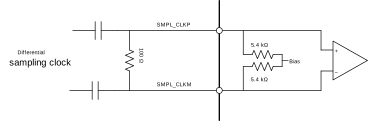 Figure 7-11 AC-Coupled Differential
Sampling Clock
Figure 7-11 AC-Coupled Differential
Sampling Clock Figure 7-12 Single-Ended Sampling
Clock
Figure 7-12 Single-Ended Sampling
ClockFigure 6-6 shows the latency from analog input sampling instant to corresponding data MSB output marked by the FCLK rising edge. The equations for data output latency depend on the output data frame width and are given in Table 7-10.
| DEVICE | 24-BIT DATA FRAME | 20-BIT DATA FRAME |
|---|---|---|
| ADS9119 | 2 × tSMPL_CLK + tLAT | Not supported |
| ADS9118 | 1.83 × tSMPL_CLK + tLAT | Not supported |
| ADS9117 | 1.83 × tSMPL_CLK + tLAT | 2 × tSMPL_CLK + tLAT |
- For tLAT, see the Switching Characteristics table.