SLOSE79B August 2022 – October 2023 DRV8462
PRODUCTION DATA
- 1
- 1 Features
- 2 Applications
- 3 Description
- 4 Revision History
- 5 Pin Configuration and Functions
- 6 Specifications
-
7 Detailed Description
- 7.1 Overview
- 7.2 Functional Block Diagram
- 7.3
Feature Description
- 7.3.1 Interface of Operation
- 7.3.2 Stepper Motor Driver Current Ratings
- 7.3.3 PWM Motor Drivers
- 7.3.4 Microstepping Indexer
- 7.3.5 Indexer Output
- 7.3.6 Automatic Microstepping Mode
- 7.3.7 Custom Microstepping Table
- 7.3.8 Current Regulation
- 7.3.9 Internal Reference Voltage
- 7.3.10 Standstill Power Saving Mode
- 7.3.11 Current Regulation Decay Modes
- 7.3.12 Current Sensing with External Resistor
- 7.3.13 Silent step decay mode
- 7.3.14 Auto-torque Dynamic Current Adjustment
- 7.3.15 Charge Pump
- 7.3.16 Linear Voltage Regulator
- 7.3.17 VCC Voltage Supply
- 7.3.18 Logic Level, Tri-Level and Quad-Level Pin Diagrams
- 7.3.19 Spread spectrum
- 7.3.20
Protection Circuits
- 7.3.20.1 VM Undervoltage Lockout
- 7.3.20.2 VCP Undervoltage Lockout (CPUV)
- 7.3.20.3 Logic Supply Power on Reset (POR)
- 7.3.20.4 Overcurrent Protection (OCP)
- 7.3.20.5 Stall Detection
- 7.3.20.6 Open-Load Detection (OL)
- 7.3.20.7 Overtemperature Warning (OTW)
- 7.3.20.8 Thermal Shutdown (OTSD)
- 7.3.20.9 Supply voltage sensing
- 7.3.20.10 nFAULT Output
- 7.3.20.11 Fault Condition Summary
- 7.3.21 Device Functional Modes
- 7.4 Programming
- 7.5
Register Maps
- 7.5.1 Status Registers
- 7.5.2
Control Registers
- 7.5.2.1 CTRL1 (address = 0x04) [Default = 0Fh]
- 7.5.2.2 CTRL2 (address = 0x05) [Default = 06h]
- 7.5.2.3 CTRL3 (address = 0x06) [Default = 38h]
- 7.5.2.4 CTRL4 (address = 0x07) [Default = 49h]
- 7.5.2.5 CTRL5 (address = 0x08) [Default = 03h]
- 7.5.2.6 CTRL6 (address = 0x09) [Default = 20h]
- 7.5.2.7 CTRL7 (address = 0x0A) [Default = FFh]
- 7.5.2.8 CTRL8 (address = 0x0B) [Default = 0Fh]
- 7.5.2.9 CTRL9 (address = 0x0C) [Default = 10h]
- 7.5.2.10 CTRL10 (address = 0x0D) [Default = 80h]
- 7.5.2.11 CTRL11 (address = 0x0E) [Default = FFh]
- 7.5.2.12 CTRL12 (address = 0x0F) [Default = 20h]
- 7.5.2.13 CTRL13 (address = 0x10) [Default = 10h]
- 7.5.2.14 CTRL14 (address = 0x3C) [Default = 58h]
- 7.5.3 Indexer Registers
- 7.5.4
Custom Microstepping Registers
- 7.5.4.1 CUSTOM_CTRL1 (address = 0x16) [Default = 00h]
- 7.5.4.2 CUSTOM_CTRL2 (address = 0x17) [Default = 00h]
- 7.5.4.3 CUSTOM_CTRL3 (address = 0x18) [Default = 00h]
- 7.5.4.4 CUSTOM_CTRL4 (address = 0x19) [Default = 00h]
- 7.5.4.5 CUSTOM_CTRL5 (address = 0x1A) [Default = 00h]
- 7.5.4.6 CUSTOM_CTRL6 (address = 0x1B) [Default = 00h]
- 7.5.4.7 CUSTOM_CTRL7 (address = 0x1C) [Default = 00h]
- 7.5.4.8 CUSTOM_CTRL8 (address = 0x1D) [Default = 00h]
- 7.5.4.9 CUSTOM_CTRL9 (address = 0x1E) [Default = 00h]
- 7.5.5
Auto torque Registers
- 7.5.5.1 ATQ_CTRL1 (address = 0x1F) [Default = 00h]
- 7.5.5.2 ATQ_CTRL2 (address = 0x20) [Default = 00h]
- 7.5.5.3 ATQ_CTRL3 (address = 0x21) [Default = 00h]
- 7.5.5.4 ATQ_CTRL4 (address = 0x22) [Default = 20h]
- 7.5.5.5 ATQ_CTRL5 (address = 0x23) [Default = 00h]
- 7.5.5.6 ATQ_CTRL6 (address = 0x24) [Default = 00h]
- 7.5.5.7 ATQ_CTRL7 (address = 0x25) [Default = 00h]
- 7.5.5.8 ATQ_CTRL8 (address = 0x26) [Default = 00h]
- 7.5.5.9 ATQ_CTRL9 (address = 0x27) [Default = 00h]
- 7.5.5.10 ATQ_CTRL10 (address = 0x28) [Default = 08h]
- 7.5.5.11 ATQ_CTRL11 (address = 0x29) [Default = 0Ah]
- 7.5.5.12 ATQ_CTRL12 (address = 0x2A) [Default = FFh]
- 7.5.5.13 ATQ_CTRL13 (address = 0x2B) [Default = 05h]
- 7.5.5.14 ATQ_CTRL14 (address = 0x2C) [Default = 0Fh]
- 7.5.5.15 ATQ_CTRL15 (address = 0x2D) [Default = 00h]
- 7.5.5.16 ATQ_CTRL16 (address = 0x2E) [Default = FFh]
- 7.5.5.17 ATQ_CTRL17 (address = 0x2F) [Default = 00h]
- 7.5.5.18 ATQ_CTRL18 (address = 0x30) [Default = 00h]
- 7.5.6 Silent Step Registers
- 8 Application and Implementation
- 9 Thermal Considerations
- 10Power Supply Recommendations
- 11Layout
- 12Device and Documentation Support
- 13Mechanical, Packaging, and Orderable Information
Package Options
Mechanical Data (Package|Pins)
Thermal pad, mechanical data (Package|Pins)
- DDW|44
Orderable Information
5 Pin Configuration and Functions
The DDW package contains a PowerPAD™ on the bottom side of the device.
The DDV package contains a PowerPAD™ on the top side of the device for thermal coupling to a heatsink.
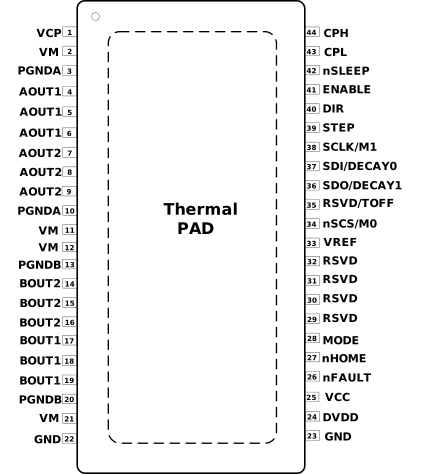 Figure 5-1 DDW Package (44-Pin HTSSOP), Top View
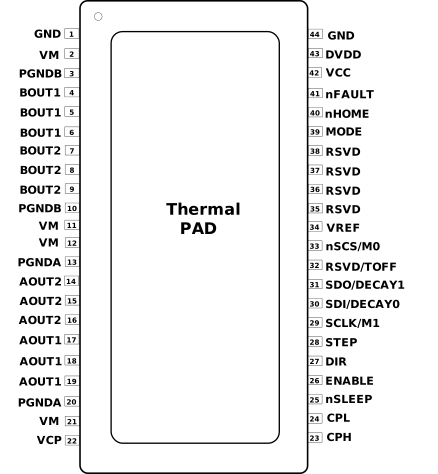 Figure 5-2 DDV Package (44-Pin HTSSOP), Top View
| PIN | TYPE | DESCRIPTION | ||
|---|---|---|---|---|
| NAME | DDW | DDV | ||
| VCP | 1 | 22 | Power | Charge pump output. Connect a X7R, 1-μF, 16-V ceramic capacitor from VCP to VM. |
VM | 2, 11, 12, 21 | 2, 11, 12, 21 | Power | Power supply. Connect to motor supply voltage and bypass to PGNDA and PGNDB with two 0.01-μF ceramic capacitors (one for each pair of pins) plus a bulk capacitor rated for VM. |
PGNDA | 3, 10 | 13, 20 | Power | Power ground. Connect to system ground. |
PGNDB | 13, 20 | 3, 10 | Power | Power ground. Connect to system ground. |
| AOUT1 | 4, 5, 6 | 17, 18, 19 | Output | Winding A output. Connect to motor winding. |
| AOUT2 | 7, 8, 9 | 14, 15, 16 | Output | Winding A output. Connect to motor winding. |
BOUT2 | 14, 15, 16 | 7, 8, 9 | Output | Winding B output. Connect to motor winding. |
BOUT1 | 17, 18, 19 | 4, 5, 6 | Output | Winding B output. Connect to motor winding. |
| GND | 22, 23 | 1, 44 | Power | Device ground. Connect to system ground. |
| DVDD | 24 | 43 | Power | Internal LDO output. Connect a X7R, 1-μF, 6.3-V or 10-V rated ceramic capacitor to GND. |
| VCC | 25 | 42 | Power | Supply voltage for internal logic blocks. When separate logic supply voltage is not available, tie the VCC pin to the DVDD pin. When configured with SPI interface, the VCC pin also acts as the supply pin for SDO output. See Section 7.3.17 for details. |
nFAULT | 26 | 41 | Open Drain | Fault indication output. Pulled logic low with fault condition. Open-drain nFAULT requires an external pullup resistor. |
| nHOME | 27 | 40 | Open Drain | Pulled logic low when the internal indexer is at home position (45°) of step table. The nHOME pin outputs one low pulse per 360º electrical rotation (four fullsteps). See Section 7.3.5.1 for details. |
MODE | 28 | 39 | Input | MODE pin programs the device to operate with either SPI or hardware (H/W) pin interface. See Section 7.3.1 for details. |
RSVD | 29, 30, 31, 32 | 35, 36, 37, 38 | - | Reserved. Leave unconnected. |
VREF | 33 | 34 | Input | Voltage reference input for setting full-scale current. DVDD can be used to generate VREF through a resistor divider. When configured with SPI interface, the VREF pin can be left unconnected if VREF_INT_EN bit is 1b. |
nSCS/M0 | 34 | 33 | Input | With SPI interface, this pin acts as serial chip select. An active low on this pin enables the serial interface communications. With H/W interface, this pin programs the microstepping mode. |
RSVD/TOFF | 35 | 32 | Input | This pin is not used with SPI interface. With H/W interface, this pin programs the OFF time for PWM current regulation. |
SDO/DECAY1 | 36 | 31 | Push-Pull/Input | With SPI interface, this pin acts as serial data output. Data is shifted out on the rising edge of the SCLK pin. With H/W interface, this pin programs the decay-mode. |
SDI/DECAY0 | 37 | 30 | Input | With SPI interface, this pin acts as serial data input. Data is captured on the falling edge of the SCLK pin. With H/W interface, this pin programs the decay-mode. |
SCLK/M1 | 38 | 29 | Input | With SPI interface, this pin acts as serial clock input. Serial data is shifted out and captured on the corresponding rising and falling edge on this pin. With H/W interface, this pin programs the microstepping mode. |
STEP | 39 | 28 | Input | Step input. An active edge causes the indexer to advance one step. With SPI interface, STEP active edge can be either rising edge or both rising and falling edge. With H/W interface, STEP active edge is always the rising edge. |
DIR | 40 | 27 | Input | Direction input. Logic level sets the direction of stepping. |
ENABLE | 41 | 26 | Input | Logic low to disable device outputs; logic high to enable. When the device operates with H/W interface, the ENABLE pin also determines the OCP, OL and OTSD fault recovery methods. |
nSLEEP | 42 | 25 | Input | Sleep mode input. Logic high to enable device; logic low to enter low-power sleep mode. A narrow nSLEEP reset pulse clears latched faults. |
CPL | 43 | 24 | Power | Charge pump switching node. Connect a X7R, 0.1-μF, VM-rated ceramic capacitor from CPH to CPL. |
CPH | 44 | 23 | Power | |
| PAD | - | - | - | Thermal pad. Connect to system ground. |