SBOSAA4B April 2025 – August 2025 INA1H94-SP
PRODUCTION DATA
- 1
- 1 Features
- 2 Applications
- 3 Description
- 4 Pin Configuration and Functions
- 5 Specifications
- 6 Detailed Description
- 7 Application and Implementation
- 8 Device and Documentation Support
- 9 Revision History
- 10Mechanical, Packaging, and Orderable Information
Package Options
Mechanical Data (Package|Pins)
- HKX|8
Thermal pad, mechanical data (Package|Pins)
Orderable Information
7.2.1 SAR ADC 12-B, 8-Channel Battery Cell Voltage Monitor
The application circuit in Figure 7-1 shows a schematic for a battery cell voltage monitoring system. This circuit example is intended to support eight standard Lithium-Ion 4.2V batteries. The difference amplifier is used to monitor the voltage level of each battery cell within a battery pack to monitor the state of health of the batteries.
The battery-monitoring circuit functions by using the INA1H94-SP, unity-gain difference amplifier, to accurately measure the voltage from each battery cell, and level-shift the common-mode voltage to the ADC input range. The INA1H94-SP is powered with bipolar supplies of +12V (VS+) and –5V (VS–). The difference amplifier is able to accommodate the input common-mode voltage of each battery cell on the 33.6V, 8-cell battery stack.
The ADC128S12QML-SP is a radiation hardened, 12-bit, 8-channel, 50kSPS to 1MSPS successive approximation register (SAR) ADC powered with a 5V unipolar supply. The INA1H94-SP op-amp buffers the difference amplifier output, and supports driving the SAR ADC up to 500kSPS maximum sampling rate.
 Figure 7-1 INA1H94-SP Battery Cell Monitor Circuit- Bipolar Supplies
Alternatively, Figure 7-2 shows the battery cell monitor circuit powered with a unipolar +12V (VS+) supply. The INA1H94-SP does not support rail-to-rail output swing, leading to the addition of a +2.5V reference. The difference amplifier output swing requires at least 1.5V headroom above the negative supply (VS–), requiring to bias the REFA and REFB reference input pins to a voltage above 1.5V to level-shift the output signal to meet the output linear range of the difference amplifier. The output of the INA is fed into a voltage divider using 0.05% tolerance resistors to bring the signal within the 5V full-scale range of the ADC.
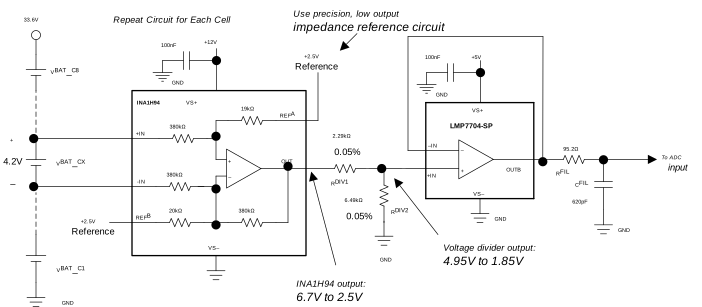 Figure 7-2 INA1H94-SP Battery Cell Monitor
Circuit-Unipolar Supply
Figure 7-2 INA1H94-SP Battery Cell Monitor
Circuit-Unipolar Supply