SBOSAM2 August 2025 INA701
PRODUCTION DATA
- 1
- 1 Features
- 2 Applications
- 3 Description
- 4 Pin Configuration and Functions
- 5 Specifications
-
6 Detailed Description
- 6.1 Overview
- 6.2 Functional Block Diagram
- 6.3 Feature Description
- 6.4 Device Functional Modes
- 6.5 Programming
- 6.6 Register Maps
- 7 Application and Implementation
- 8 Power Supply Recommendations
- 9 Layout
- 10Device and Documentation Support
- 11Revision History
- 12Mechanical, Packaging, and Orderable Information
Package Options
Refer to the PDF data sheet for device specific package drawings
Mechanical Data (Package|Pins)
- YWF|8
Thermal pad, mechanical data (Package|Pins)
Orderable Information
6.3.1 Integrated Shunt Resistor
The INA701 is a precise, low-drift, digital power monitor that provides accurate measurements over the entire specified ambient temperature range of –40°C to +105°C. The integrated current-sensing resistor is internally compensated to provide measurement stability over temperature, while simplifying printed circuit board (PCB) layout and size constraints. Figure 6-2 shows the device gain error as a function of current.
The IN+ and IN– pins allow access to the on-chip current-sensing resistor. This resistor features internal sense connections that are factory-calibrated and temperature-compensated to achieve a high level of accuracy. The INA701 is system-calibrated so that the current-sensing resistor and current-sensing amplifier are both precisely matched to one another.
The nominal pin-to-pin resistance from IN+ to IN– is approximately 7mΩ, while the internal resistance seen by the digital power monitor is nominally 5mΩ. The power dissipation requirements of the system and package are based on the total package resistance between the IN+ and IN– pins. The material composition of the internal shunt has a resistance that increases with temperature as shown in Figure 6-1.
 Figure 6-1 IN+ to IN– Package Resistance vs
Temperature
Figure 6-1 IN+ to IN– Package Resistance vs
TemperatureThe internal compensation of the INA701 corrects for pin-to-pin resistance increases with temperature, achieving less than 50ppm/°C drift over the ambient temperature range.
The INA701 is most accurate when measuring currents in the range of 0.1A to 3A. As currents increase the error in the current measurement also increases. Figure 6-2 below shows how the gain error of the INA701 stays under 0.4% for the shunt current range of 0.1A to 2.5A.
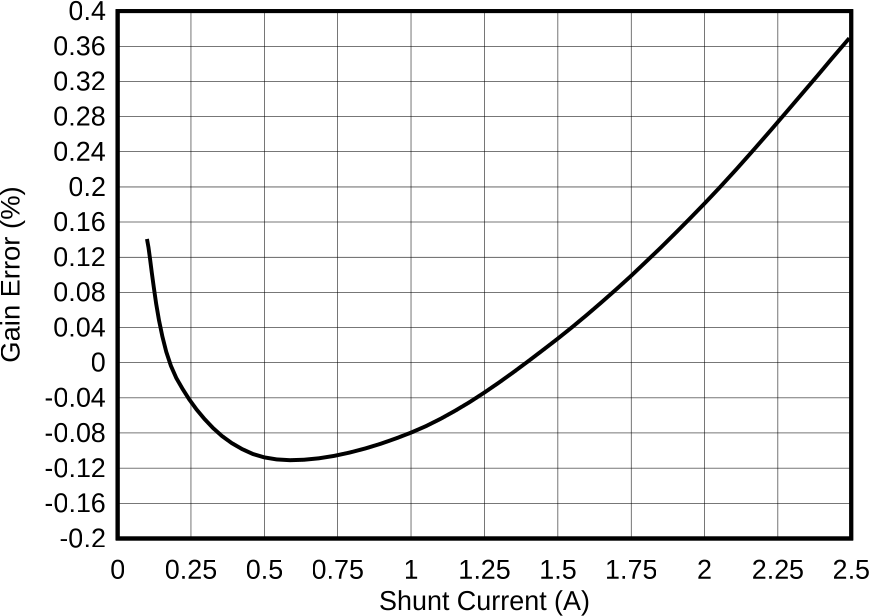 Figure 6-2 Gain Error vs Shunt Current
The change in gain error is consistent enough from device to device that returned values can be scaled up or down depending on the shunt current to give a more accurate result. For example, to achieve higher accuracy when measuring currents around 5A, the returned value can be scaled down by approximately 2% as shown in Figure 6-3.
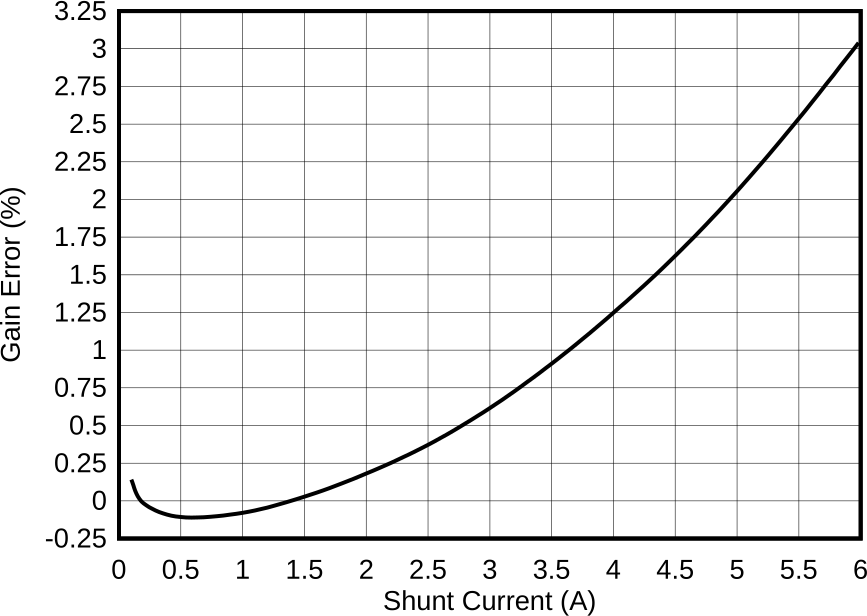 Figure 6-3 Gain Error vs Shunt Current (Full
Range)
Figure 6-3 Gain Error vs Shunt Current (Full
Range)