SNVSCF4 July   2025 LM25139-Q1

PRODUCTION DATA  

  1.   1
  2. Features
  3. Applications
  4. Description
  5. Pin Configuration and Functions
    1. 4.1 Wettable Flanks
  6. Specifications
    1. 5.1 Absolute Maximum Ratings
    2. 5.2 ESD Ratings 
    3. 5.3 Recommended Operating Conditions
    4. 5.4 Thermal Information
    5. 5.5 Electrical Characteristics
    6. 5.6 Typical Characteristics
  7. Detailed Description
    1. 6.1 Overview
    2. 6.2 Functional Block Diagram
    3. 6.3 Feature Description
      1. 6.3.1  Input Voltage Range (VIN )
      2. 6.3.2  High-Voltage Bias Supply Regulator (VCC)
      3. 6.3.3  Precision Enable (EN)
      4. 6.3.4  Power-Good Monitor (PG)
      5. 6.3.5  Switching Frequency (RT)
      6. 6.3.6  Dual Random Spread Spectrum (DRSS)
      7. 6.3.7  Soft Start
      8. 6.3.8  Output Voltage Setpoint (FB)
      9. 6.3.9  Minimum Controllable On Time
      10. 6.3.10 Error Amplifier and PWM Comparator (FB)
      11. 6.3.11 Slope Compensation
      12. 6.3.12 Inductor Current Sense (ISNS, VOUT)
        1. 6.3.12.1 Shunt Current Sensing
        2. 6.3.12.2 Inductor DCR Current Sensing
        3. 6.3.12.3 Hiccup-Mode Current Limiting
    4. 6.4 Device Functional Modes
      1. 6.4.1 Sleep Mode
      2. 6.4.2 Forced PWM and Synchronization (FPWM/SYNC)
      3. 6.4.3 Thermal Shutdown
  8. Application and Implementation
    1. 7.1 Application Information
      1. 7.1.1 Power Train Components
        1. 7.1.1.1 Buck Inductor
        2. 7.1.1.2 Output Capacitors
        3. 7.1.1.3 Input Capacitors
        4. 7.1.1.4 Power MOSFETs
        5. 7.1.1.5 EMI Filter
      2. 7.1.2 Error Amplifier and Compensation
    2. 7.2 Typical Applications
      1. 7.2.1 Design 1 – High Efficiency 2.2MHz Synchronous Buck Regulator
        1. 7.2.1.1 Design Requirements
        2. 7.2.1.2 Detailed Design Procedure
          1. 7.2.1.2.1 Custom Design With WEBENCH® Tools
          2. 7.2.1.2.2 Buck Inductor
          3. 7.2.1.2.3 Current-Sense Components
          4. 7.2.1.2.4 Output Capacitors
          5. 7.2.1.2.5 Input Capacitors
          6. 7.2.1.2.6 Frequency Set Resistor
          7. 7.2.1.2.7 Feedback Resistors
          8. 7.2.1.2.8 Compensation Components
        3. 7.2.1.3 Application Curves
      2. 7.2.2 Design 2 – High-Efficiency, 440kHz, Synchronous Buck Regulator
        1. 7.2.2.1 Design Requirements
        2. 7.2.2.2 Detailed Design Procedure
        3. 7.2.2.3 Application Curves
    3. 7.3 Power Supply Recommendations
    4. 7.4 Layout
      1. 7.4.1 Layout Guidelines
        1. 7.4.1.1 Power Stage Layout
        2. 7.4.1.2 Gate Drive Layout
        3. 7.4.1.3 PWM Controller Layout
        4. 7.4.1.4 Thermal Design and Layout
        5. 7.4.1.5 Ground Plane Design
      2. 7.4.2 Layout Example
  9. Device and Documentation Support
    1. 8.1 Device Support
      1. 8.1.1 Development Support
        1. 8.1.1.1 Custom Design With WEBENCH® Tools
    2. 8.2 Documentation Support
      1. 8.2.1 Related Documentation
        1. 8.2.1.1 Low-EMI Design Resources
        2. 8.2.1.2 Thermal Design Resources
        3. 8.2.1.3 PCB Layout Resources
    3. 8.3 Receiving Notification of Documentation Updates
    4. 8.4 Support Resources
    5. 8.5 Trademarks
    6. 8.6 Electrostatic Discharge Caution
    7. 8.7 Glossary
  10. Revision History
  11. 10Mechanical, Packaging, and Orderable Information

Package Options

Mechanical Data (Package|Pins)
Thermal pad, mechanical data (Package|Pins)
Orderable Information

Layout Guidelines

Proper PCB design and layout is important in a high-current, fast-switching circuit (with high current and voltage slew rates) to achieve a robust and reliable design. As expected, certain issues must be considered before designing a PCB layout using the LM25139-Q1. The high-frequency power loop of a buck regulator power stage is denoted by loop 1 in the shaded area of Figure 7-26. The topological architecture of a buck regulator means that particularly high di/dt current flows in the components of loop 1, and reducing the parasitic inductance of this loop by minimizing the effective loop area becomes mandatory. Also important are the gate drive loops of the high-side and low-side MOSFETs, denoted by 2 and 3, respectively, in Figure 7-26.
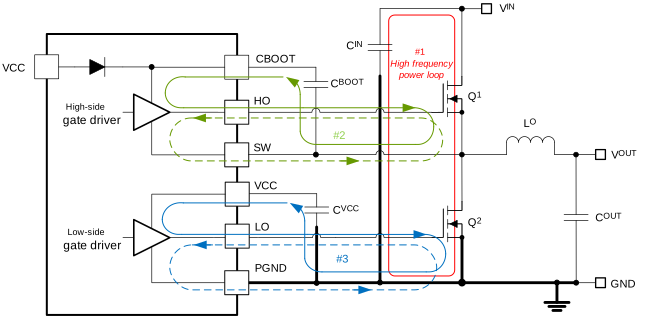
LM25139-Q1 DC/DC Regulator Ground System
                    With Power Stage and Gate Drive Circuit Switching Loops Figure 7-26 DC/DC Regulator Ground System With Power Stage and Gate Drive Circuit Switching Loops