SLVSFF1C December 2021 – November 2025 LM5123-Q1
PRODUCTION DATA
- 1
- 1 Features
- 2 Applications
- 3 Description
- 4 Description (continued)
- 5 Pin Configuration and Functions
- 6 Specifications
-
7 Detailed Description
- 7.1 Overview
- 7.2 Functional Block Diagram
- 7.3
Feature Description
- 7.3.1 Device Enable/Disable (EN, VH Pin)
- 7.3.2 High Voltage VCC Regulator (BIAS, VCC Pin)
- 7.3.3 Light Load Switching Mode Selection (MODE Pin)
- 7.3.4 VOUT Range Selection (RANGE Pin)
- 7.3.5 Line Undervoltage Lockout (UVLO Pin)
- 7.3.6 Fast Restart Using VCC HOLD (VH Pin)
- 7.3.7 Adjustable Output Regulation Target (VOUT, TRK, VREF Pin)
- 7.3.8 Overvoltage Protection (VOUT Pin)
- 7.3.9 Power Good Indicator (PGOOD Pin)
- 7.3.10 Dynamically Programmable Switching Frequency (RT)
- 7.3.11 External Clock Synchronization (SYNC Pin)
- 7.3.12 Programmable Spread Spectrum (DITHER Pin)
- 7.3.13 Programmable Soft Start (SS Pin)
- 7.3.14 Wide Bandwidth Transconductance Error Amplifier and PWM (TRK, COMP Pin)
- 7.3.15 Current Sensing and Slope Compensation (CSP, CSN Pin)
- 7.3.16 Constant Peak Current Limit (CSP, CSN Pin)
- 7.3.17 Maximum Duty Cycle and Minimum Controllable On-Time Limits
- 7.3.18 Deep Sleep Mode and Bypass Operation (HO, CP Pin)
- 7.3.19 MOSFET Drivers, Integrated Boot Diode, and Hiccup Mode Fault Protection (LO, HO, HB Pin)
- 7.3.20 Thermal Shutdown Protection
- 7.4 Device Functional Modes
- 8 Application and Implementation
- 9 Power Supply Recommendations
- 10Layout
- 11Device and Documentation Support
- 12Revision History
- 13Mechanical, Packaging, and Orderable Information
Package Options
Refer to the PDF data sheet for device specific package drawings
Mechanical Data (Package|Pins)
- RGR|20
Thermal pad, mechanical data (Package|Pins)
- RGR|20
Orderable Information
6.6 Typical Characteristics
 Figure 6-1 Frequency vs RT Resistance
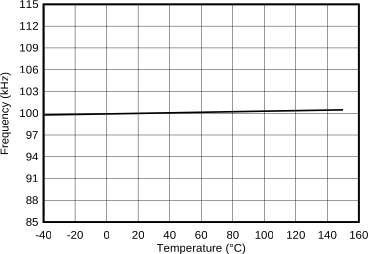 Figure 6-3 Frequency vs Temperature
(RT = 220kΩ, 100kHz)
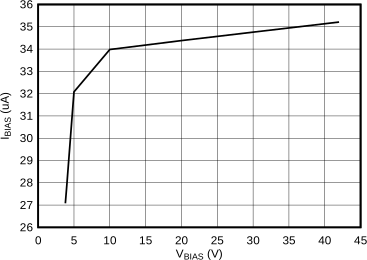 Figure 6-5 VBIAS vs IBIAS (Bypass Mode,
Charge Pump On)
Figure 6-5 VBIAS vs IBIAS (Bypass Mode,
Charge Pump On) Figure 6-7 VBIAS vs IBIAS (Shutdown
Mode)
Figure 6-7 VBIAS vs IBIAS (Shutdown
Mode) Figure 6-9 VVCC vs IVCC
 Figure 6-11 Peak
Current Limit Threshold vs VCSP
Figure 6-11 Peak
Current Limit Threshold vs VCSP
 Figure 6-13 ICSP vs Temperature (Active Mode)
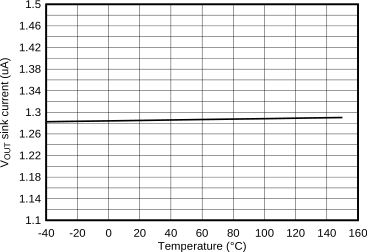 Figure 6-15 VOUT Sink Current vs Temperature (Deep Sleep)
 Figure 6-17 DMAX vs
Frequency
Figure 6-17 DMAX vs
Frequency Figure 6-2 Frequency vs Temperature
 (RT = 9.09kΩ, 2.2MHz)
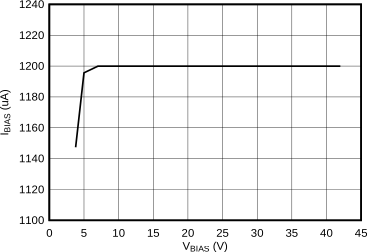 Figure 6-4 VBIAS vs IBIAS (Active Mode)
  Figure 6-6 VBIAS vs IBIAS (Bypass Mode,
Charge Pump Off)
Figure 6-6 VBIAS vs IBIAS (Bypass Mode,
Charge Pump Off) Figure 6-8 VBIAS vs VVCC
 Figure 6-10 VVCC vs Peak
Driver Current
Figure 6-10 VVCC vs Peak
Driver Current  Figure 6-12 Peak
Current Limit Threshold VCLTH vs Temperature (CSP = 3V)
Figure 6-12 Peak
Current Limit Threshold VCLTH vs Temperature (CSP = 3V)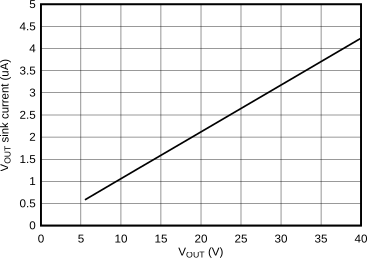 Figure 6-14 VOUT
Sink Current vs VOUT (Deep Sleep)
Figure 6-14 VOUT
Sink Current vs VOUT (Deep Sleep) Figure 6-16 VREF vs Temperature