SNVSCU2B August 2024 – August 2025 LM5137-Q1
PRODUCTION DATA
- 1
- 1 Features
- 2 Applications
- 3 Description
- 4 Related Products
- 5 Pin Configuration and Functions
- 6 Specifications
-
7 Detailed Description
- 7.1 Overview
- 7.2 Functional Block Diagram
- 7.3
Feature Description
- 7.3.1 Input Voltage Range (VIN)
- 7.3.2 Bias Supply Regulator (VCC, BIAS1/VOUT1, VDDA)
- 7.3.3 Precision Enable (EN1, EN2)
- 7.3.4 Switching Frequency (RT)
- 7.3.5 Pulse Frequency Modulation and Synchronization (PFM/SYNC)
- 7.3.6 Synchronization Out (SYNCOUT)
- 7.3.7 Dual Random Spread Spectrum (DRSS)
- 7.3.8 Configurable Soft Start (RSS)
- 7.3.9 Output Voltage Setpoints (FB1, FB2)
- 7.3.10 Error Amplifier and PWM Comparator (FB1, FB2, COMP1, COMP2)
- 7.3.11 Inductor Current Sense (ISNS1+, BIAS1/VOUT1, ISNS2+, VOUT2)
- 7.3.12 Minimum Controllable On-Time
- 7.3.13 100% Duty Cycle Capability
- 7.3.14 MOSFET Gate Drivers (HO1, HO2, LO1, LO2)
- 7.3.15 Output Configurations (CNFG)
- 7.4 Device Functional Modes
-
8 Application and Implementation
- 8.1 Application Information
- 8.2
Typical Applications
- 8.2.1
Design 1 – Dual 5V and 3.3V, 20A Buck Regulator for 12V
Automotive Battery Applications
- 8.2.1.1 Design Requirements
- 8.2.1.2
Detailed Design Procedure
- 8.2.1.2.1 Custom Design With WEBENCH® Tools
- 8.2.1.2.2 Custom Design With Excel Quickstart Tool
- 8.2.1.2.3 Inductor Calculations
- 8.2.1.2.4 Shunt Resistors
- 8.2.1.2.5 Ceramic Output Capacitors
- 8.2.1.2.6 Ceramic Input Capacitors
- 8.2.1.2.7 Feedback Resistors
- 8.2.1.2.8 Input Voltage UVLO Resistors
- 8.2.1.2.9 Compensation Components
- 8.2.1.3 Application Curves
- 8.2.2 Design 2 – Two-Phase, Single-Output Synchronous Buck Regulator for Automotive ADAS Applications
- 8.2.3 Design 3 – 12V, 20A, 400kHz, Two-Phase Buck Regulator for 48V Automotive Applications
- 8.2.1
Design 1 – Dual 5V and 3.3V, 20A Buck Regulator for 12V
Automotive Battery Applications
- 8.3 Power Supply Recommendations
- 8.4 Layout
- 9 Device and Documentation Support
- 10Revision History
- 11Mechanical, Packaging, and Orderable Information
Package Options
Mechanical Data (Package|Pins)
- RHA|36
Thermal pad, mechanical data (Package|Pins)
- RHA|36
Orderable Information
8.4.2 Layout Example
Based on the LM25137F-Q1-EVM5D3 design, Figure 8-30 shows a single-sided layout of a dual-output synchronous buck regulator. The design uses layer 2 of the PCB as a power-loop ground return path directly underneath the top layer to create a low-area switching power loop of approximately 2mm². This loop area must be as small as possible to minimize power-loop parasitic inductance, which results in reduced switch-node voltage overshoot and ringing (and hence an improved overall EMI signature). See also the LM25137F-Q1-EVM5D3 Evaluation Module and LM5137F-Q1-EVM12V Evaluation Module EVM user's guides.
 Figure 8-30 PCB Top
Layer
Figure 8-30 PCB Top
LayerAs shown in Figure 8-31, the high-frequency power loop current flows through MOSFETs Q3 and Q4, through the power ground plane on layer 2, and back to VIN through the 0603 ceramic capacitors C30 through C33. The currents flowing in opposing directions in the vertical loop configuration provide field self-cancellation, reducing parasitic loop inductance. Figure 8-32 shows a side view to illustrate the concept of creating a low-profile, self-canceling loop in a multilayer PCB structure. The layer-2 GND plane layer, shown in Figure 8-31, provides a tightly-coupled current return path directly under the MOSFETs to the source terminals of Q4.
Four 10nF input capacitors with small 0603 case size, place in parallel close to the drain of each high-side MOSFET. The low ESL and high self-resonant frequency (SRF) of the small footprint capacitors yield excellent high-frequency performance. The negative terminals of these capacitors connect to the layer-2 GND plane with multiple 12mil (0.3mm) diameter vias, further reducing parasitic inductance.
Additional steps used in this layout example include:
- Keep the SW connection from the power MOSFETs to the inductor (for each channel) at minimum copper area to reduce capacitive coupling and radiated EMI.
- Locate the IC close to the power MOSFETs and keep the gate drive traces short and direct. Route the HO and SW traces as a diff pair and run the LO trace above or below a ground plane.
- Create an analog ground plane near the IC for sensitive analog components. Connect the AGND plane and the PGND power ground planes at a single point at the die attach pad (DAP) of the IC.
- Increase the width of the BIAS1/VOUT1 trace to minimize the voltage offset related to VCC bias current, as shown in Figure 8-33.
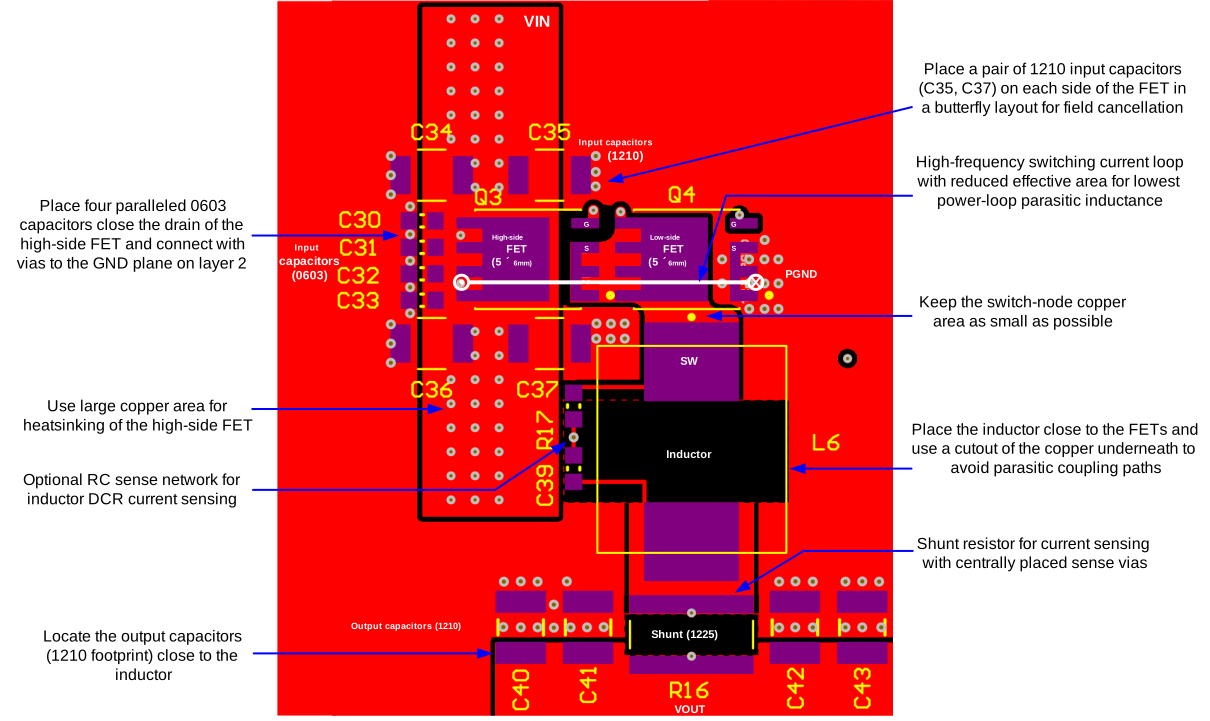 Figure 8-31 Power Stage
Component Layout
Figure 8-31 Power Stage
Component Layout
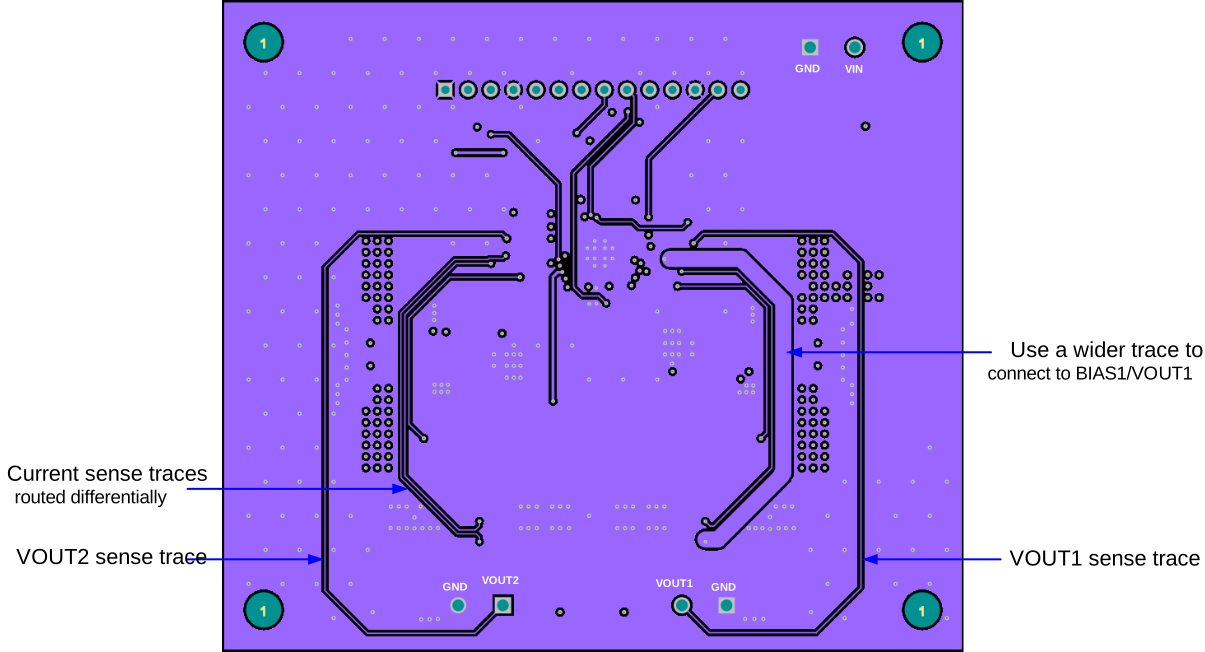 Figure 8-33 PCB Inner Layer