SNVSCF0 October 2024 LM65680-Q1
ADVANCE INFORMATION
- 1
- 1 Features
- 2 Applications
- 3 Description
- 4 Device Comparison Table
- 5 Pin Configuration and Functions
- 6 Specifications
-
7 Detailed Description
- 7.1 Overview
- 7.2 Functional Block Diagram
- 7.3
Feature Descriptions
- 7.3.1 Output Voltage Selection
- 7.3.2 EN Pin and Use as VIN UVLO
- 7.3.3 Device Configuration
- 7.3.4 Single-Output Dual-Phase Operation
- 7.3.5 Mode Selection
- 7.3.6 Adjustable Switching Frequency
- 7.3.7 Dual Random Spread Spectrum (DRSS)
- 7.3.8 Internal LDO, VCC UVLO, and BIAS Input
- 7.3.9 Bootstrap Voltage (BST Pin)
- 7.3.10 Soft Start and Recovery From Dropout
- 7.3.11 Safety Features
- 7.4 Device Functional Modes
- 8 Application and Implementation
- 9 Device and Documentation Support
- 10Revision History
- 11Mechanical, Packaging, and Orderable Information
Package Options
Mechanical Data (Package|Pins)
- RZY|26
Thermal pad, mechanical data (Package|Pins)
Orderable Information
7.3.11.2 Overcurrent and Short-Circuit Protection
The LM656x0-Q1 is protected from overcurrent conditions by cycle-by-cycle current limiting on both the high-side and the low-side MOSFETs.
High-side MOSFET overcurrent protection is implemented by the nature of the peak current mode control. The HS switch current is sensed when the HS is turned on after a short blanking time. The HS switch current is compared to the minimum of a fixed current setpoint, or the output of the voltage regulation loop minus slope compensation, every switching cycle. Since the voltage loop has a maximum value and slope compensation increases with duty cycle, the HS current limit decreases with increased duty cycle if duty cycle is above 35%.
When the LS switch is turned on, the current going through the switch is also sensed and monitored. Like the high-side MOSFET, the low-side MOSFET turn-off is commanded by the voltage control loop. For a low-side device, turn-off is prevented if the current limit is exceeded, even if the oscillator normally starts a new switching cycle. Also, like the high-side device, there is a limit on how high the turn-off current is allowed to be. This is called the low-side current limit; see the Electrical Characteristics for values. If the LS current limit is exceeded, the LS MOSFET stays on and the HS switch is not turned on. The LS switch is turned off after the LS current falls below the limit. The HS switch is turned on again as long as at least one clock period has passed since the last time the HS device has turned on.
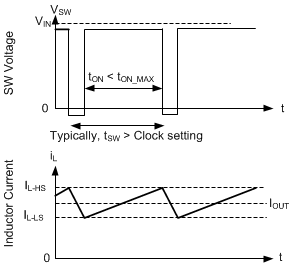 Figure 7-9 Current Limit Waveforms
The net effect of the operation of high-side and low-side current limit is that the IC operates in hysteretic control. Because the current waveform assumes values between IL-HS and IL-LS, output current is close to the average of these two values unless duty cycle is very high. After operating in current limit, hysteretic control is used and current does not increase as output voltage approaches zero.
If the duty cycle is very high, current ripple must be very low to prevent instability. Because the current ripple is low, the part is able to deliver full current. The current delivered is very close to IL-LS.
After the overload condition is removed, the device recovers as though in soft start; see Section 7.3.10. Note that hiccup can be triggered if output voltage drops below approximately 0.4 times the intended output voltage.