SNOS611F July 1999 – March 2025 LMC6041 , LMC6042 , LMC6044
PRODUCTION DATA
- 1
- 1Features
- 2Applications
- 3Description
- 4Pin Configuration and Functions
- 5Specifications
- 6Application and Implementation
- 7Device and Documentation Support
- 8Revision History
- 9Mechanical, Packaging, and Orderable Information
Package Options
Refer to the PDF data sheet for device specific package drawings
Mechanical Data (Package|Pins)
- D|8
- P|8
Thermal pad, mechanical data (Package|Pins)
Orderable Information
6.1.3 Capacitive-Load Tolerance
Direct capacitive loading reduces the phase margin of many op amps. A pole in the feedback loop is created by the combination of the op-amp output impedance and the capacitive load. This pole induces phase lag at the unity-gain crossover frequency of the amplifier resulting in either an oscillatory or underdamped pulse response. With a few external components, op amps can easily indirectly drive capacitive loads. Figure 6-2 shows an example.
 Figure 6-2 LMC604x Noninverting
Gain-of-10 Amplifier, Compensated to Handle Capacitive Loads
Figure 6-2 LMC604x Noninverting
Gain-of-10 Amplifier, Compensated to Handle Capacitive LoadsIn the circuit of Figure 6-2, R1 and C1 serve to counteract the loss of phase margin by feeding the high-frequency component of the output signal back into the inverting input of the amplifier, thereby preserving phase margin in the overall feedback loop.
Capacitive load driving capability is enhanced by using a pullup resistor to V+ (Figure 6-3). Typically, a pullup resistor conducting 10μA or more significantly improves capacitive load responses. The value of the pullup resistor must be determined based on the current sinking capability of the amplifier with respect to the desired output swing. The open-loop gain of the amplifier can also be affected by the pullup resistor (see Section 5.7).
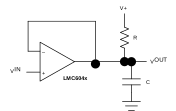 Figure 6-3 Compensating for Large
Capacitive Loads With a Pullup Resistor
Figure 6-3 Compensating for Large
Capacitive Loads With a Pullup Resistor