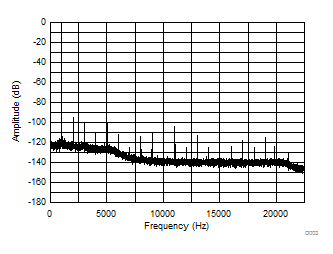
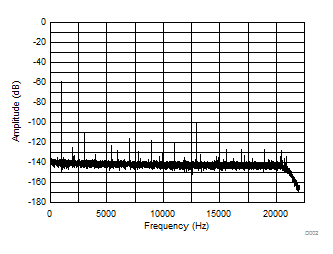
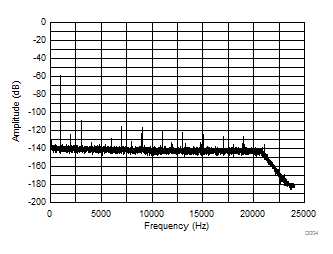
6 Specifications
6.1 Absolute Maximum Ratings(1)
| MIN | MAX | UNIT | |||
|---|---|---|---|---|---|
| Supply voltage, DVDD1 and DVDD2 | –0.3 | 3.9 | V | ||
| Supply voltage, AVDD and AVDD_PWM | –0.3 | 3.9 | V | ||
| Input voltage | 3.3-V digital input | –0.5 | DVDD + 0.5 | V | |
| 5-V tolerant(2) digital input | –0.5 | 6 | |||
| IIK | Input clamp current (VI < 0 or VI > 1.8 V | ±20 | μA | ||
| IOK | Output clamp current (VO < 0 or VO > 1.8 V) | ±20 | μA | ||
| TSTG | Storage temperature range | –65 | 150 | °C | |
(1) Stresses beyond those listed under Absolute Maximum Ratings may cause permanent damage to the device. These are stress ratings only. Functional operation of the device at these or any other conditions beyond those indicated under Recommended Operating Conditions are not implied. Exposure to absolute-maximum-rated conditions for extended periods may affect device reliability.
(2) 5-V tolerant signals are RESET, PDN, MUTE, HP_SEL, SCLK, LRCLK, MCLK, SDIN1, SDIN2, SDIN3, SDIN4, SDA, and SCL.
6.2 ESD Ratings
| VALUE | UNIT | |||
|---|---|---|---|---|
| V(ESD) | Electrostatic discharge | Human body model (HBM), per ANSI/ESDA/JEDEC JS-001, all pins (1) | ±250 | V |
| Charged device model (CDM), per JEDEC specification JESD22-C101, all pins (2) | ±1000 | V |
(1) JEDEC document JEP155 states that 500-V HBM allows safe manufacturing with a standard ESD control process.
(2) JEDEC document JEP157 states that 250-V CDM allows safe manufacturing with a standard ESD control process.
6.3 Recommended Operating Conditions
over 0°C to 85°C| MIN | NOM | MAX | UNIT | |||
|---|---|---|---|---|---|---|
| Digital supply voltage, DVDD1 and DVDD2 | 3 | 3.3 | 3.6 | V | ||
| Analog supply voltage, AVDD and AVDD_PWM | 3 | 3.3 | 3.6 | V | ||
| VIH | High‐level input voltage | 3.3 V | 2 | V | ||
| 5-V tolerant | 2 | |||||
| 1.8-V LVCMOS (XTL_IN) | 1.26 | |||||
| VIL | Low‐level input voltage | 3.3 V | 0.8 | V | ||
| 5-V tolerant | 0.8 | |||||
| 1.8-V (XTL_IN) | 0.54 | |||||
| TA | Operating ambient-air temperature | 0 | 25 | 85 | °C | |
| TJ | Operating junction temperature | 0 | 105 | °C | ||
6.4 Thermal Information
| THERMAL METRIC(1) | TAS5558 | UNIT | |
|---|---|---|---|
| DCA (HTSSOP) | |||
| 56 PINS | |||
| RθJA | Junction-to-ambient thermal resistance | 26.1 | °C/W |
| RθJCtop | Junction-to-case (top) thermal resistance | 13.0 | |
| RθJB | Junction-to-board thermal resistance | 8.0 | |
| ψJT | Junction-to-top characterization parameter | 0.4 | |
| ψJB | Junction-to-board characterization parameter | 7.9 | |
| RθJCbot | Junction-to-case (bottom) thermal resistance | 0.4 | |
(1) For more information about traditional and new thermal metrics, see the IC Package Thermal Metrics application report, SPRA953.
6.5 Electrical Characteristics
At recommended operating conditions - 25 °C Operating Temp, 3.3V Power Supplies with 48kHz input data unless otherwise specified| PARAMETER | TEST CONDITIONS | MIN | TYP | MAX | UNIT | ||
|---|---|---|---|---|---|---|---|
| VOH | High-level output voltage | 3.3-V TTL and 5-V tolerant | IOH = –4 mA | 2.4 | V | ||
| 1.8-V LVCMOS (XTL_OUT) | IOH = –0.55 mA | 1.44 | |||||
| VOL | Low-level output voltage | 3.3-V TTL and 5-V tolerant | IOL = 4 mA | 0.5 | V | ||
| 1.8-V LVCMOS (XTL_OUT) | IOL = 0.75 mA | 0.5 | |||||
| IOZ | High-impedance output current | 3.3-V TTL | ±20 | μA | |||
| IIL | Low-level input current | 3.3-V TTL | VI = VIL | ±1 | μA | ||
| 1.8-V LVCMOS (XTL_IN) | VI = VIL | ±1 | |||||
| 5-V tolerant(2) | VI = 0 V, DVDD = 3 V | ±1 | |||||
| IIH | High-level input current | 3.3-V TTL | VI = VIH | ±1 | μA | ||
| 1.8-V LVCMOS (XTL_IN) | VI = VIH | ±1 | |||||
| 5-V tolerant(2) | VI = 5.5 V, DVDD = 3 V | ±1 | |||||
| IDD | Input supply current | Digital supply voltage, DVDD | Input fS = 48 kHz | 220 | mA | ||
| Power down | 9 | ||||||
| Analog supply voltage, AVDD | Input fS = 48 kHz | 8 | |||||
| Power down | 8 | ||||||
6.6 Dynamic Performance
At recommended operating conditions at (25°C, 3.3V Power Supplies with 48kHz input data) unless otherwise noted.| PARAMETER | TEST CONDITIONS | MIN | NOM | MAX | UNIT |
|---|---|---|---|---|---|
| Dynamic range | TAS5558 A-weighted (Test Range: 20Hz to 20kHz. fS = 96 kHz). | 105 | dB | ||
| Total harmonic distortion | TAS5558 output (1kHz at -1dBFS) | 0.01% | |||
| Frequency response | 32-kHz to 96-kHz sample rates (Test Range 20Hz - 20kHz) | ±0.1 | dB | ||
| 176.4, 192-kHz sample rates (Test Range 20Hz - 20kHz) | ±0.2 |
6.7 SRC Performance
| ATTRIBUTE | VALUE |
|---|---|
| SRC Latency | 102.53125/FSin + 36.46875/FSout |
| THD+N at 1kHz | |
| Pass Band Ripple (worst case) | ±0.05dB |
| SRC Channel Gain | <1 (slightly lower to compensate for ripple) |
| Stop Band Attenuation | 130dB |
| Pass Band Edge | 0.425 FS-in |
| Stop Band Edge | 0.575 FS-in |
6.8 Timing I2C Serial Control Port Operation
Timing Characteristics for I2C Interface Signals over recommended operating conditions (unless otherwise noted)| STANDARD MODE | FAST MODE | UNIT | ||||
|---|---|---|---|---|---|---|
| MIN | MAX | MIN | MAX | |||
| fSCL | SCL clock frequency | 0 | 100 | 0 | 400 | kHz |
| tHD-STA | Hold time (repeated) START condition. After this period, the first clock pulse is generated. | 4 | 0.6 | μs | ||
| tLOW | LOW period of the SCL clock | 4.7 | 1.3 | μs | ||
| tHIGH | HIGH period of the SCL clock | 4 | 0.6 | μs | ||
| tSU-STA | Setup time for repeated START | 4.7 | 0.6 | μs | ||
| tSU-DAT | Data setup time | 250 | 200 | ns | ||
| tHD-DAT | Data hold time | 0 | 3.45 | 0 | 0.9 | μs |
| tr | Rise time of both SDA and SCL, see Figure 1 | 1000 | 20 + 0.1 Cb | 500 | ns | |
| tf | Fall time of both SDA and SCL, see Figure 1 | 300 | 20 + 0.1 Cb | 300 | ns | |
| tSU-STO | Setup time for STOP condition | 4 | 0.6 | μs | ||
| tBUF | Bus free time between a STOP and START condition | 4.7 | 1.3 | μs | ||
| Cb | Capacitive loads for each bus line | 400 | 400 | pF | ||
| VnL | Noise margin at the LOW level for each connected device (including hysteresis) | 0.1 × VDD | 0.1 × VDD | V | ||
| VnH | Noise margin at the HIGH level for each connected device (including hysteresis) | 0.2 × VDD | 0.2 × VDD | V | ||
6.9 Reset Timing (RESET)
Control signal parameters over recommended operating conditions (unless otherwise noted)| PARAMETER | MIN | TYP | MAX | UNIT | |
|---|---|---|---|---|---|
| tr(DMSTATE) | Time to Non PWM Switching low | 400 | ns | ||
| tw(RESET) | Pulse duration, RESET active, see Figure 3 | 400 | None | ns | |
| tr(I2C_ready) | Time to enable I2C | 5 | ms | ||
6.10 Power-Down (PDN) Timing
Control signal parameters over recommended operating conditions (unless otherwise noted)| PARAMETER | MIN | TYP | MAX | UNIT | |
|---|---|---|---|---|---|
| tp(DMSTATE) | Time to Non PWM Switching low | 650 | μs | ||
| Number of MCLKs preceding the release of PDN, see Figure 4 | 5 | ||||
| tsu | Device startup time | 200 | µs | ||
| Time to audio output | 160 | mS | |||
6.11 Back-End Error (BKND_ERR)
Control signal parameters over recommended operating conditions (unless otherwise noted)| PARAMETER | MIN | TYP | MAX | UNIT | |
|---|---|---|---|---|---|
| tw(ER) | Pulse duration, BKND_ERR active, see Figure 5 | 350 | None | ns | |
| tp(valid_low) | Minimum amount of time that device asserts VALID low. | <100 | μs | ||
| tp(valid_high) | I2C programmable to be between <1mS to 1.2 seconds (to avoid glitching with persistent BKND_ERR) | –25 | 25 | % of interval | |
6.12 Mute Timing (MUTE)
Control signal parameters over recommended operating conditions (unless otherwise noted). See Figure 6| PARAMETER | MIN | TYP | MAX | UNIT | |
|---|---|---|---|---|---|
| td(VOL) | Volume ramp time | Defined by rate setting(1) | ms | ||
Note: No I2C commands during the volume ramp up/down.
6.13 Headphone Select (HP_SEL)
Control signal parameters over recommended operating conditions (unless otherwise noted)| PARAMETER | MIN | TYP | MAX | UNIT | |
|---|---|---|---|---|---|
| tw(HP_SEL) | Pulse duration, HP_SEL active, see Figure 7 | 165 | ms | ||
| td(VOL) | Soft volume update time | Defined by rate setting(1) | ms | ||
| t(SW) | Switchover time | 165 | ms | ||
6.14 Switching Characteristics - Clock Signals
PLL input parameters and external filter components over recommended operating conditions (unless otherwise noted)| PARAMETER | TEST CONDITIONS | MIN | TYP | MAX | UNIT | |
|---|---|---|---|---|---|---|
| fMCLKI | Frequency, MCLK (1/tcyc2) | 2 | 50 | MHz | ||
| TAS5558: MCLK duty cycle | 40% | 50% | 60% | |||
| TAS5558: MCLK minimum high time | ≥2-V MCLK = 49.152 MHz, within the min and max duty cycle constraints | 5 | ns | |||
| TAS5558: MCLK minimum low time | ≤0.8-V MCLK = 49.152 MHz, within the min and max duty cycle constraints | 5 | ns | |||
| LRCLK allowable drift before LRCLK reset | 10 | MCLKs | ||||
| External PLL filter capacitors | SMD 0603 X7R | 100 | nF | |||
| External PLL filter capacitors | SMD 0603 X7R | 10 | nF | |||
| External PLL filter resistors | SMD 0603, metal film, 1% | 200 | Ω | |||
| External VRA_PWM decoupling C14 | SMD 0603 X7R | 100 | nF | |||
6.15 Switching Characteristics - Serial Audio Port
Serial audio port slave mode over recommended operating conditions (unless otherwise noted)| PARAMETER | TEST CONDITIONS | MIN | TYP | MAX | UNIT | |
|---|---|---|---|---|---|---|
| fSCLKIN | SCLK input frequency | CL = 30 pF | 2.048 | 12.288 | MHz | |
| tsu1 | Setup time, LRCLK to SCLK rising edge | 10 | ns | |||
| th1 | Hold time, LRCLK from SCLK rising edge | 10 | ns | |||
| tsu2 | Setup time, SDIN to SCLK rising edge | 10 | ns | |||
| th2 | Hold time, SDIN from SCLK rising edge | 10 | ns | |||
| LRCLK frequency | 32 | 48 | 192 | kHz | ||
| SCLK rising edges between LRCLK rising edges | 64 | 64 | SCLK edges | |||
| SDOUT delay with respect to SCLK output (load = 30pF), see Figure 8 | 20 | ns | ||||
6.16 Volume Control
Control signal parameters over recommended operating conditions (unless otherwise noted)| PARAMETER | TEST CONDITIONS | MIN | MAX | UNIT |
|---|---|---|---|---|
| Maximum attenuation before mute | Individual volume, master volume, or a combination of both | –127 | dB | |
| Maximum gain | Individual volume, master volume | 18 | dB | |
| Maximum volume before the onset of clipping | 0-dB input, any modulation limit | 0 | dB | |
| PSVC range | PSVC enabled | 12, 18, or 24 | dB | |
| PSVC rate | fS | |||
| PSVC modulation | Single sided | |||
| PSVC quantization | 2048 | Steps | ||
| PSVC PWM modulation limits | PSVC range = 24 dB | 6% (120 : 2048) |
95% (1944 : 2048) |
dB |
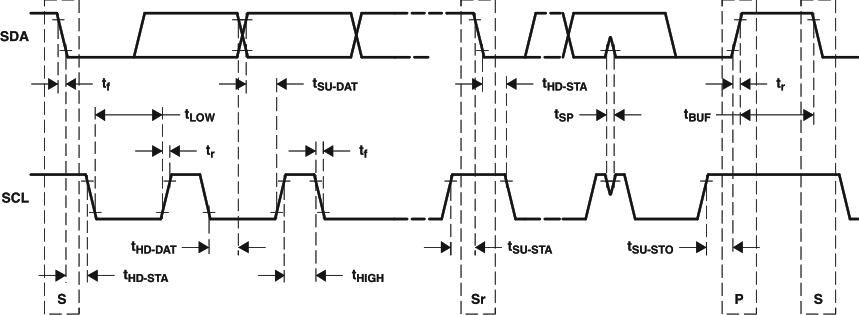 Figure 1. SCL and SDA Timing
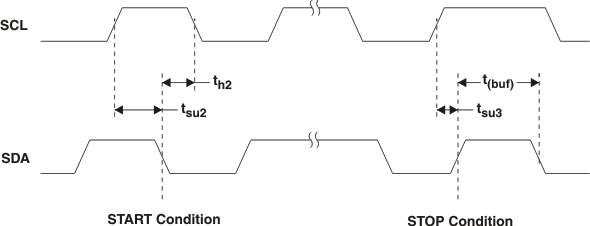 Figure 2. START and STOP Conditions Timing
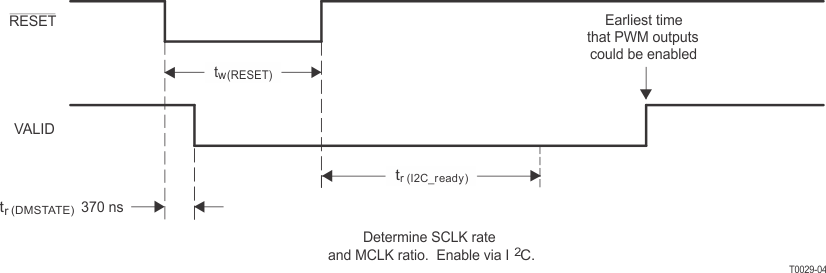 Figure 3. Reset Timing
 Figure 4. Power-Down Timing
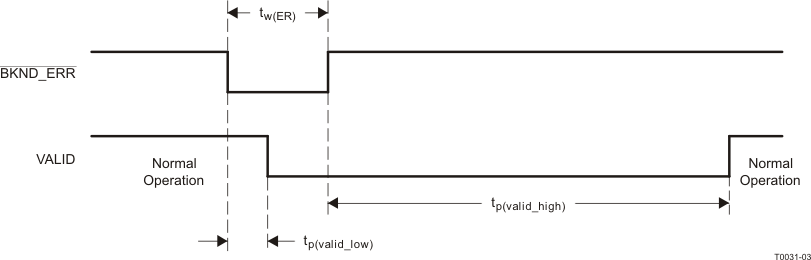 Figure 5. Error-Recovery Timing
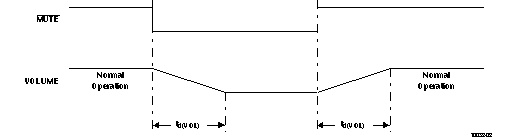 Figure 6. Mute Timing
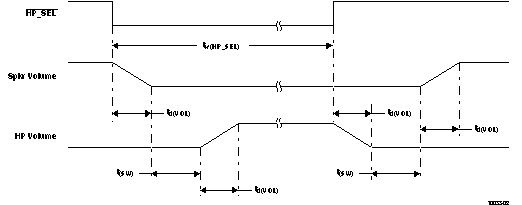 Figure 7. HP_SEL Timing
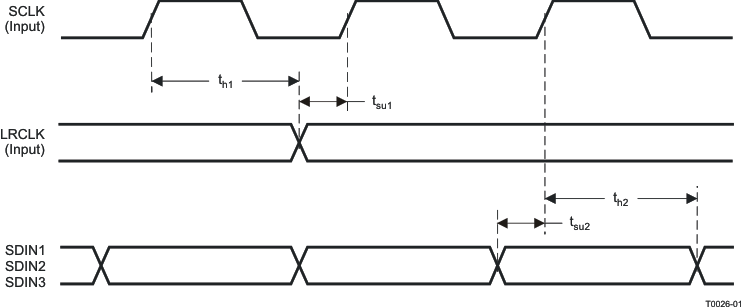 Figure 8. Slave Mode Serial Data Interface Timing
6.17 Typical Characteristics