SLLSFM2A November 2024 – October 2025 TCAN2855-Q1 , TCAN2857-Q1
PRODUCTION DATA
- 1
- 1 Features
- 2 Applications
- 3 Description
- 4 Device Comparison Table
- 5 Pin Configuration and Functions
- 6 Specifications
- 7 Parameter Measurement Information
-
8 Detailed Description
- 8.1 Overview
- 8.2 Functional Block Diagram
- 8.3
Feature Description
- 8.3.1 VSUP Pin
- 8.3.2 VCC1 Regulator
- 8.3.3 VCC2 Regulator
- 8.3.4 nRST Pin
- 8.3.5 VEXCC Regulator
- 8.3.6 CAN FD Transceiver
- 8.3.7 LIN Transceiver
- 8.3.8 GND
- 8.3.9 LIMP Pin
- 8.3.10 High-side Switches (HSS1- HSS4)
- 8.3.11 WAKE1, WAKE2 and WAKE3/DIR Pins
- 8.3.12 SDO Pin
- 8.3.13 nCS Pin
- 8.3.14 SCK Pin
- 8.3.15 SDI Pin
- 8.3.16 Interrupt Function (nINT)
- 8.3.17 SW Pin
- 8.3.18 GFO Pin
- 8.4
Device Functional Modes
- 8.4.1 Init Mode
- 8.4.2 Normal Mode
- 8.4.3 Standby Mode
- 8.4.4 Restart Mode
- 8.4.5 Fail-safe Mode
- 8.4.6 Sleep Mode
- 8.4.7 Wake Functions
- 8.4.8
Protection Features
- 8.4.8.1 Fail-safe Features
- 8.4.8.2 Device Reset
- 8.4.8.3 Floating Terminals
- 8.4.8.4 TXD Dominant Time Out (DTO)
- 8.4.8.5 LIN Bus Stuck Dominant System Fault: False Wake Up Lockout
- 8.4.8.6 CAN Bus Short Circuit Current Limiting
- 8.4.8.7 Thermal Shutdown
- 8.4.8.8 Under and Over Voltage Lockout and Unpowered Device
- 8.4.8.9
Watchdog
- 8.4.8.9.1 Watchdog Error Counter and Action
- 8.4.8.9.2 Watchdog SPI Programming
- 8.4.8.9.3 Watchdog Timing
- 8.4.8.9.4 Question and Answer Watchdog
- 8.4.8.10 Bus Fault Detection and Communication
- 8.5 Programming
- 9 Application and Implementation
-
10Registers
- 10.1
Registers
- 10.1.1 DEVICE_ID_y Register (Address = 00h + formula) [reset = xxh]
- 10.1.2 REV_ID Register (Address = 08h) [reset = 2Xh]
- 10.1.3 SPI_CONFIG Register (Address = 09h) [reset = 00h]
- 10.1.4 CRC_CNTL Register (Address = 0Ah) [reset = 00h]
- 10.1.5 CRC_POLY_SET (Address = 0Bh) [reset = 00h]
- 10.1.6 SBC_CONFIG (Address = 0Ch) [reset = 06h]
- 10.1.7 VREG_CONFIG1 (Address = 0Dh) [reset = 80h]
- 10.1.8 SBC_CONFIG1 Register (Address = 0Eh) [reset = 01h]
- 10.1.9 Scratch_Pad_SPI Register (Address = 0Fh) [reset = 00h]
- 10.1.10 CAN_CNTRL_1 Register (Address = 10h) [reset = 04h]
- 10.1.11 WAKE_PIN_CONFIG1 Register (Address = 11h) [reset = 00h]
- 10.1.12 WAKE_PIN_CONFIG2 Register (Address = 12h) [reset = 02h]
- 10.1.13 WD_CONFIG_1 Register (Address = 13h) [reset = 82h]
- 10.1.14 WD_CONFIG_2 Register (Address = 14h) [reset = 60h]
- 10.1.15 WD_INPUT_TRIG Register (Address = 15h) [reset = 00h]
- 10.1.16 WD_RST_PULSE Register (Address = 16h) [reset = 00h]
- 10.1.17 FSM_CONFIG Register (Address = 17h) [reset = 00h]
- 10.1.18 FSM_CNTR Register (Address = 18h) [reset = 00h]
- 10.1.19 DEVICE_CONFIG0 Register (Address = 19h) [reset = 10h]
- 10.1.20 DEVICE_CONFIG1 (Address = 1Ah) [reset = 00h]
- 10.1.21 DEVICE_CONFIG2 (Address = 1Bh) [reset = 00h]
- 10.1.22 SWE_TIMER (Address = 1Ch) [reset = 28h]
- 10.1.23 LIN_CNTL (Address = 1Dh) [reset = 20h]
- 10.1.24 HSS_CNTL (Address = 1Eh) [reset = 00h]
- 10.1.25 PWM1_CNTL1 (Address = 1Fh) [reset = 00h]
- 10.1.26 PWM1_CNTL2 (Address = 20h) [reset = 00h]
- 10.1.27 PWM1_CNTL3 (Address = 21h) [reset = 00h]
- 10.1.28 PWM2_CNTL1 (Address = 22h) [reset = 00h]
- 10.1.29 PWM2_CNTL2 (Address = 23h) [reset = 00h]
- 10.1.30 PWM2_CNTL3 (Address = 24h) [reset = 00h]
- 10.1.31 TIMER1_CONFIG (Address = 25h) [reset = 00h]
- 10.1.32 TIMER2_CONFIG (Address = 26h) [reset = 00h]
- 10.1.33 RSRT_CNTR (Address = 28h) [reset = 40h]
- 10.1.34 nRST_CNTL (Address = 29h) [reset = 2Ch]
- 10.1.35 WAKE_PIN_CONFIG3 Register (Address = 2Ah) [reset = E0h]
- 10.1.36 WAKE_PIN_CONFIG4 Register (Address = 2Bh) [reset = 22h]
- 10.1.37 WD_QA_CONFIG Register (Address = 2Dh) [reset = 0Ah]
- 10.1.38 WD_QA_ANSWER Register (Address = 2Eh) [reset = 00h]
- 10.1.39 WD_QA_QUESTION Register (Address = 2Fh) [reset = 3Ch]
- 10.1.40 SW_ID1 Register (Address = 30h) [reset = 00h]
- 10.1.41 SW_ID2 Register (Address = 31h) [reset = 00h]
- 10.1.42 SW_ID3 Register (Address = 32h) [reset = 00h]
- 10.1.43 SW_ID4 Register (Address = 33h) [reset = 00h]
- 10.1.44 SW_ID_MASK1 Register (Address = 34h) [reset = 00h]
- 10.1.45 SW_ID_MASK2 Register (Address = 35h) [reset = 00h]
- 10.1.46 SW_ID_MASK3 Register (Address = 36h) [reset = 00h]
- 10.1.47 SW_ID_MASK4 Register (Address = 37h) [reset = 00h]
- 10.1.48 SW_ID_MASK_DLC Register (Address = 38h) [reset = 00h]
- 10.1.49 DATA_y Register (Address = 39h + formula) [reset = 00h]
- 10.1.50 SW_RSVD_y Register (Address = 41h + formula) [reset = 00h]
- 10.1.51 SW_CONFIG_1 Register (Address = 44h) [reset = 50h]
- 10.1.52 SW_CONFIG_2 Register (Address = 45h) [reset = 00h]
- 10.1.53 SW_CONFIG_3 Register (Address = 46h) [reset = 1Fh]
- 10.1.54 SW_CONFIG_4 Register (Address = 47h) [reset = 00h]
- 10.1.55 SW_CONFIG_RSVD_y Register (Address = 48h + formula) [reset = 00h]
- 10.1.56 HSS_CNTL2 (Address = 4Dh) [reset = 00h]
- 10.1.57 EEPROM_CONFIG (Address = 4Eh) [reset = 00h]
- 10.1.58 HSS_CNTL3 (Address = 4Fh) [reset = 00h]
- 10.1.59 INT_GLOBAL Register (Address = 50h) [reset = 00h]
- 10.1.60 INT_1 Register (Address = 51h) [reset = 00h]
- 10.1.61 INT_2 Register (Address = 52h) [reset = 40h]
- 10.1.62 INT_3 Register (Address 53h) [reset = 00h]
- 10.1.63 INT_CANBUS_1 Register (Address = 54h) [reset = 00h]
- 10.1.64 INT_7 (Address = 55h) [reset = 00h]
- 10.1.65 INT_EN_1 Register (Address = 56h) [reset = FFh]
- 10.1.66 INT_EN_2 Register (Address = 57h) [reset = 7Eh]
- 10.1.67 INT_EN_3 Register (Address = 58h) [reset = FEh]
- 10.1.68 INT_EN_CANBUS_1 Register (Address = 59h) [reset = BFh]
- 10.1.69 INT_4 Register (Address = 5Ah) [reset = 00h]
- 10.1.70 INT_6 Register (Address 5Ch) [reset = 00h]
- 10.1.71 INT_EN_4 Register (Address = 5Eh) [reset = DFh]
- 10.1.72 INT_EN_6 Register (Address = 60h) [reset = FFh]
- 10.1.73 INT_EN_7 Register (Address = 62) [reset = FFh]
- 10.1
Registers
- 11Device and Documentation Support
- 12Revision History
- 13Mechanical, Packaging, and Orderable Information
Package Options
Refer to the PDF data sheet for device specific package drawings
Mechanical Data (Package|Pins)
- RHB|32
Thermal pad, mechanical data (Package|Pins)
Orderable Information
3 Description
The TCAN285x-Q1 is a family of system basis chips (SBC) that provide a control area network flexible data rate capable (CAN FD) transceiver that supports selective wake. The TCAN2857-Q1 includes a local interconnect network (LIN) transceiver. The CAN FD transceiver supports data rates up to 8Mbps while the LIN transceiver supports fast mode data rates up to 200kbps. The VCC1 LDO provides 3.3V or 5V ±2% with up to 250mA of current and determines the digital IO logic levels. If more current is needed, an external PNP transistor can be used to support up to 350mA and voltages of 1.8V, 2.5V, 3.3V, or 5V. VCC2 LDO provides 5V up to 200mA.
The TCAN285x-Q1 includes features such as LIMP, three local wake inputs and four high side switches. The high side switch can be on/off, 10-bit PWM or timer controlled. Controlling an external CAN FD, LIN transceiver, CAN SBC or LIN SBC is possible using the GFO pin. The WAKE pins can be configured for static sensing, cyclic sensing (with HSS4 pin) and pulse based for waking up. These devices provide EEPROM to store specific device configuration information; thus, avoiding extensive reprogramming after power fluctuations. WAKE1 and WAKE2 can enable an internal switch between pins to enable external VBAT monitoring. WAKE3 can be configured as a direct drive control pin for any combinations of high-side switches when cyclic sensing wake is enabled.
| PART NUMBER | PACKAGE(1) | PACKAGE SIZE(2) |
|---|---|---|
| TCAN2855-Q1 TCAN2857-Q1 | QFN (RHB, 32) | 5mm × 5mm |
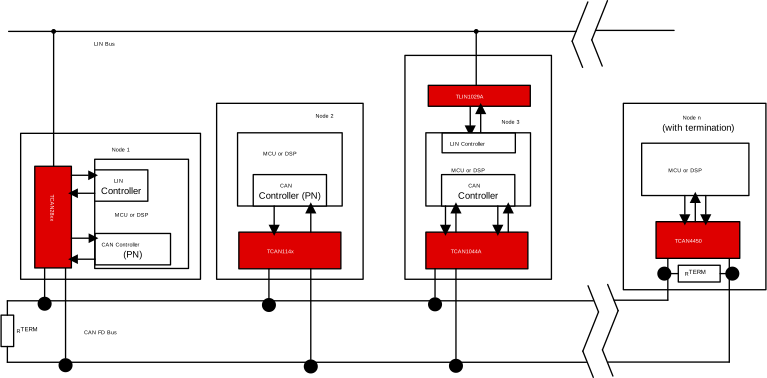 Simplified Schematic
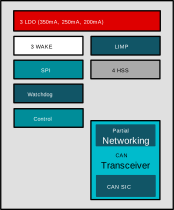 Figure 3-1 TCAN2855-Q1
Diagram
Figure 3-1 TCAN2855-Q1
Diagram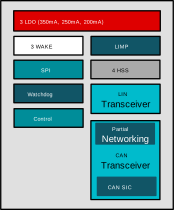 Figure 3-2 TCAN2857-Q1
Diagram
Figure 3-2 TCAN2857-Q1
Diagram