SNOSDJ3A May   2024  – July 2025 TLV1812-EP , TLV1822-EP

PRODUCTION DATA  

  1.   1
  2. Features
  3. Applications
  4. Description
  5.   Pin Configuration and Functions
  6. Specifications
    1. 4.1 Absolute Maximum Ratings
    2. 4.2 ESD Ratings
    3. 4.3 Recommended Operating Conditions
    4. 4.4 Thermal Information
    5. 4.5 Electrical Characteristics
    6. 4.6 Switching Characteristics
  7. Typical Characteristics
  8. Detailed Description
    1. 6.1 Overview
    2. 6.2 Functional Block Diagrams
    3. 6.3 Feature Description
    4. 6.4 Device Functional Modes
      1. 6.4.1 Inputs
        1. 6.4.1.1 TLV18x2-EP Rail-to-Rail Input
        2. 6.4.1.2 ESD Protection
        3. 6.4.1.3 Unused Inputs
      2. 6.4.2 Outputs
        1. 6.4.2.1 TLV1812-EP Push-Pull Output
        2. 6.4.2.2 TLV1822-EP Open-Drain Output
      3. 6.4.3 Power-On Reset (POR)
      4. 6.4.4 Hysteresis
  9. Application and Implementation
    1. 7.1 Application Information
      1. 7.1.1 Basic Comparator Definitions
        1. 7.1.1.1 Operation
        2. 7.1.1.2 Propagation Delay
        3. 7.1.1.3 Overdrive and Underdrive Voltage
      2. 7.1.2 Hysteresis
        1. 7.1.2.1 Inverting Comparator With Hysteresis
        2. 7.1.2.2 Non-Inverting Comparator With Hysteresis
        3. 7.1.2.3 Inverting and Non-Inverting Hysteresis using Open-Drain Output
    2. 7.2 Typical Applications
      1. 7.2.1 Window Comparator
        1. 7.2.1.1 Design Requirements
        2. 7.2.1.2 Detailed Design Procedure
        3. 7.2.1.3 Application Curve
      2. 7.2.2 Square-Wave Oscillator
        1. 7.2.2.1 Design Requirements
        2. 7.2.2.2 Detailed Design Procedure
        3. 7.2.2.3 Application Curve
      3. 7.2.3 Adjustable Pulse Width Generator
      4. 7.2.4 Time Delay Generator
      5. 7.2.5 Logic Level Shifter
      6. 7.2.6 One-Shot Multivibrator
      7. 7.2.7 Bi-Stable Multivibrator
      8. 7.2.8 Zero Crossing Detector
      9. 7.2.9 Pulse Slicer
    3. 7.3 Power Supply Recommendations
    4. 7.4 Layout
      1. 7.4.1 Layout Guidelines
      2. 7.4.2 Layout Example
  10. Device and Documentation Support
    1. 8.1 Documentation Support
      1. 8.1.1 Related Documentation
    2. 8.2 Receiving Notification of Documentation Updates
    3. 8.3 Support Resources
    4. 8.4 Trademarks
    5. 8.5 Electrostatic Discharge Caution
    6. 8.6 Glossary
  11. Revision History
  12. 10Mechanical, Packaging, and Orderable Information

Package Options

Mechanical Data (Package|Pins)
Thermal pad, mechanical data (Package|Pins)
Orderable Information

Pulse Slicer

A Pulse Slicer is a variation of the Zero Crossing Detector and is used to detect the zero crossings on an input signal with a varying baseline level. This circuit works best with symmetrical waveforms. The RC network of R1 and C1 establishes an mean reference voltage VREF, which tracks the mean amplitude of the VIN signal. The non-inverting input is directly connected to VREF through R2. R2 and R3 are used to produce hysteresis to keep transitions free of spurious toggles. The time constant is a tradeoff between long-term symmetry and response time to changes in amplitude.

The data is recommended to be encoded in NRZ (Non-Return to Zero) format to maintain proper average baseline. Asymmetrical inputs can suffer from timing distortions caused by the changing VREF average voltage.
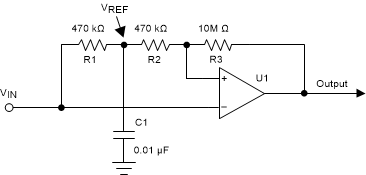
TLV1812-EP TLV1822-EP Pulse SlicerFigure 7-18 Pulse Slicer

For this design, follow these design requirements:

  • The RC constant value (R2 and C1) must support the targeted data rate to maintain a valid tripping threshold.
  • The hysteresis introduced with R2 and R43 helps to avoid spurious output toggles.

The TLV1822-EP can also be used, but with the addition of a pull-up resistor on the output (not shown for clarity).

Figure 7-19 shows the results of a 9600 baud data signal riding on a varying baseline.
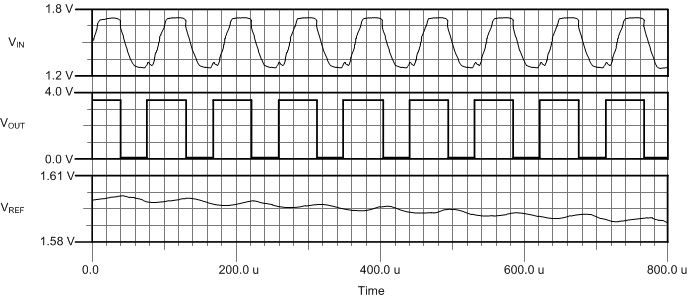
TLV1812-EP TLV1822-EP Pulse Slicer WaveformsFigure 7-19 Pulse Slicer Waveforms