SLVSHN0A September   2024  – October 2025 TPS548B23

PRODUCTION DATA  

  1.   1
  2. Features
  3. Applications
  4. Description
  5. Pin Configuration and Functions
  6. Specifications
    1. 5.1 Absolute Maximum Ratings
    2. 5.2 ESD Ratings
    3. 5.3 Recommended Operating Conditions
    4. 5.4 Thermal Information
    5. 5.5 Electrical Characteristics
    6. 5.6 Typical Characteristics
  7. Detailed Description
    1. 6.1 Overview
    2. 6.2 Functional Block Diagram
    3. 6.3 Feature Description
      1. 6.3.1  D-CAP4 Control
      2. 6.3.2  Internal VCC LDO and Using External Bias On the VCC Pin
        1. 6.3.2.1 Powering the Device From a Single Bus
        2. 6.3.2.2 Powering the Device From a Split-Rail Configuration
      3. 6.3.3  Multifunction Configuration (CFG1-5) Pins
        1. 6.3.3.1 Multifunction Configuration (CFG1-2) Pins (Internal Feedback)
        2. 6.3.3.2 Multifunction Configuration (CFG1-2) Pins (External Feedback)
        3. 6.3.3.3 Multifunction Configuration (CFG3-5) Pins
      4. 6.3.4  Enable
      5. 6.3.5  Soft Start
      6. 6.3.6  Power Good
      7. 6.3.7  Overvoltage and Undervoltage Protection
      8. 6.3.8  Output Voltage Setting (External Feedback Configuration)
      9. 6.3.9  Remote Sense
      10. 6.3.10 Low-side MOSFET Zero-Crossing
      11. 6.3.11 Current Sense and Positive Overcurrent Protection
      12. 6.3.12 Low-side MOSFET Negative Current Limit
      13. 6.3.13 Output Voltage Discharge
      14. 6.3.14 UVLO Protection
      15. 6.3.15 Thermal Shutdown
    4. 6.4 Device Functional Modes
      1. 6.4.1 Auto-Skip (PFM) Eco-mode Light Load Operation
      2. 6.4.2 Forced Continuous-Conduction Mode
  8. Application and Implementation
    1. 7.1 Application Information
    2. 7.2 Typical Application
      1. 7.2.1 Design Requirements
      2. 7.2.2 Detailed Design Procedure
        1. 7.2.2.1 Output Voltage Setting Point
        2. 7.2.2.2 Choose the Switching Frequency
        3. 7.2.2.3 Choose the Inductor
        4. 7.2.2.4 Choose the Output Capacitor
        5. 7.2.2.5 Choose the Input Capacitors (CIN)
        6. 7.2.2.6 VCC Bypass Capacitor
        7. 7.2.2.7 BOOT Capacitor
        8. 7.2.2.8 PG Pullup Resistor
      3. 7.2.3 Application Curves
    3. 7.3 Power Supply Recommendations
    4. 7.4 Layout
      1. 7.4.1 Layout Guidelines
      2. 7.4.2 Layout Example
  9. Device and Documentation Support
    1. 8.1 Documentation Support
      1. 8.1.1 Related Documentation
    2. 8.2 Receiving Notification of Documentation Updates
    3. 8.3 Support Resources
    4. 8.4 Trademarks
    5. 8.5 Electrostatic Discharge Caution
    6. 8.6 Glossary
  10. Revision History
  11. 10Mechanical, Packaging, and Orderable Information

Package Options

Mechanical Data (Package|Pins)
Thermal pad, mechanical data (Package|Pins)
Orderable Information

Application Curves

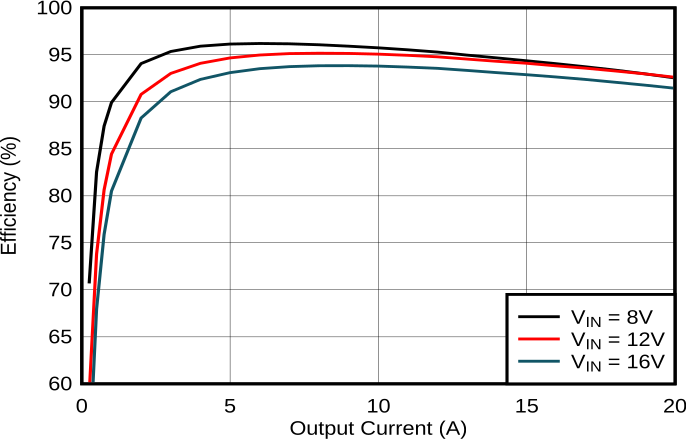
TPS548B23 Efficiency –
            PFM ModeFigure 7-2 Efficiency – PFM Mode
TPS548B23 Load
            RegulationFigure 7-4 Load Regulation
TPS548B23 Load
            Transient
IOUT = 5A to 15A at 1A/μs
Figure 7-6 Load Transient
TPS548B23 Output Voltage
            Ripple – PFM Mode
IOUT = 10mA
Figure 7-8 Output Voltage Ripple – PFM Mode
TPS548B23 Start-Up With
            ENFigure 7-10 Start-Up With EN
TPS548B23 Efficiency –
            FCCM ModeFigure 7-3 Efficiency – FCCM Mode
TPS548B23 Line
            RegulationFigure 7-5 Line Regulation
TPS548B23 Frequency
            Response
IOUT = 10A
Figure 7-7 Frequency Response
TPS548B23 Output Voltage
            Ripple – FCCM Mode
IOUT = 20A
Figure 7-9 Output Voltage Ripple – FCCM Mode
TPS548B23 Shutdown With
            ENFigure 7-11 Shutdown With EN