SLOSEF4 August 2025 TRF1208-EP
PRODUCTION DATA
- 1
- 1 Features
- 2 Applications
- 3 Description
- 4 Pin Configuration and Functions
- 5 Specifications
- 6 Detailed Description
- 7 Application and Implementation
- 8 Device and Documentation Support
- 9 Revision History
- 10Mechanical, Packaging, and Orderable Information
Package Options
Refer to the PDF data sheet for device specific package drawings
Mechanical Data (Package|Pins)
- RPV|12
Thermal pad, mechanical data (Package|Pins)
Orderable Information
7.1.1 Driving a High-Speed ADC
A common application for the TRF1208-EP is driving a high-speed ADC that has a differential input (such as the ADC12DJ5200-EP or AFE7950-EP). Conventionally passive baluns are used to drive giga-samples-per-second (GSPS) ADCs as a result of the low availability of high-bandwidth, linear amplifiers. The TRF1208-EP is typically configured as a single-ended to differential (S2D) RF amplifier that has excellent bandwidth flatness, gain, and phase imbalance comparable to or exceeding costly passive RF baluns.
Figure 7-1 shows a typical interface circuit for ADC12DJ5200-EP. Depending on the ADC and system requirement, simplify this circuit or make this circuit more complex.
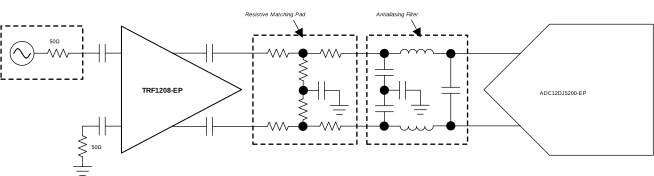 Figure 7-1 Interfacing With the ADC12DJ5200-EP
Figure 7-1 shows two sections of the circuit between the driver amp and the ADC: namely, the matching pad (or attenuator pad) and the antialiasing filter. Use small-form-factor, RF-quality, passive components for these circuits. The output swing of the TRF1208-EP is designed to drive these ADCs full-scale, while at the same time not overdrive the ADC. This functionality avoids the need for any voltage limiting device at the ADC.
Figure 7-2 shows a typical interface circuit for the AFE7950-EP, where the TRF1208-EP is the S2D amplifier.
