SLLSFZ7 February 2025 TUSB1146-Q1
PRODUCTION DATA
- 1
- 1 Features
- 2 Applications
- 3 Description
- 4 Pin Configuration and Functions
-
5 Specifications
- 5.1 Absolute Maximum Ratings
- 5.2 ESD Ratings
- 5.3 Recommended Operating Conditions
- 5.4 Thermal Information
- 5.5 Power Supply Characteristics
- 5.6 Control I/O DC Electrical Characteristics
- 5.7 USB and DP Electrical Characteristics
- 5.8 Timing Requirements
- 5.9 Switching Characteristics
- 5.10 Typical Characteristics
- Parameter Measurement Information
-
6 Detailed Description
- 6.1 Overview
- 6.2 Functional Block Diagram
- 6.3 Feature Description
- 6.4 Device Functional Modes
- 6.5 Programming
- 7 Register Maps
- 8 Application and Implementation
- 9 Device and Documentation Support
- 10Revision History
- 11Mechanical, Packaging, and Orderable Information
Package Options
Mechanical Data (Package|Pins)
- RGF|40
Thermal pad, mechanical data (Package|Pins)
- RGF|40
Orderable Information
6.5.4 TUSB1146-Q1 I2C Target Behavior
 Figure 6-2 I2C Write With Data
Use the following procedure to write data to TUSB1146-Q1 I2C registers (refer to Figure 6-2):
- The controller initiates a write operation by generating a start condition (S), followed by the TUSB1146-Q1 7-bit address and a zero-value “W/R” bit to indicate a write cycle.
- The TUSB1146-Q1 acknowledges the address cycle.
- The controller presents the register offset within TUSB1146-Q1 to be written, consisting of one byte of data, MSB-first.
- The TUSB1146-Q1 acknowledges the sub-address cycle.
- The controller presents the first byte of data to be written to the I2C register.
- The TUSB1146-Q1 acknowledges the byte transfer
- The controller can continue to present additional bytes of data to be written, where each byte transfer is complete after an acknowledge from the TUSB1146-Q1.
- The controller terminates the write operation by generating a stop condition (P).
 Figure 6-3 I2C Read Without Repeated Start
Use the following procedure to read the TUSB1146-Q1 I2C registers without a repeated Start (refer Figure 6-3).
- The controller initiates a read operation by generating a start condition (S), followed by the TUSB1146-Q1 7-bit address and a zero-value “W/R” bit to indicate a read cycle.
- The TUSB1146-Q1 acknowledges the 7-bit address cycle.
- Following the acknowledge the controller continues sending clock.
- The TUSB1146-Q1 transmit the contents of the memory registers MSB-first starting at register 00h or last read register offset+1. If a write to the I2C register occurred prior to the read, then the TUSB1146-Q1 shall start at the register offset specified in the write.
- The TUSB1146-Q1 waits for either an acknowledge (ACK) or a not-acknowledge (NACK) from the controller after each byte transfer; the I2C controller acknowledges reception of each data byte transfer.
- If an ACK is received, the TUSB1146-Q1 transmits the next byte of data as long as the controller provides the clock. If a NAK is received, the TUSB1146-Q1 stops providing data and waits for a stop condition (P).
- The controller terminates the write operation by generating a stop condition (P).
 Figure 6-4 I2C Read With Repeated Start
Use the following procedure to read the TUSB1146-Q1 I2C registers with a repeated Start (refer Figure 6-4).
- The controller initiates a read operation by generating a start condition (S), followed by the TUSB1146-Q1 7-bit address and a zero-value “W/R” bit to indicate a write cycle.
- The TUSB1146-Q1 acknowledges the 7-bit address cycle.
- The controller presents the register offset within TUSB1146-Q1 to be written, consisting of one byte of data, MSB-first.
- The TUSB1146-Q1 acknowledges the register offset cycle.
- The controller presents a repeated start condition (Sr).
- The controller initiates a read operation by generating a start condition (S), followed by the TUSB1146-Q1 7-bit address and a one-value “W/R” bit to indicate a read cycle.
- The TUSB1146-Q1 acknowledges the 7-bit address cycle.
- The TUSB1146-Q1 transmit the contents of the memory registers MSB-first starting at the register offset.
- The TUSB1146-Q1 shall wait for either an acknowledge (ACK) or a not-acknowledge (NACK) from the controller after each byte transfer; the I2C controller acknowledges reception of each data byte transfer.
- If an ACK is received, the TUSB1146-Q1 transmits the next byte of data as long as the controller provides the clock. If a NAK is received, the TUSB1146-Q1 stops providing data and waits for a stop condition (P).
- The controller terminates the read operation by generating a stop condition (P).
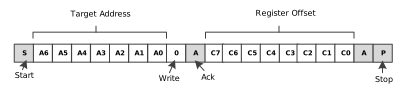 Figure 6-5 I2C Write Without Data
Use the following procedure to set a starting sub-address for I2C reads (refer to Figure 6-5).
- The controller initiates a write operation by generating a start condition (S), followed by the TUSB1146-Q1 7-bit address and a zero-value “W/R” bit to indicate a write cycle.
- The TUSB1146-Q1 acknowledges the address cycle.
- The controller presents the register offset within TUSB1146-Q1 to be written, consisting of one byte of data, MSB-first.
- The TUSB1146-Q1 acknowledges the register offset cycle.
- The controller terminates the write operation by generating a stop condition (P).
After initial power-up, if no register offset is included for the read procedure (refer to Figure 6-3), then reads start at register offset 00h and continue byte by byte through the registers until the I2C controller terminates the read operation. During a read operation, the TUSB1146-Q1 auto-increments the I2C internal register address of the last byte transferred independent of whether or not an ACK was received from the I2C controller.