5.5.3.1.3.2 Driving CLKin and OSCin Pins With a Single-Ended Source
The CLKin pins of the LMK0461x family can be driven using a single-ended reference clock source, like a sine wave source or an LVCMOS or LVTTL source. Either AC coupling or DC coupling may be used. In the case of the sine wave source that is expecting a 50-Ω load, TI recommends using AC coupling as shown in Figure 22 with a 50-Ω termination.
NOTE
The signal level must conform to the requirements for the CLKin pins listed in Clock Input Characteristics (CLKinX). CLKINX_SE_MODE is recommended to be set to single-ended mode (CLKINX_SE_MODE = 1).
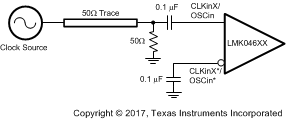 Figure 22. CLKinX/X* and OSCin AC-Coupled Single-Ended Termination
 If the CLKin pins are being driven with a single-ended LVCMOS or LVTTL source, either DC coupling or AC coupling may be used. If DC coupling is used, the CLKINX_SE_MODE should be set to single-ended buffer mode (CLKINX_SE_MODE = 1) and the voltage swing of the source must meet the specifications for
DC-coupled, single-ended mode clock inputs given in Clock Input Characteristics (CLKinX). If AC coupling is used, the CLKINX_SE_MODE should be set to the differential buffer mode (CLKINX_SE_MODE = 0). The voltage swing at the input pins must meet the specifications for AC-coupled, differential mode clock inputs given in Clock Input Characteristics (CLKinX). In this case, some attenuation of the clock input level may be required. A simple resistive divider circuit before the AC-coupling capacitor is sufficient.
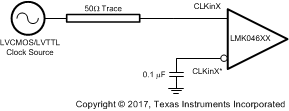 Figure 23. DC-Coupled LVCMOS or LVTTL Reference Clock