SBAU427 July   2025 ADS131E08


  1.   1
  2.   Description
  3.   Get Started
  4.   Features
  5.   Applications
  6.   6
  7. 1Evaluation Module Overview
    1. 1.1 Introduction
    2. 1.2 Kit Contents
    3. 1.3 Device Information
    4. 1.4 Specification
  8. 2Hardware
    1. 2.1 EVM Analog Inputs
    2. 2.2 Power Supplies
    3. 2.3 ADC Connections and Decoupling
    4. 2.4 Voltage Reference
    5. 2.5 Op Amp Common-Mode Bias
    6. 2.6 Digital Interface
    7. 2.7 EEPROM
  9. 3Software
    1. 3.1 Software Description
    2. 3.2 Software Installation
  10. 4Implementation Results
    1. 4.1 Hardware Connections
    2. 4.2 Optional EVM Configuration
    3. 4.3 GUI Software Operation
      1. 4.3.1 EVM Register Settings
      2. 4.3.2 GUI Settings for ADC Control
      3. 4.3.3 Time Domain Display
      4. 4.3.4 Frequency Domain Display
      5. 4.3.5 Histogram Display
  11. 5Hardware Design Files
    1. 5.1 Schematics
    2. 5.2 PCB Layouts
    3. 5.3 Bill of Materials (BOM)
  12. 6Additional Information
    1. 6.1 Trademarks

Digital Interface

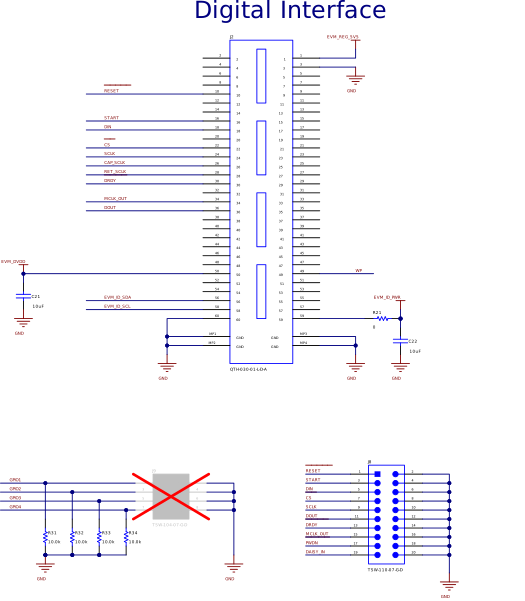
Figure 2-6 shows the digital connections between the EVM and the PHI. The EVM interfaces with the PHI and communicates with the computer over USB. The PHI communicates with two devices on the EVM: the ADS131E08 (over SPI) and the EEPROM (over I2C). The EEPROM comes preprogrammed with the information required to configure and initialize the ADS131E08 platform. The EEPROM is no longer used when the hardware is initialized. The ADS131E08 uses SPI serial communication in mode 1 (CPOL = 0, CPHA = 1). The PHI also provides power for the EVM.

Header J8 provides test points to probe the digital signals. Install header J9 to access the ADS131E08 general-purpose input/output pins. The GPIO pins are pulled down to GND by 10kΩ resistors when not used as per the data sheet.
ADS131E08EVM-PDK Digital Interface ConnectionsFigure 2-6 Digital Interface Connections