SLVUDI2 September 2025
- 1
- Description
- Get Started
- Features
- 5
- 1Evaluation Module Overview
-
2Hardware
- 2.1 Board Overview
- 2.2 Key Features
- 2.3 Power Requirements
- 2.4 Header Information
- 2.5 Detailed Hardware Design
- 3Hardware Design Files
- 4Compliance Information
- 5Additional Information
- 6Related Documentation
1.3 Specification
BeagleBone Green Eco is built around Texas Instruments' AM335x Arm Cortex-A8 processor, providing a robust foundation for diverse embedded applications. Figure 1-1 shows the functional block diagram illustrating the primary components and interconnections that make up the hardware architecture of the board. This diagram shows how the AM335x system on chip (SoC) interfaces with memory, storage, peripherals, and various I/O options.
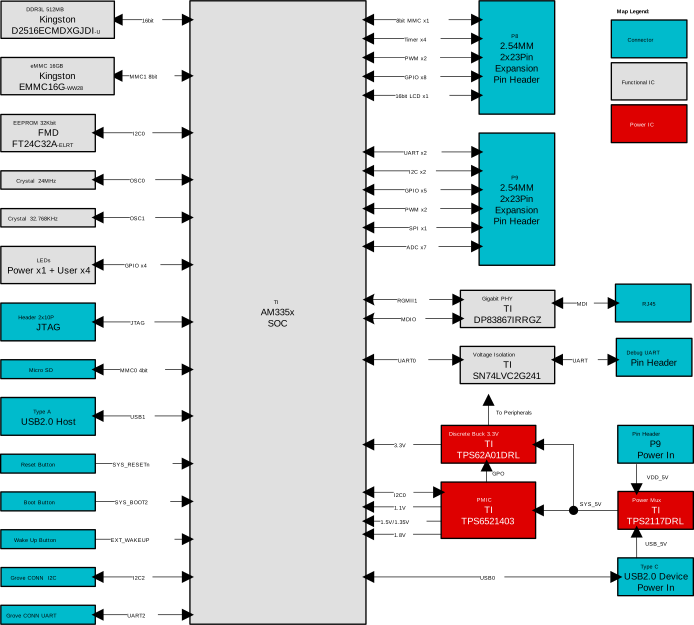 Figure 1-1 Functional Block Diagram of
BeagleBone Green Eco
Figure 1-1 Functional Block Diagram of
BeagleBone Green EcoTable 1-1 provides detailed information about key components and capabilities of BeagleBone Green Eco. This industrial-grade development platform offers significant processing power, generous memory, extensive I/O options, and modern connectivity features designed for commercial and educational applications.
| Category | Item | Specification |
|---|---|---|
| Processor | Core | TI AM335x 1GHz Arm Cortex-A8 |
| Accelerators | NEON™ floating-point unit and 3D graphics accelerator | |
| Memory | RAM | 512MB DDR3L, 800MHz |
| Flash Storage | 16GB eMMC | |
| EEPRAM | 32Kbit | |
| External Storage | microSD® card slot, supports up to 32GB | |
| Power | Power Management | TI TPS6521403 PMIC |
| Voltage Regulators |
TI TPS62A01DRL (3.3V Buck converter) TPS2117DRL (Power MUX) |
|
| Input Voltage | 5V DC (through USB Type-C and Cape headers) | |
| Operating Current | Maximum 614mA | |
| Interface | USB |
1 × USB 2.0 Host Type-A port for connecting peripherals (keyboard, mouse, Wi-Fi® adapter, and so forth.) 1 × USB 2.0 Type-C for power and device communication |
| Network | Gigabit Ethernet (10-, 100-, 1000Mbps) | |
| Expansion Headers | 4 × UART, 2 × I2C, 1 × Serial Peripheral Interface (SPI), 13 × General-Purpose Input/Output (GPIO) | |
| Grove | 1 × I2C, 1 × UART | |
| Buttons | 1 × Reset button, 1 × Wake up button, 1 × User button (Boot button) | |
| Indicators | 1 × power LED, 4 × user-programmable LEDs | |
| Physical | Dimensions | 86.4mm × 53.3mm × 18mm |
| Weight | 39.3g | |
| Operating Temperature | –40°C to 85°C |