SPRABJ8D September   2022  – May 2025 AM2612 , AM2631 , AM2631-Q1 , AM2632 , AM2632-Q1 , AM2634 , AM2634-Q1 , AM263P2 , AM263P2-Q1 , AM263P4 , AM263P4-Q1


  1.   1
  2.   Abstract
  3.   Trademarks
  4. Introduction
  5. Power
    1. 2.1 Discrete DC-DC Power Solution
    2. 2.2 Integrated PMIC Power Solution
    3. 2.3 Power Decoupling and Filtering
      1. 2.3.1 ADC/DAC Voltage Reference Decoupling
    4. 2.4 Estimated Power Consumption
    5. 2.5 Power Distribution Network
      1. 2.5.1 Simulations
        1. 2.5.1.1 Core Digital Power 1.2V
        2. 2.5.1.2 Digital and Analog I/O Power 3.3V
    6. 2.6 eFuse Power
  6. Clocking
    1. 3.1 Crystal and Oscillator Input Options
    2. 3.2 Output Clock Generation
    3. 3.3 Crystal Selection and Shunt Capacitance
    4. 3.4 Crystal Placement and Routing
  7. Resets
  8. Bootstrapping
    1. 5.1 SOP Signal Implementation
  9. OSPI and QSPI Memory Implementation
    1. 6.1 ROM OSPI and QSPI Boot Requirements
      1. 6.1.1 AM263x QSPI Boot Pin Requirements
      2. 6.1.2 AM263Px OSPI and QSPI Boot Pin Requirements
      3. 6.1.3 AM261x OSPI and QSPI Boot Pin Requirements
    2. 6.2 Additional OSPI and QSPI References
  10. Debug Interfaces
    1. 7.1 JTAG Emulators and Trace
    2. 7.2 UART
  11. USB
    1. 8.1 USB Device Mode
    2. 8.2 USB Host Mode
  12. Multiplexed Peripherals
  13. 10Digital Peripherals
    1. 10.1 General Digital Peripheral Routing Guidelines
    2. 10.2 Trace Length Matching
  14. 11Analog Peripherals
    1. 11.1 General Analog Peripheral Routing Guidelines
      1. 11.1.1 Resolver ADC Routing Guidelines
  15. 12Layer Stackup
    1. 12.1 Key Stackup Features
  16. 13Vias
  17. 14BGA Power Fan-Out and Decoupling Placement
    1. 14.1 Ground Return
      1. 14.1.1 Ground Return - ZCZ Package AM26x Devices
      2. 14.1.2 Ground Return - ZNC and ZFG Package AM261x Devices
    2. 14.2 1.2V Core Digital Power
      1. 14.2.1 1.2V Core Digital Power Key Layout Considerations - ZCZ
      2. 14.2.2 1.2V Core Digital Power Key Layout Considerations - ZFG
    3. 14.3 3.3V Digital and Analog Power
      1. 14.3.1 3.3V I/O Power Key Layout Considerations - ZCZ
      2. 14.3.2 3.3V I/O Power Key Layout Considerations - ZFG
    4. 14.4 1.8V Digital and Analog Power
      1. 14.4.1 1.8V Key Layout Considerations - ZCZ
      2. 14.4.2 1.8V Key Layout Considerations - ZFG
  18. 15Summary
  19. 16References
  20. 17Revision History

Introduction

The AM263x, AM263Px, and AM261x devices are single, dual, or quad-core Arm® Cortex®-R5F based MCUs in the Sitara™ MCU family intended for industrial and automotive motion control applications.

Note: In this document, AM26x refers to the TI Sitara™ MCU family of high-performance microcontrollers. This includes the AM263x, AM263Px, and AM261x devices. Device-specific references are denoted by the full general product number (AM263x, AM263Px, AM261x), while general device information are denoted by AM26x.

A typical AM26x design with a discrete power design is shown in Figure 1-1. This diagram is excerpted from the AM263x LaunchPad™ (LP-AM263) system block diagram.

A typical AM26x design with a Power Management Integrated Circuit (PMIC)-based power design is shown in Figure 1-2. This diagram is excerpted from the AM263Px controlCard (TMDSCNCD263P) system block diagram.

A typical AM261x design with a smaller footprint PMIC is shown in Figure 1-3. This diagram is taken from the AM261x LaunchPad (LP-AM261) system block diagram.

As seen in the following block diagrams, the AM26x devices offer designers a wide range of digital connectivity, control and analog sensor feedback options with multiple power design options supported.
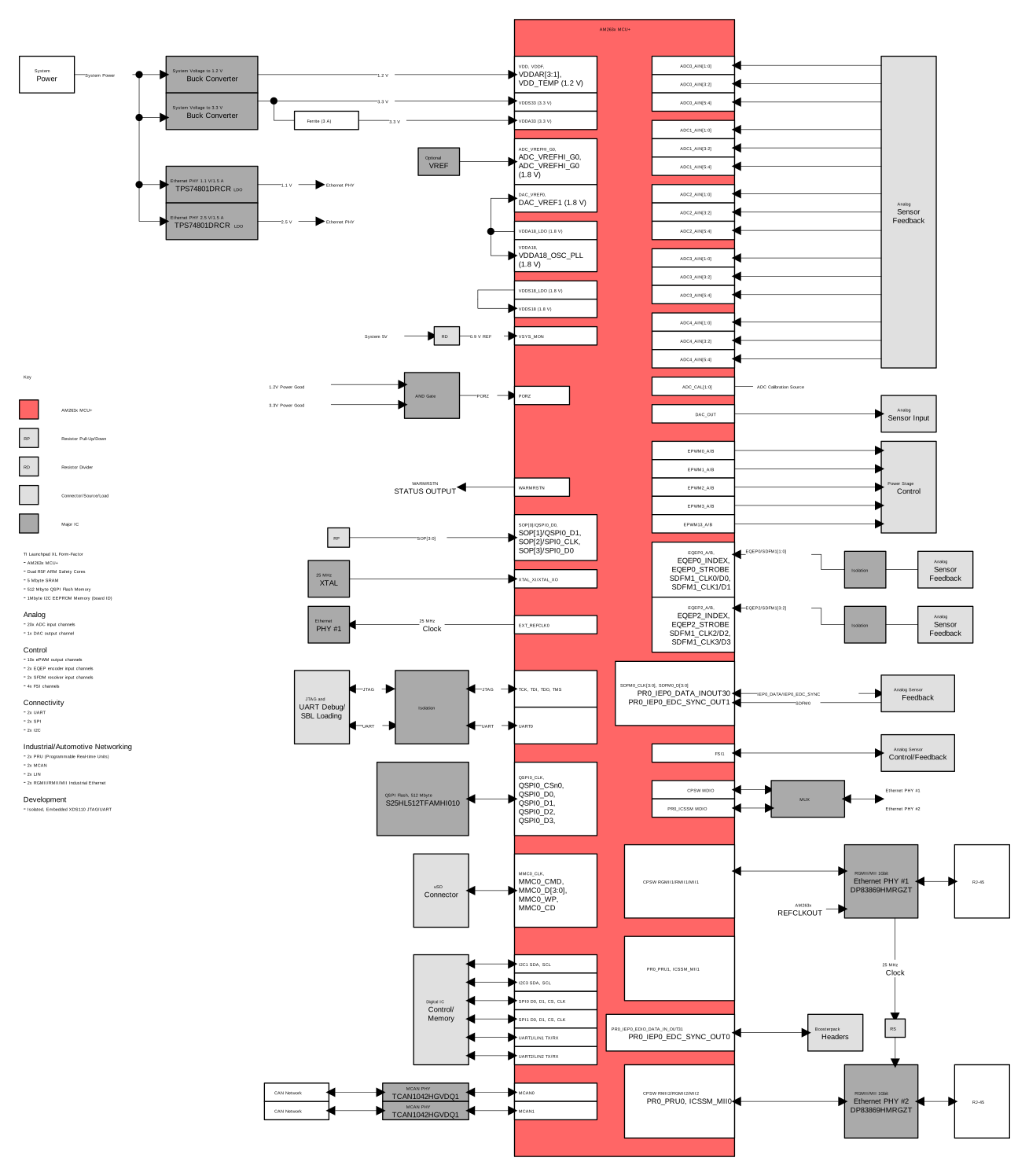
 Typical AM26x System Block Diagram with Discrete Power (Based on LP-AM263 Launchpad Design)
Note: The current requirement for the System Voltage to 1.2V Buck Converter for AM263x, AM263Px is 3A. For AM261x, the current limit is 2A.
Figure 1-1 Typical AM26x System Block Diagram with Discrete Power (Based on LP-AM263 Launchpad Design)
 Typical AM26x System Block Diagram with PMIC Power (Based on TMDSCNCD263P controlCard Design)
Note: For AM263x, AM263Px, the 1.2V DC/DC converter must output 3A. For AM261x, the DC/DC converter must be current limited to 2A.
Figure 1-2 Typical AM26x System Block Diagram with PMIC Power (Based on TMDSCNCD263P controlCard Design)
 Typical AM261x System Block Diagram with PMIC Power (Based on LP-AM261
                Design)
Note: Due to the current output of the Buck_3 of the TPS6503600 (2A), this system block diagram is only applicable to AM261x systems. Note that for industrial-grade AM261x devices, the core voltage requirement is 1.25V. For automotive-grade AM261x devices, the core voltage requirement is 1.2V.
Figure 1-3 Typical AM261x System Block Diagram with PMIC Power (Based on LP-AM261 Design)

This document must be referenced along with the other key AM26x collateral references. See Section 16 for a complete list of supplementary documents for the AM26x MCU devices.

Table 1-1 Acronyms Used in This Document
Acronym Description
EVM Evaluation Module. Referencing TI PCB assemblies such as the AM263x controlCard (TMDSCNCD263) or AM263x LaunchPad (LP-AM263).
PDN Power Distribution Network. The active and passive components providing regulated power to a load such as the AM263x MCU power pins.
EMI Electromagnetic Interference
PI Power Integrity
SI Signal Integrity
BOM Bill of Materials
PMIC Power Management Integrated Circuit
SOM System on Module
LP LaunchPad
SoC System on a Chip