SBOA601 January 2025 LOG200
- 1
- Abstract
- Trademarks
- 1Introduction
- 2Critical Photodiode Specifications
- 3Interfacing the LOG200 With the Photosensor
- 4Optical Bench for Current Sensing Measurements
- 5Optical Power Measurements with the LOG200
- 6Error Sources and Uncalibrated Error Analysis
- 7Auxiliary Op Amp Circuits
- 8Summary
- 9References
6 Error Sources and Uncalibrated Error Analysis
This section shows an example of the LOG200 circuit estimated DC error analysis. These calculations use the typical LOG200 data sheet specifications to calculate the device's uncalibrated DC accuracy. This error estimate only includes the errors of the LOG200 device stand-alone.
This example assumes a photosensor application requiring a current range of 20nA to 2.5mA, where the LOG200 connects to a 12-Bit pseudo-differential input ADC powered with a 3V supply. Figure 6-1 shows the LOG200 circuit connections to the ADC.
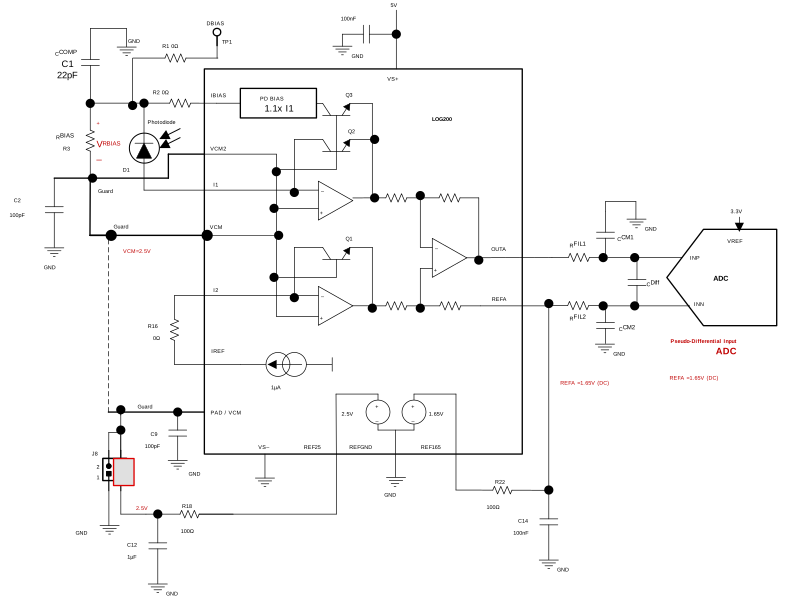 Figure 6-1 LOG200 Circuit connected to
Pseudo-Differential Input ADC
Figure 6-1 LOG200 Circuit connected to
Pseudo-Differential Input ADCTable 6-3 show the typical LOG200 specifications for error calculation:
| Parameter | Description/Comment | Error Typical |
UNIT |
|---|---|---|---|
| KError | Scaling
factor error 100pA to 1mA |
±0.15 | % |
| LCEError | Logarithmic
conformity error 10nA to 1mA |
±0.050 | % |
| IREF_Error | Reference
current error ±0.3% of IREF = 1µA |
±0.003 | µA |
| VOSO | Output offset error of logarithmic amplifier | ±1.300 | mV |
Equation 9 shows the LOG200 designed for transfer function:
Equation 10 uses the designed for LOG200 transfer function to calculate the logarithmic amplifier output while adding the typical data sheet error parameters:
On a typical photodiode measurement application, where the photosensor connects to I1, VOS does not contribute a significant error on the log amplifier transfer function. When the photodiode is biased with a proper reverse voltage, the sensor produces an input current virtually independent of the small input offset voltage VOS. Therefore, in this photodiode measurement, VLOG_Actual is only dependent on the output offset error (VOSO) of the logarithmic amplifier.
In this example, the REF165 1.65V reference connects to the negative input of a pseudo-differential input ADC, where the ADC converts only the difference between the ADC positive and negative inputs (AINP-AINN). Therefore, the accuracy of the voltage reference does not contribute to an error in the overall ADC conversionEquation 11 provides an estimate the total uncalibrated output error for a given photodiode current in this example:
Table 6-2 summarizes the primary error sources in the LOG200 application. The calculations assume a photosensor application requiring a current range from Imin = 20nA to Imax = 2mA.
| Parameter | Equation | Result |
|---|---|---|
| Uncalibrated DC accuracy at Imin = 20nA, at 25 °C | ||
| Nominal log amp
output at Imin
VLOG_Imin |
1.2253V | |
| Log conformity error at
Imin
LCEError_Imin |
-0.212mV | |
| Actual log amp output at
Imin
VLOG_Actual_Imin |
1.223V | |
| Log amp error at at
Imin VLOG_Error_Imin |
-2.598mV | |
| Uncalibrated DC accuracy at Imax = 2.5mA, at 25 °C | ||
| Nominal log amp output at
Imax
VLOG_Imax |
2.4995V | |
| Log conformity error at
Imax
LCEError_Imax |
0.425mV | |
| Actual log amp output at
Imax
VLOG_Actual_Imax |
2.504V | |
| Log amp error at at
Imax VLOG_Error_Imax |
4.526mV | |
| Total uncalibrated error as % of full-scale | ||
| % Full-scale error at
Imin VLOG_Error_Imin_FS |
-0.204% | |
| % Full-scale error at
Imax VLOG_Error_Imax_FS |
0.355% | |
The typical error specifications are added into the LOG200 transfer function to calculate a total compounded error. Since the absolute values are added together to calculate the total error, calculations using these typical values can yield a conservative error analysis, as the summation of uncorrelated errors tends to result in a larger compounded total predicted error than the actual total error observed on a real system. In many applications, the circuit designer can perform a two point linear calibration to reduce the errors due to offset and scale factor, resulting in a smaller DC error.