SBOA624 March 2025 TMCS1123 , TMCS1126 , TMCS1127 , TMCS1133
- 1
- Abstract
- Trademarks
- 1Introduction
- 2Solar Application Scenarios with Hall-effect Current Sensing
- 3Summary
- 4References
2.4 Split-Phase Hybrid Inverter
Split-phase hybrid inverter is specially designed to split the single-phase power output into two separate phases. This is usually for where the grid supports split phase, such as in North America (115V/230V) and Japan (100V/200V) market. The split-phase inverter has the same demand of unbalanced loads output as the 3-phase hybrid inverter does. Figure 2-8 shows the typical split-phase hybrid inverter block diagram with Hall-effect Current Sensors.
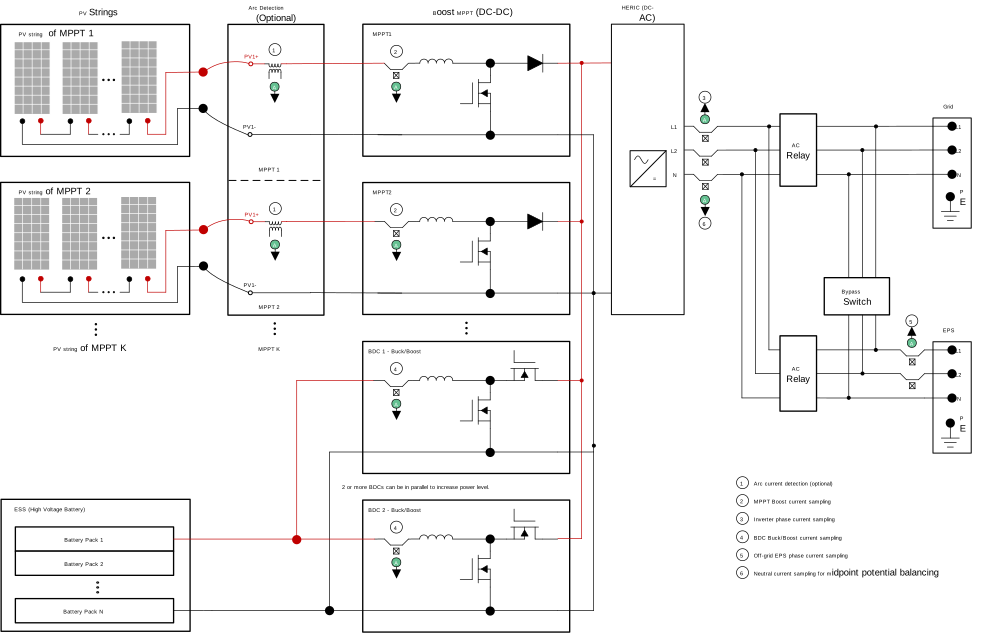 Figure 2-8 Split-phase Hybrid Inverter
Block Diagram with Hall-effect Current Sensors
Figure 2-8 Split-phase Hybrid Inverter
Block Diagram with Hall-effect Current SensorsFigure 2-9 shows the HERIC inverter with the fourth-leg (also known as balancing bridge) to actively control the midpoint voltage that allows the inverter to support split-phase (unbalanced loads) output.
 Figure 2-9 Balancing Bridge Design for
Midpoint Potential Balancing in Split-Phase Inverter
Figure 2-9 Balancing Bridge Design for
Midpoint Potential Balancing in Split-Phase Inverter