SBOSA43A June   2021  – June 2025 TMCS1100-Q1

PRODUCTION DATA  

  1.   1
  2. Features
  3. Applications
  4. Description
  5. Device Comparison
  6. Pin Configuration and Functions
  7. Specifications
    1. 6.1  Absolute Maximum Ratings
    2. 6.2  ESD Ratings
    3. 6.3  Recommended Operating Conditions
    4. 6.4  Thermal Information
    5. 6.5  Power Ratings
    6. 6.6  Insulation Specifications
    7. 6.7  Safety-Related Certifications
    8. 6.8  Safety Limiting Values
    9. 6.9  Electrical Characteristics
    10. 6.10 Typical Characteristics
      1. 6.10.1 Insulation Characteristics Curves
  8. Parameter Measurement Information
    1. 7.1 Accuracy Parameters
      1. 7.1.1 Sensitivity Error
      2. 7.1.2 Offset Error and Offset Error Drift
      3. 7.1.3 Nonlinearity Error
      4. 7.1.4 Power Supply Rejection Ratio
      5. 7.1.5 Common-Mode Rejection Ratio
      6. 7.1.6 Reference Voltage Rejection Ratio
      7. 7.1.7 External Magnetic Field Errors
    2. 7.2 Transient Response Parameters
      1. 7.2.1 Slew Rate
      2. 7.2.2 Propagation Delay and Response Time
      3. 7.2.3 Current Overload Parameters
      4. 7.2.4 CMTI, Common-Mode Transient Immunity
    3. 7.3 Safe Operating Area
      1. 7.3.1 Continuous DC or Sinusoidal AC Current
      2. 7.3.2 Repetitive Pulsed Current SOA
      3. 7.3.3 Single Event Current Capability
  9. Detailed Description
    1. 8.1 Overview
    2. 8.2 Functional Block Diagram
    3. 8.3 Feature Description
      1. 8.3.1 Current Input
      2. 8.3.2 Input Isolation
      3. 8.3.3 High-Precision Signal Chain
        1. 8.3.3.1 Temperature Stability
        2. 8.3.3.2 Lifetime and Environmental Stability
        3. 8.3.3.3 Frequency Response
        4. 8.3.3.4 Transient Response
      4. 8.3.4 External Reference Voltage Input
      5. 8.3.5 Current-Sensing Measurable Ranges
    4. 8.4 Device Functional Modes
      1. 8.4.1 Power-Down Behavior
  10. Application and Implementation
    1. 9.1 Application Information
      1. 9.1.1 Total Error Calculation Examples
        1. 9.1.1.1 Room Temperature Error Calculations
        2. 9.1.1.2 Full Temperature Range Error Calculations
    2. 9.2 Typical Application
      1. 9.2.1 Design Requirements
      2. 9.2.2 Detailed Design Procedure
    3. 9.3 Power Supply Recommendations
    4. 9.4 Layout
      1. 9.4.1 Layout Guidelines
      2. 9.4.2 Layout Example
  11. 10Device and Documentation Support
    1. 10.1 Device Support
      1. 10.1.1 Development Support
    2. 10.2 Documentation Support
      1. 10.2.1 Related Documentation
    3. 10.3 Receiving Notification of Documentation Updates
    4. 10.4 Support Resources
    5. 10.5 Trademarks
    6. 10.6 Electrostatic Discharge Caution
    7. 10.7 Glossary
  12. 11Revision History
  13. 12Mechanical, Packaging, and Orderable Information

Repetitive Pulsed Current SOA

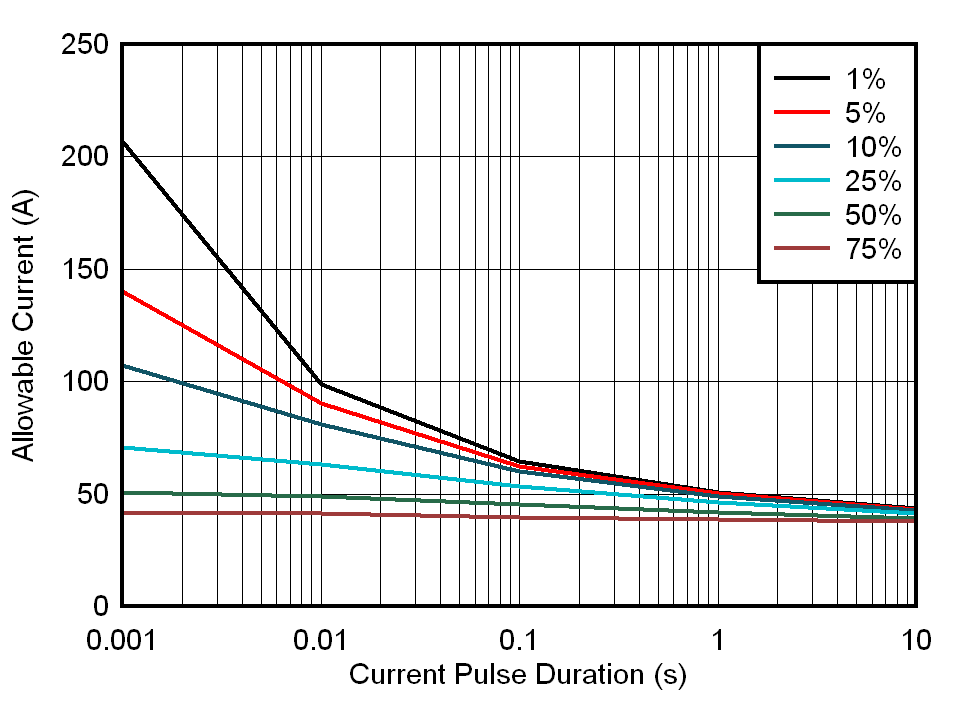
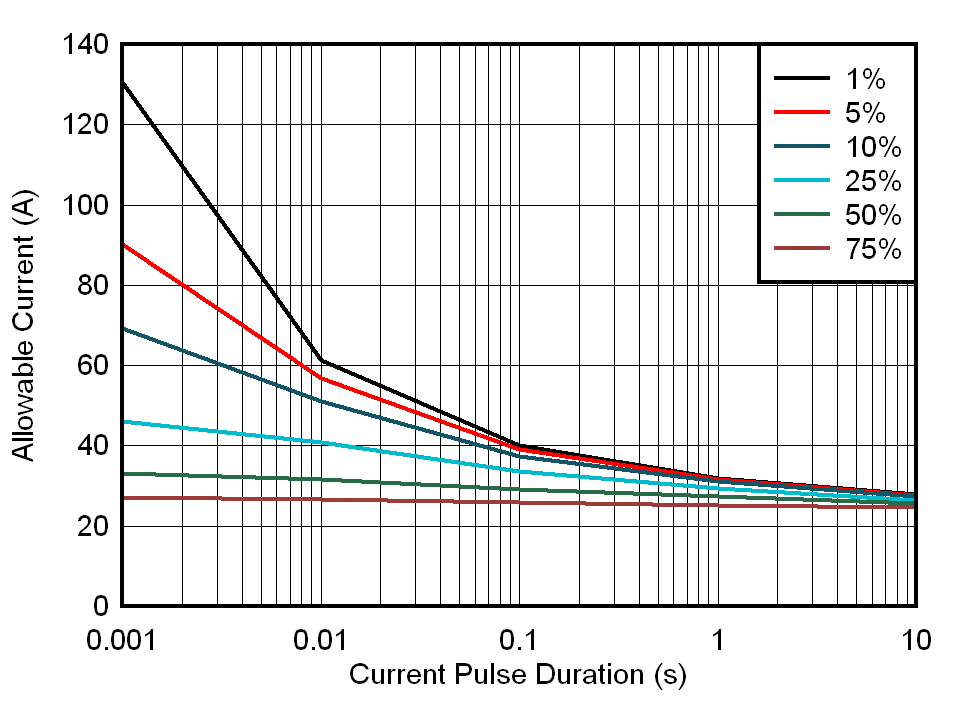
For applications where current is pulsed between a high current and no current, the allowable capabilities are limited by short-duration heating in the leadframe. The TMCS1100-Q1 can tolerate higher current ranges under some conditions, however, for repetitive pulsed events, the current levels must satisfy both the pulsed current SOA and the RMS continuous current constraint. Pulse duration, duty cycle, and ambient temperate all impact the SOA for repetitive pulsed events. Figure 7-6, Figure 7-7, Figure 7-8, and Figure 7-9 illustrate repetitive stress levels based on test results from the TMCS1100EVM under which parametric performance and isolation integrity is not impacted post-stress for multiple ambient temperatures. At high duty cycles or long pulse durations, this limit approaches the continuous current SOA for a RMS value defined by Equation 15.

Equation 15. I I N ,   R M S = I I N , P × D

where

  • IIN,RMS is the RMS input current level
  • IIN,P is the pulse peak input current
  • D is the pulse duty cycle
TMCS1100-Q1 Maximum Repetitive Pulsed Current vs. Pulse Duration
TA = 25°C
Figure 7-6 Maximum Repetitive Pulsed Current vs. Pulse Duration
TMCS1100-Q1 Maximum Repetitive Pulsed Current vs. Pulse Duration
TA = 105°C
Figure 7-8 Maximum Repetitive Pulsed Current vs. Pulse Duration
TMCS1100-Q1 Maximum Repetitive Pulsed Current vs. Pulse Duration
TA = 85°C
Figure 7-7 Maximum Repetitive Pulsed Current vs. Pulse Duration
TMCS1100-Q1 Maximum Repetitive Pulsed Current vs. Pulse Duration
TA = 125°C
Figure 7-9 Maximum Repetitive Pulsed Current vs. Pulse Duration