SDAA155 November 2025 AMC0381D , AMC0381D-Q1 , AMC0386 , AMC0386-Q1
1
Introduction
The AMC038x is a family of galvanically-isolated amplifiers and modulators designed for high-voltage sensing applications. Different from traditional isolated amplifiers and modulators, such as the AMC1311 and AMC1336, these devices feature a high-impedance, integrated resistive divider that connects directly to a high-voltage signal source. The integrated divider exhibits excellent DC accuracy, low temperature drift, and high life-time stability. AMC038x devices achieve better than 1% accuracy over a lifetime and temperature range without system-level calibration.
In a typical application, the integrated high-impedance resistive divider replaces a discrete resistive divider with much lower impedance. For comparison, the AMC0386M10 has a divider impedance of 12.5MΩ. Typical discrete implementations are in the range of 2-5MΩ due to concerns over coupling noise into a high-impedance sense point. This application brief summarizes measurement results under real-life operating conditions in a high-power application. Results show that the integrated high-impedance resistive divider is not affected by switching noise in the system.
| Device | Type | R1 (1) | R2 (1) | DIVIDER RATIO | LINEAR INPUT RANGE | CLIPPING VOLTAGE | ABS MAX INPUT VOLTAGE |
|---|---|---|---|---|---|---|---|
| AMC0381D06-Q1 | Isolated amplifier | 10MΩ | 16.7kΩ | 601:1 | 600V | 769V | 900V |
| AMC0381D10-Q1 | Isolated amplifier | 12.5MΩ | 12.5kΩ | 1001:1 | 1000V | 1281V | 1500V |
| AMC0381D16-Q1 | Isolated amplifier | 33.5MΩ | 21kΩ | 1601:1 | 1600V | 2049V | 2000V |
| AMC0380D04-Q1 | Isolated amplifier | 8.3MΩ | 20kΩ | 401:1 | ±400V | ±513V | ±600V |
| AMC0386M06-Q1 | Isolated modulator | 10MΩ | 16.6kΩ | 601:1 | ±600V | ±751V | ±900V |
| AMC0386M10-Q1 | Isolated modulator | 12.5MΩ | 12.5kΩ | 1001:1 | ±1000V | ±1251V | ±1500V |
- R1 and R2 are approximated resistor values and do not accurately reflect divider ratio.
The latest revision of the TIDA-02014, high-power, high-performance automotive SIC traction inverter reference design, integrates AMC0381M10 device for DC-link voltage sensing. Figure 1 shows the implementation on the PCB. For the circuit diagram, see the reference design folder on ti.com.
 Figure 1 TIDM-02014 DC Link Voltage Sensing Subsystem with AMC0381M10
The AMC0386M10 is an isolated modulator with 10MHz external clock. The digital output connects to the sigma-delta filter module (SDFM) of the F29H859TU-Q1 microcontroller (MCU). The SDFM converts the 10MHz single-bit data stream from the modulator into a 16-bit word at a sample rate of 10MHz/OSR. A 16b data in 2's complement format can store integer from -32768 to +32767. However, the SDFM module in 16b result configuration outputs data in the range from -16384 to +16384. For this reason, the LSB size is double the expected value. Table 2 lists the system configuration.
| Modulator Clock | Filter | Over-Sampling Ratio (OSR) | Output Data Format | Differential Clipping Voltage | LSB Size |
|---|---|---|---|---|---|
| 10MHz | Sinc3 | 256Ω | 16b 2's complement | ±1251V | 76.35mV |
The reference design was tested in a motor laboratory under various operating conditions. During the tests, the microcontroller stores voltage readings in the internal debug memory. 1000 voltage readings were collected for each operating condition and plot histograms. The histogram width and distribution help engineers identify how the real-life conditions affect the voltage measurement subsystem. The motor runs at 100RPM during all tests. This mechanical speed corresponds to an electrical frequency of 6.66Hz for a four-pole electric motor.
Figure 2 shows histograms of the voltage readings at a nominal 400V DC-link voltage, and phase peak currents of 0A, 50A, 100A, and 150A. The histogram bin width corresponds to the least significant bit (LSB) size. The histograms illustrate that the noise floor, represented by the width of the distribution, slightly increases with the phase current, as expected. However, no outliers in the data are observed. Table 3 summarizes the test results. Root mean square (RMS) noise, signal-to-noise ratio (SNR) and effective number of bits (ENOB) parameters are approximations that assume Gauss distribution of the noise.
Equation 1 calculates the RMS noise in volts:
where
- σ is standard deviation of the SDFM output data
- LSB is the size of the least significant bit in volts (refer to Table 2)
Equation 2 calculates SNR in decibels:
where
- VIN is the linear input voltage range of the AMC0386M10 device (2000V)
- RMS noise is the value from Equation 1
Equation 3 calculates ENOB in bits:
where
- SNR is signal-to-noise ratio in decibels
| Phase Current | DC Link Voltage Readout (MIN) | DC Link Voltage Readout (AVG) | DC Link Voltage Readout (MAX) | DC Link Voltage RMS Noise | DC Link Voltage SNR | DC Link Voltage ENOB |
|---|---|---|---|---|---|---|
| 0A | 399.170V | 399.626V | 400.085V | 0.154VRMS | 82.3dB | 13.4b |
| 50A | 399.018V | 399.599V | 400.237V | 0.203VRMS | 79.9dB | 13b |
| 100A | 398.789V | 399.650V | 400.618V | 0.349VRMS | 75.2dB | 12.2b |
| 150A | 398.408V | 399.548V | 401.000V | 0.382VRMS | 74.4dB | 12.1b |
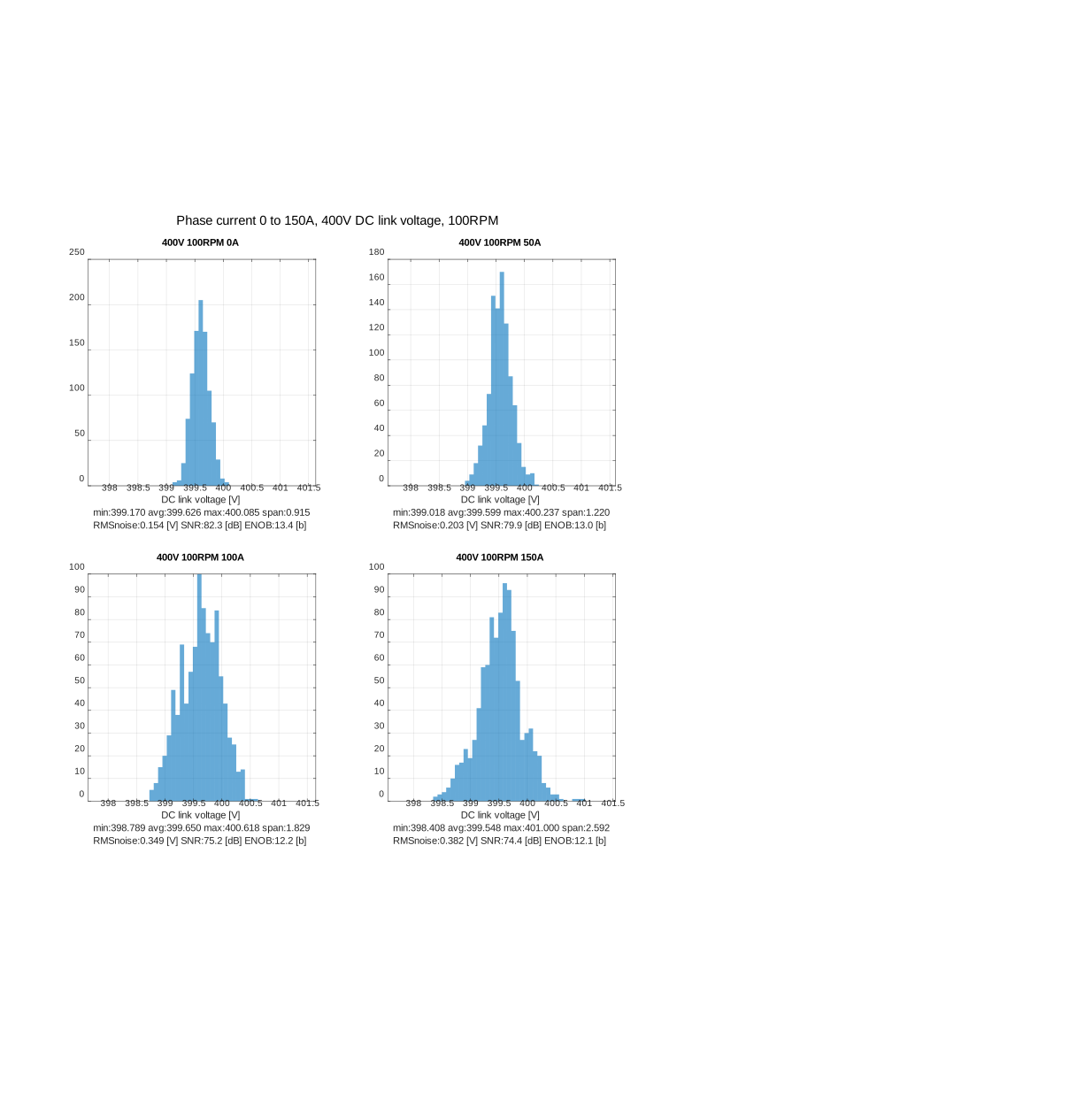 Figure 2 Phase Current Sweep at Fixed
DC-link Voltage of 400V
Figure 2 Phase Current Sweep at Fixed
DC-link Voltage of 400VFigure 3 displays histograms of the voltage readings at nominal 100V, 200V, and 400V DC-link voltage at a fixed 50A phase peak current. The histogram plots show that the noise decreases as the input voltage increases. Expect this behavior because the input current increases when the input voltage decreases. Additionally, reducing the input voltage affects the SNR calculation. Table 4 summarizes the results.
| DC Link Voltage | DC Link Voltage Readout (MIN) | DC Link Voltage Readout (AVG) | DC Link Voltage Readout (MAX) | DC Link Voltage RMS Noise | DC Link Voltage SNR | AMC0386 SNR (Spec) |
|---|---|---|---|---|---|---|
| 100V | 98.630V | 99.968V | 101.450V | 0.473VRMS | 72.5dB | 11.8b |
| 200V | 198.861V | 199.787V | 200.690V | 0.291VRMS | 76.8dB | 12.5b |
| 400V | 399.018V | 399.599V | 400.237V | 0.203VRMS | 79.9dB | 13.0b |
 Figure 3 DC Link Voltage Sweep for 50A
Phase Current
Figure 3 DC Link Voltage Sweep for 50A
Phase CurrentTrademarks
All trademarks are the property of their respective owners.