SLAAE84B March 2023 – September 2025 MSPM0G1105 , MSPM0G1106 , MSPM0G1107 , MSPM0G1505 , MSPM0G1506 , MSPM0G1507 , MSPM0G3105 , MSPM0G3106 , MSPM0G3107 , MSPM0G3505 , MSPM0G3506 , MSPM0G3507 , MSPM0H3216 , MSPM0L1105 , MSPM0L1106 , MSPM0L1303 , MSPM0L1304 , MSPM0L1304-Q1 , MSPM0L1305 , MSPM0L1305-Q1 , MSPM0L1306 , MSPM0L1306-Q1 , MSPM0L1343 , MSPM0L1344 , MSPM0L1345 , MSPM0L1346
1 Description
The DMA Ping Pong with ADC example demonstrates how to use the DMA to transfer ADC data between two different buffers, also known as a DMA Ping Pong. A DMA Ping Pong is commonly used to transfer data to one buffer while the CPU is working with the other buffer. The blue path in Figure 1-1 shows that the DMA transfers data to Buffer 1 and the CPU gets data from Buffer 2. When the paths switch, the DMA transfers data to Buffer 2 and the CPU gets data from Buffer 1. The benefit to this technique is faster total application runtime because the CPU is free to operate on a section of data at all times. In this example, the ADC is configured in single conversion mode and the DMA and CPU switches between buffers after each conversion.
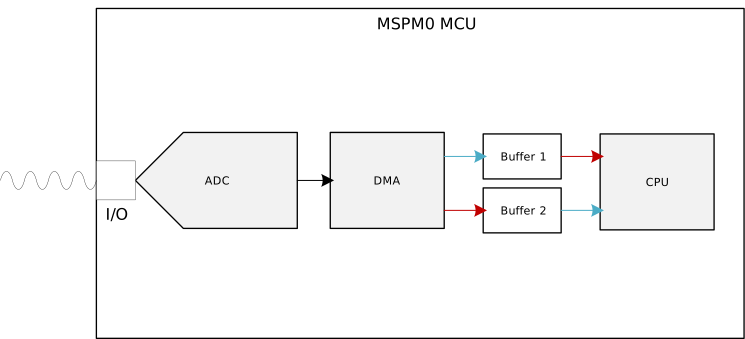 Figure 1-1 Subsystem Functional Block
Diagram
Figure 1-1 Subsystem Functional Block
Diagram