SLAAEH8 October 2024 AFE781H1 , AFE782H1 , AFE881H1 , AFE882H1 , DAC8740H , DAC8741H , DAC8742H
- 1
- Abstract
- Trademarks
- 1Introduction
- 2AFE881H1 HART Modem
-
3HART Testing and Registration
- 3.1 HART History and the FieldComm Group
- 3.2 HART Testing Overview
- 3.3 HART Test Equipment
- 3.4 HART Physical Layer Testing
- 3.5 Data Link Layer Tests
- 3.6 Universal Command Tests
- 3.7 Common-Practice Command Tests
- 3.8 Device Specific Command Tests
- 3.9 HART Protocol Test Submission
- 3.10 HART Registration
- 4Other TI HART Modem Designs
- 5Summary
- 6Acknowledgments
- 7References
3.4.6 Receive Impedance Test
Another physical layer test is to measure the receive impedance of the transmitter. The AFE881H1 is built into a high-impedance transmitter and the receive impedance must be above a minimum level over both the primary variable and HART transmission frequencies. In this test, a 5kΩ series test resistance is used in the loop to measure the receive impedance of the transmitter. This test requires a significantly higher power supply voltage. The normal starting current of the transmitter is 4mA. This amount of current across 5kΩ is 20V and a supply of over 40V is required to operate this test. Figure 3-17 shows a block diagram of the test setup for measuring the receive impedance of the transmitter.
 Figure 3-17 HART Receive Impedance Test
Setup
Figure 3-17 HART Receive Impedance Test
SetupA signal generator inputs a sine wave of different frequencies into the loop. The oscilloscope measures the voltage from the signal generator, the voltage across the test resistor, and the voltage dropped across the transmitter. From these three measured values on the oscilloscope, and using the known 5kΩ resistance of the test resistor, the equivalent impedance of the transmitter is calculated. Over frequency, an equivalent resistance and capacitance (Rx and Cx) can be calculated and plotted.
Table 3-6 tabulates the measured values for VA and VB and the calculated equivalent impedance for ZM looking into the transmitter.
| FREQUENCY | VA (V) | VB (V) | ZM (Ω, calculated) |
|---|---|---|---|
| 200Hz | 0.018 | 1 | 277778 |
| 500Hz | 0.025 | 1 | 200000 |
| 950Hz | 0.05 | 0.99 | 99000 |
| 1.6kHz | 0.09 | 0.98 | 54444 |
| 2.5kHz | 0.13 | 0.96 | 36923 |
| 5kHz | 0.26 | 0.95 | 18289 |
| 10kHz | 0.48 | 0.87 | 9063 |
| 20kHz | 0.73 | 0.65 | 4452 |
| 50kHz | 0.93 | 0.33 | 1774 |
The impedance is then plotted versus frequency in Figure 3-18.
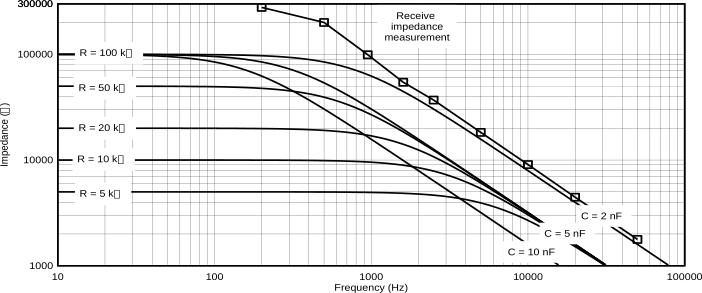 Figure 3-18 Receive Impedance Test Results
Plotted Over Frequency
Figure 3-18 Receive Impedance Test Results
Plotted Over FrequencyFor this test, signals in a frequency range from 200Hz to 50kHz are measured and calculated. The equivalent resistance and capacitance for the transmitter receive impedance are 278kΩ and 1800pF. For high-impedance transmitters, the minimum equivalent resistance is 100kΩ and the maximum capacitance is 5nF.