SLUUD32A June 2024 – April 2025 BQ41Z50
- 1
- Description
- Features
- 4
- 1Evaluation Module Overview
- 2BQ41Z50EVM Quick Start Guide
- 3Hardware
- 4Software
- 5IT-DZT Guide To Gauging
- 6Hardware Design Files
- 7Additional Information
- 8Related Documentation
- 9Revision History
5.2 Overview of IT-DZT
The IT-DZT algorithm builds on the basics of the IT algorithm. As such, it is crucial to have a basic understanding of the factors that go into IT-DZT gauging. Both IT and IT-DZT gauging algorithms use factors such as Depth of Discharge (DoD), total chemical capacity (Qmax) and internal cell resistance RBAT(DoD, Temperature) to calculate the remaining capacity and the full charge capacity.
DOD and Qmax update timing shows the timing of updates during a cycle. After a 30 minute relaxation period, OCV readings are taken every 100 seconds. The OCV readings are correlated with a predefined OCV table using linear interpolation, resulting in a DoD. The first DoD measurement is DOD_0. The OCV table remains the same for a particular battery chemistry. Subsequent DOD measurements are found using DOD Formula.
 Figure 5-1 DOD Formula
 Figure 5-2 DOD and Qmax Update Timing
Qmax is updated based on two DOD readings, DOD1 and DOD2, made before and after a charge or discharge cycle, which is then calculated using Figure 5-3.
 Figure 5-3 Qmax Formula
Qmax updates larger than 30% from the last updated Qmax value are filtered to avoid jumps. Note that Qmax updates only occur when the change in DoD between t2 and t1 is larger than 37% in passed charge. Accurate Qmax measurements are critical for accurate gauging. The gauge has additional TI proprietary safe-guards preventing Qmax updates if the conditions are unfavorable.
During a discharge cycle, the voltage drop between the OCV curve and the measured IR drop voltage (V) is used to calculate the resistance using the formula based on Ohm’s law as seen in equations below Loaded voltage equation.
 Figure 5-4 Loaded Voltage Equation
Resistance values as a function of DoD and temperature are calculated using resistance factors Ra and Rb. Normalized resistance values are calculated using Resistance equation. The values are updated in the data flash through Ra tables. Ra tables are updated after each 11.1% of DoD charge is exceeded. Once DoD reaches 77.7%, further updates to the Ra tables occur after every 3.3% DoD charge exceeded, totaling 15 Ra updates. The updates are then stored in a grid where each grid point represents a DoD as seen in Ra Grid Table.
 Figure 5-5 Resistance Equation
 Figure 5-6 Ra Grid Table
Resistance estimates in the grid are further refined through regression based on nearby grid estimates. The refined values are then used to scale the rest of the values for subsequent resistance updates.
The IT algorithm uses grid arrays for the average current (Iav) and average temperature (Tav) measured via current sensing and thermistors, respectively. These measurements are mainly used to compute Ra updates. If some entries have zero values, linear interpolation is applied and nearby estimates are averaged for the new value.
TI Impedance Tracking works off of a steady state model to determine full charge capacity consisting of a resistor to model internal cell resistance. Battery resistance changes due to factors such as age and temperature, while chemical capacity of the battery changes due to aging.
While Impedance Tracking gauges provide accurate gauging for current loads that are fairly consistent, their accuracy diminishes with variable loads. This is because IT gauges require at least a 500 second (default value) settling time during discharge routines to accurately gauge and update the Ra table. In applications with fluctuating load currents, such as power tools and drones, IT gauges may not update the Ra table due to delaying the update until finding a point to settle for the 500 second period, leading to overestimated cell resistance and underestimated battery State of Charge (SoC).
Dynamic Z-Track™ (IT-DZT) extends IT by using model that is a more accurate representation of the battery under load, done through the usage of specific battery parameters that allow it to model the transient response of the battery more accurately without needing constant current loads or long relaxation periods. This model incorporates advanced algorithms to process variable current loads using regressions techniques to update the Ra table by selecting input data that reflects real-time changes in current. This ensures that the resistance values remain accurate even with significant load fluctuations. Under a constant current load, the IT-DZT model performs similarly to the IT model.
Figure 5-7 below shows a comparison between the IT and the IT-DZT enhanced battery model. For the same load, the enhanced battery model performs much more accurately when compared to the OCV + IR drop model. As can be seen, the IT model requires a longer settle time to accurately start gauging after a discharge cycle.
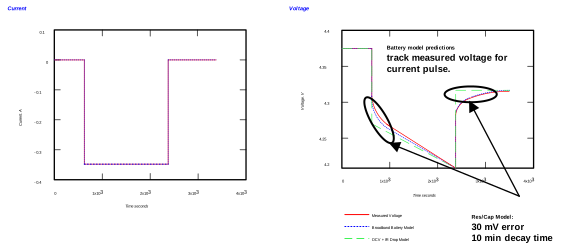 Figure 5-7 IT-DZT vs IT Simulation
Model
Figure 5-7 IT-DZT vs IT Simulation
Model