SLYT863 April 2025 LM5066I
- 1
- 1 Introduction
- 2 3
- 3 Challenges in designing a hot-swap circuit for a 48V AI server
- 4 Challenge No. 1: Turnoff delay during an output short-circuit
- 5 Challenge No. 2: False gate turn-off during a load transient
- 6 Challenge No. 3: Parallel resonance during controlled (slow) turn-on
- 7 Proposed circuit enhancements
- 8 Improving the turn-off response
- 9 Overcoming false turn-off for dynamic loads
- 10Damping parasitic oscillations
- 11Design guidelines and component selection
- 12Cdv/dt discharge circuit
- 13Conclusion
- 14References
- 15Related Websites
9 Overcoming false turn-off for dynamic loads
In this solution, the hot-swap gate node is decoupled from the MOSFET gate terminal by placing the DSS diode between them, again shown in Figure 8. This modification helps eliminate the reflection of output voltage ripple to the hot-swap controller GATE node and avoids false turn-on of the soft-start PNP transistor, Qss. Changing the position of the diode does not impact controller behavior during start-up nor any of the fault events. As shown in the test result (see Figure 10), the system operates continuously even for large load steps from 20A to 120A at a 1kHz frequency.
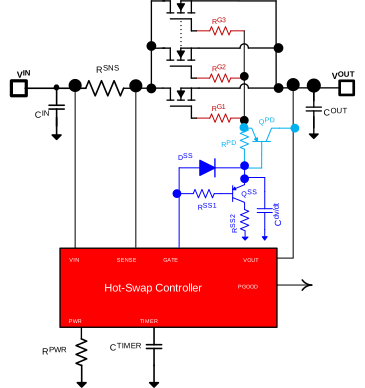 Figure 8 Proposed hot-swap circuit
configuration.
Figure 8 Proposed hot-swap circuit
configuration. Figure 9 Output short-circuit response
with fast pull-down circuit.
Figure 9 Output short-circuit response
with fast pull-down circuit. Figure 10 Load transient performance for
steps from 20A to 120A to 20A at a 1kHz frequency.
Figure 10 Load transient performance for
steps from 20A to 120A to 20A at a 1kHz frequency.