SLYT867 June 2025 LDC5072-Q1 , MSPM0G1106 , MSPM0G1107 , MSPM0G1506 , MSPM0G1507 , MSPM0G1518 , MSPM0G1519 , MSPM0G3106 , MSPM0G3106-Q1 , MSPM0G3107 , MSPM0G3107-Q1 , MSPM0G3506 , MSPM0G3506-Q1 , MSPM0G3507 , MSPM0G3507-Q1 , MSPM0G3518 , MSPM0G3518-Q1 , MSPM0G3519 , MSPM0G3519-Q1 , TMAG5170 , TMAG6180-Q1
- 1
- 1 Introduction
- 2 Using a position sensor with brushless motor control
- 3 Incremental and absolute encoders
- 4 FOC motor-control techniques and requirements for encoders
- 5 Position sensor technologies
- 6 Magnetic position sensors
- 7 Linear position example with a 3D Hall-effect linear sensor
- 8 Rotary angle example with an AMR sensor
- 9 Inductive position sensing
- 10Conclusion
- 11Additional resources
4 FOC motor-control techniques and requirements for encoders
The FOC method shown in Figure 2 is a high-performance technique that controls the resulting stator current vector according to the rotor magnetic flux angle to maximize torque with permanent-magnet synchronous motors. FOC enables smooth torque with fast transient response from standstill to high-speed operation. Accurate and low-latency measurement of the rotor magnet field angle will decompose the three stator-phase currents (iU, iV and iW) into a rotor magnetic field-oriented coordinate system, with iq equal to the torque-generating current and id equal to the field-weakening current.
In end equipment such as humanoid robots, the absolute rotary angle is typically measured at an accuracy from 1 degree to 0.1 degrees, an ENOB from 12 bits to 15 bits, and sample rates from 8kHz to 32kHz. The rotary angle is sensed simultaneously with the motor-phase currents. A low-latency angle measurement of <20µs enables enough time for the microcontroller (MCU) to run the control algorithms and update the pulse-width modulator (PWM) for the next PWM cycle.
It is possible to integrate rotary angle sensors into the motor housing, as in most humanoid robots, or in separate housing for mounting onto the motor shaft. Both cases require operation at high temperatures – often up to 125C ambient. In humanoid robots, where the control MCU is located close to the rotary encoder, 360-degree angle sensors such as TI’s TMAG6180-Q1 anisotropic magnetoresistive (AMR) sensor offer a cost-efficient and low-latency interface.
Unlike rotary motors, linear motor-based transport systems require absolute linear position sensing, but still apply FOC for maximum torque. A 12-bit position resolution with <100µs latency is often sufficient.
In addition, achieving International Electrotechnical Commission 62061 or International Organization for Standardization (ISO) 13849 functional safety in industrial machinery requires safety-certified encoders determined by the safety integrity level or performance level, as well as additional diagnostics with the position sensor to detect random hardware faults. In automotive applications, systems designed according to ISO 26262 run diagnostics during system startup, whereas industrial systems require continuous diagnostics during normal operation, since they often run 24/7.
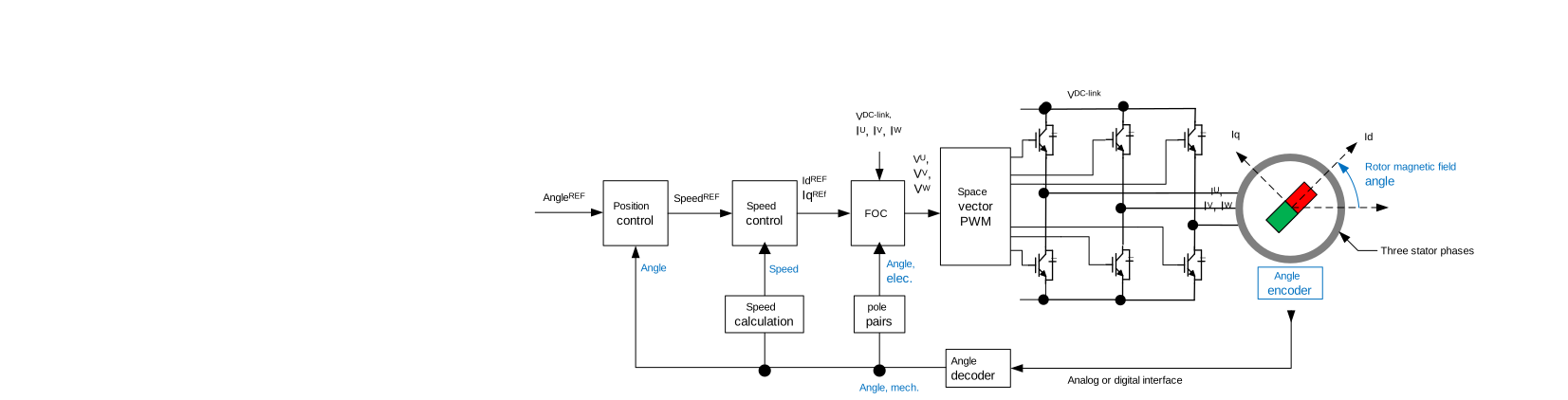 Figure 2 Cascaded position, speed and
FOC.
Figure 2 Cascaded position, speed and
FOC.