SNAA400 March 2025 CDC6C , LMK6C , LMK6D , LMK6H , LMK6P
2.2 BAW Oscillator Overview
The CDC6C and the LMK6C incorporate the BAW as the resonator source. These devices are factory programmed and capable of producing large range of frequencies up to 200MHz. Figure 2-2 illustrates the simplified structure of the BAW oscillators. As each of these BAW oscillators have different use cases Table 2-3 illustrates the differences.
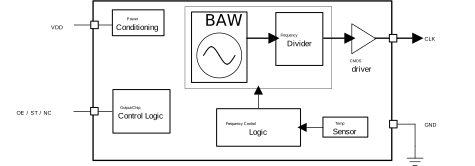 Figure 2-2 Simplified Block
Diagram
Figure 2-2 Simplified Block
DiagramTable 2-3 LMK6C and CDC6C Comparison
Overview
| Parameter | LMK6C | CDC6C |
|---|---|---|
| Output frequency range | Any frequency between 1MHz and 200MHz | Select frequencies between 250kHz and 200MHz |
| RMS jitter maximum1 | 0.5ps | 1ps |
| Start up time maximum | 5ms | 3ms |
| Operating temperature range | -40 C to 105 C | -40 C to 105C |
| Current consumption maximum at 100MHz and 1.8V | 59mA | 7.2mA |
| Device supply voltage options | 1.8V 2.5V to 3.3V |
1.8V - 3.3V |
| Package size options | 3.2mm x 2.5mm 2.5mm x 2.0mm |
3.2mm x 2.5mm 2.5mm x 2.0mm 2.0mm x 1.6mm 1.6mm x 1.2mm |
(1) Fout ≥ 25MHz; Integration BW: 12kHz - 20MHz