SNVSCN7C November 2023 – May 2025 REF54
PRODUCTION DATA
- 1
- 1 Features
- 2 Applications
- 3 Description
- 4 Device Comparison Table
- 5 Pin Configuration and Functions
-
6 Specifications
- 6.1 Absolute Maximum Ratings
- 6.2 ESD Ratings
- 6.3 Recommended Operating Conditions
- 6.4 Thermal Information
- 6.5 Electrical Characteristics REF54250
- 6.6 Electrical Characteristics REF54300
- 6.7 Electrical Characteristics REF54410
- 6.8 Electrical Characteristics REF54450
- 6.9 Electrical Characteristics REF54500
- 6.10 Typical Characteristics
- 7 Parameter Measurement Information
- 8 Detailed Description
- 9 Application and Implementation
- 10Device and Documentation Support
- 11Revision History
- 12Mechanical, Packaging, and Orderable Information
7.2 Long-Term Stability
Long-term stability is a key performance parameter for series voltage references in all precision applications. This is defined as variation of reference voltage over time. The long-term stability value is tested in a typical setup that reflects standard PCB board manufacturing practices. The boards are made of standard FR4 material, the board does not have special cuts or grooves around the devices or go through burn-in process to relieve the mechanical stress of the PCB. These conditions reflect real world use case scenario and common manufacturing techniques.
During the long-term stability testing, precautions are taken to make sure that only the long-term stability drift is being measured. The boards are maintained at 35°C ± 0.02°C in an oil bath. The oil bath makes sure that the temperature is constant across the device over time. The measurements are captured every 30 minutes with a calibrated 8.5 digit multimeter.
Typical long term stability characteristic are expressed as reference voltage deviation over time. Figure 7-2 shows the typical drift value for the REF54 in SOIC package VREF is 25ppm from 0 to 1000hours. Figure 7-4 shows the typical drift value for the REF54 in FKH package VREF is 3ppm from 0 to 1000hours. The REF54 experiences the highest drift in the initial 1000hr, subsequent deviation is typically lower than previous 1000hours.
 Figure 7-2 Long-Term Stability SOIC 2000 Hours
(VREF)
Figure 7-2 Long-Term Stability SOIC 2000 Hours
(VREF) Figure 7-4 Long-Term Stability FKH 2000 Hours
(VREF)
Figure 7-4 Long-Term Stability FKH 2000 Hours
(VREF)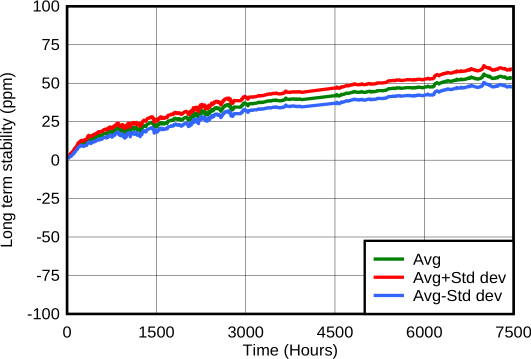 Figure 7-3 Long-Term Stability SOIC 7500 Hours
(VREF)
Figure 7-3 Long-Term Stability SOIC 7500 Hours
(VREF)