SPVA018 August 2025 LM2904B
- 1
- Abstract
- Trademarks
- 1Introduction
- 2ESD Overview
- 3Types of ESD Cells
- 4How to Determine the ESD Structure of the Device from the Data Sheet
- 5How to Protect The System from In Circuit ESD/EOS Events
- 6How to Test an Op Amp in a System Level Circuit
- 7Summary
- 8References
3.2 Bootstrapped Diodes
Only dual diode ESD protection structure has been discussed. There is another type of ESD protection structure called bootstrapped diodes, where the diodes are placed in parallel and reverse. An additional diode is routed from the input to the supply to allow for the same protection path as seen before.
Typical ESD steering diodes have a leakage current. The current is picoamps at room temperature and thousands of picoamps at 125C. For applications with high source impedances, this leakage can create large input offset voltage errors. Bootstrapping reduces this leakage to femtoamps across temperature. Bootstrapping does this by motoring the input voltage and forcing the same voltage on the opposite side of the diode. The forced voltage is called the guard voltage. The input ESD diodes have the same voltage on both the cathode and anode so that there is zero volts across the diode. Forcing zero volts across the diode, also known as bootstrapping, forces the leakage current to essentially zero. During an ESD event, the input diodes channels the ESD pulse to the diodes connected to the supply. Since there are two diodes routed to the supply, voltage drop from input to supply is measured. There is a drop of 1.4V, or approximately two diode drops. A flagship device that uses this topology is the OPA928. The bootstrapped inputs allow for an input bias current of 20fA at both 25°C and 85°C.
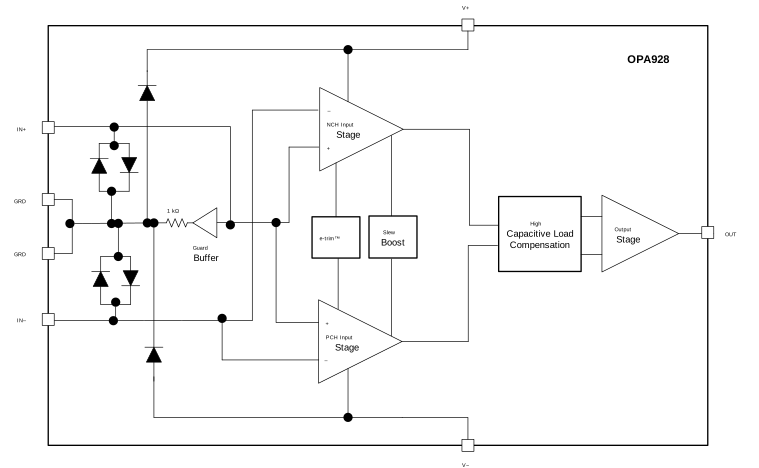 Figure 3-2 OPA928 Bootstrapped Diode Structure