TIDUF18A October 2022 – February 2024
- 1
- Description
- Resources
- Features
- Applications
- 6
- 1 CLLLC System Description
- 2 CLLLC System Overview
- 3 Totem Pole PFC System Description
- 4 Highlighted Products
-
5 Hardware, Software, Testing Requirements, and Test Results
- 5.1 Required Hardware and Software
- 5.2
Testing and Results
- 5.2.1 Test Setup (Initial)
- 5.2.2
CLLLC Test Procedure
- 5.2.2.1 Lab 1. Primary to Secondary Power Flow, Open Loop Check PWM Driver
- 5.2.2.2
Lab 2. Primary to Secondary Power Flow, Open Loop CheckPWM
Driver and ADC with Protection, Resistive Load Connected on Secondary
- 5.2.2.2.1 Setting Software Options for Lab 2
- 5.2.2.2.2 Building and Loading the Project and Setting up Debug Environment
- 5.2.2.2.3 Using Real-time Emulation
- 5.2.2.2.4 Running the Code
- 5.2.2.2.5 Measure SFRA Plant for Voltage Loop
- 5.2.2.2.6 Verify Active Synchronous Rectification
- 5.2.2.2.7 Measure SFRA Plant for Current Loop
- 5.2.2.3 Lab 3. Primary to Secondary Power Flow, Closed Voltage Loop Check, With Resistive Load Connected on Secondary
- 5.2.2.4 Lab 4. Primary to Secondary Power Flow, Closed Current Loop Check, With Resistive Load Connected on Secondary
- 5.2.2.5 Lab 5. Primary to Secondary Power Flow, Closed Current Loop Check, With Resistive Load Connected on Secondary in Parallel to a Voltage Source to Emulate a Battery Connection on Secondary Side
- 5.2.3 TTPLPFC Test procedure
- 5.2.4 Test Results
- 6 Design Files
- 7 Software Files
- 8 Related Documentation
- 9 Terminology
- 10About the Author
- 11Revision History
2.2.1.1 Voltage Gain
To understand tank design, first the gains for both battery-charging mode and reverse-power-flow mode must be analyzed with First Harmonic Analysis (FHA) using first harmonic approximation. The simplified diagram of the resonant tank is given in Figure 2-4.
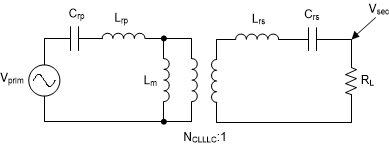 Figure 2-4 FHA Model for CLLLC Resonant Tank During Battery Charging Mode (BCM)
The nomenclature for Figure 2-4 is as follows:
| Vprim (TTPLPFC_VBUS) | Voltage input at primary side |
| Lrp | Primary side resonant inductor |
| Crp | Primary side resonant capacitor |
| NCLLLC | Turns ratio of the transformer |
| Lm | Magnetizing inductor |
| Vsec | Voltage output at secondary side |
| Lrs | Secondary side resonant inductor |
| Crs | Secondary side resonant capacitor |
| RL | Effective load seen with FHA on the secondary output |
Note here the effective RL is accounted for as  where RL_dc is the DC resistive load at the output.
Referring to secondary side quantities on the primary side,
- Lrs' is equal to Lrs * NCLLLC * NCLLLC
- Crs' is equal to Crs / (NCLLLC * NCLLLC)
- RL' is equal to RL * (NCLLLC * NCLLLC)
- Vrs' is equal to Vrs * NCLLLC
 Figure 2-5 FHA CLLLC With Quantities Referred to Primary Side in BCM
Using KCL and KVL, the gain equation can be written as Equation 1.

Similarly, for the reverse power flow, the circuit can be simplified as shown in Figure 2-6, and the gain can be written as Equation 2.
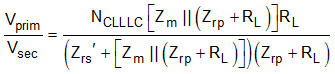
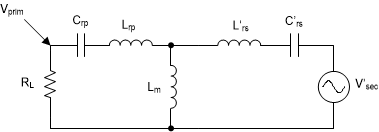 Figure 2-6 FHA Model for Gain Calculation in RCM
Equation 1 and Equation 2 are used in the following section to study the voltage gain based on the parameters selected for the design.