TIDUF25A June 2023 – March 2025 ADS131M08 , MSPM0G1507
- 1
- Description
- Resources
- Features
- Applications
- 6
- 1System Description
- 2System Overview
-
3System Design Theory
- 3.1 How to Implement Software for Metrology Testing
- 3.2 Clocking System
- 3.3 UART Setup for GUI Communication
- 3.4 Real-Time Clock (RTC)
- 3.5 LCD Controller in MSP430FR4131
- 3.6 Direct Memory Access (DMA)
- 3.7 ADC Setup
- 3.8 Foreground Process
- 3.9 Background Process
- 3.10 Software Function per_sample_dsp()
- 3.11 LED Pulse Generation
- 3.12 Phase Compensation
-
4Hardware, Software, Testing Requirements, and Test Results
- 4.1 Required Hardware and Software
- 4.2
Test Setup
- 4.2.1 Connecting the TIDA-010243 to the Metering Test Equipment
- 4.2.2 Power Supply Options and Jumper Settings
- 4.2.3 Electricity Meter Metrology Accuracy Testing
- 4.2.4 Viewing Metrology Readings and Calibration
- 4.2.5 Calibration and FLASH Settings for MSPM0+ MCU
- 4.2.6 Gain Calibration
- 4.2.7 Voltage and Current Gain Calibration
- 4.2.8 Active Power Gain Calibration
- 4.2.9 Offset Calibration
- 4.2.10 Phase Calibration
- 4.2.11 Software Code Example
- 4.3 Test Results
- 5Design and Documentation Support
- 6About the Author
- 7Revision History
2.2.3.1 Voltage Measurement Analog Front End
The nominal voltage from the Mains is from 100V–240V so the voltage needs to be scaled down to be sensed by an ADC. Figure 2-3 shows the analog front end used for this voltage scaling. J1 is where the voltage is applied for Phase A, similar circuitry is used for each of the Phases B and C.
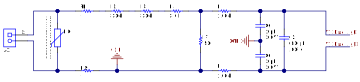 Figure 2-3 Analog Front End for Voltage
Inputs
Figure 2-3 Analog Front End for Voltage
InputsIn the analog front end for voltage, there consists a spike protection varistor (R6), footprints for electromagnetic interference filter beads (resistor footprints R1 and R9), a voltage divider network (R2, R3, R4, and R7), and an RC low-pass filter (R5, R8, C1, C3, and C2).
At lower currents, voltage-to-current crosstalk affects active energy accuracy much more than voltage accuracy, if power offset calibration is not performed. To maximize the accuracy at these lower currents, in this design only a small part of the full ADC range is used for voltage channels. Since the ADCs of the ADS131M08 device are high-accuracy ADCs, using the reduced ADC range for the voltage channels in this design still provides more than enough accuracy for measuring voltage. Equation 1 shows how to calculate the range of differential voltages fed to the voltage ADC channel for a given Mains voltage and selected voltage divider resistor values.
Based on this formula and the selected resistor values in Figure 2-3, for a mains voltage of 120V (as measured between the line and neutral), the input signal to the voltage ADC has a voltage swing of ±128mV (91mVRMS). For a mains voltage of 230V (as measured between the line and neutral, the 230V input to the front-end circuit produces a voltage swing of ±245.33mV (173.48mVRMS). The ±128mV and the ±245.33mV voltage ranges are both well within the ±1.2V input voltage that can be sensed by the ADS131M08 device for the selected PGA gain value of 1 that is used for the voltage channels.