TIDUF27A February 2025 – March 2025 AMC131M03 , MSPM0G1507
- 1
- Description
- Resources
- Features
- Applications
- 6
- 1System Description
-
2System Overview
- 2.1 Block Diagram
- 2.2
Design Considerations
- 2.2.1 Voltage Measurement Analog Front End
- 2.2.2 Analog Front End for Current Measurement
- 2.2.3 XDS110 Emulator
- 2.2.4 Bluetooth® Data Transmission
- 2.2.5 Bluetooth® Connection Between Two Modules
- 2.2.6 Bluetooth® to UART Connection
- 2.2.7 Magnetic Tamper Detection With TMAG5273 Linear 3D Hall-Effect Sensor
- 2.3 Highlighted Products
- 3Hardware, Software, Testing Requirements, and Test Results
- 4Design and Documentation Support
- 5About the Author
- 6Revision History
2.2.1 Voltage Measurement Analog Front End
The nominal voltage from the Mains in many regions of the world varies from 100V–240V so the voltage needs to be scaled down to be sensed by an ADC. Figure 2-2 shows the analog front end used for this voltage scaling, voltage is applied at J11 for Phase C, similar circuitry is used for each of the Phases A and B.
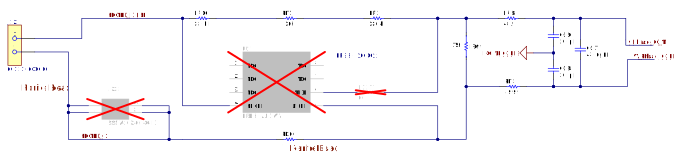 Figure 2-2 Analog Front End for Voltage
Inputs
Figure 2-2 Analog Front End for Voltage
InputsThe analog front end for voltage inputs has a voltage divider network (R70, R71, R72, and R69), and an RC low-pass filter (R68, R73, C56, C57) and C58, as shown in Figure 2-2.
Optionally, a high-precision resistor divider RES60A (U17) is added. This resistor divider lowers the voltage with the ratio 1000:1 and is an alternative to the discrete voltage divider with R70, R71, R72, and R69. To use the RES60A instead of the series resistor chain divider network, change the following components:
- Remove R69, R70, R71, and R72
- Place R127 (0Ω)
- Place RES60A
Follow similar steps for Phase A and B.
At lower currents, voltage-to-current crosstalk affects active energy accuracy much more than voltage accuracy if power offset calibration is not performed. To maximize the accuracy at these lower currents, in this design the entire ADC range is not used for the voltage channels. The reduced ADC range for the voltage channels in this design still provides more than enough accuracy for measuring voltage. Equation 1 shows how to calculate the range of differential voltages fed to the voltage ADC channel for a given Mains voltage and selected voltage divider resistor values.
Based on this formula and the selected resistor values in Equation 1, for a Mains voltage of 120V (as measured between the line and neutral), the input signal to the voltage ADC has a voltage swing of ±128.47mV (90.8mVRMS). For a Mains voltage of 230V (as measured between the line and neutral), the 230V input to the front-end circuit produces a voltage swing of ±246.23mV (174.11mVRMS). The ±128.47mV and the ±246.23mV voltage ranges are both well within the –1.3V to + 2.7V range (for GAIN = 1, see the recommended operating conditions section of the AMC131M03 3-Channel, 64-kSPS, Simultaneous-Sampling, 24-Bit, Reinforced Isolated Delta-Sigma ADC With Integrated DC/DC Converter data sheet), that can be sensed by the ADC.