TIDUF53 December 2023 DRV8210 , INA350 , MSPM0C1105 , MSPM0C1106 , MSPM0H3216 , MSPM0L1306
2.2.1 System Design Theory
Blood flows into the arm and creates pressure in the blood vessel; the blood flow changes with the heart rate and creates a periodic waveform. The blood flow is blocked when the pressure of the cuff is greater than systolic; after the blood flow is blocked, the waveform disappears. During the measuring period, the pressure data from the sensor is the superposition of static pressure from the cuff and the oscillation wave from the vessel. The oscillation wave becomes larger with the further increase of pressure in the cuff. After reaching the maximum value, the oscillation wave lessens; after the blood vessel is blocked, the oscillation wave disappears. The pressure of the cuff is called average pressure where the oscillation wave has the maximum value (see Figure 2-3).
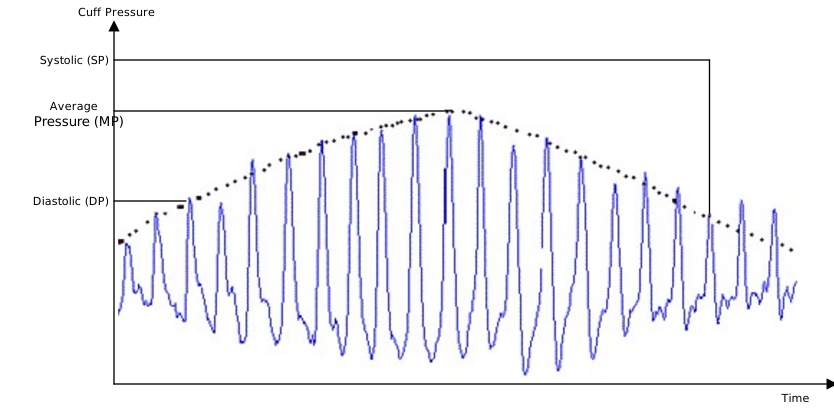 Figure 2-3 Oscillation Method to Get Blood Pressure
Obtaining the oscillation wave and the envelop is easy (see Figure 2-3), but systolic and diastolic parameters are required. There are two methods get these parameters from the oscillation curve. One method is called the proportionality coefficient method, where a proportional relationship exists between average pressure and systolic and diastolic (the coefficients are called Ks and Kd, respectively).
These two coefficients are obtained from a large number of statistical data. The proportionality coefficient method is simple and suitable for MCU applications, but the difference between individuals is large and inconsistent. Sometimes large errors occur with this method.
Many other algorithms and approaches are available, and provide trade-offs between power consumption and processor requirements. The proportionality coefficients (Ks, Kd) are listed in Table 2-1 for reference only. The included software leaves the blood pressure algorithm section blank.
| AVERAGE PRESSURE RANGE (mmHg) | Ks | AVERAGE PRESSURE RANGE (mmHg) | Kd |
|---|---|---|---|
| MAP > 200 | 0.5 | MAP > 180 | 0.75 |
| 200 ≥ MAP > 150 | 0.29 | 180 ≥ MAP > 140 | 0.82 |
| 150 ≥ MAP > 135 | 0.45 | 140 ≥ MAP > 120 | 0.85 |
| 135 ≥ MAP > 120 | 0.52 | 120 ≥ MAP > 60 | 0.78 |
| 120 ≥ MAP > 110 | 0.57 | 60 ≥ MAP > 50 | 0.6 |
| 110 ≥ MAP > 70 | 0.58 | 50 ≥ MAP | 0.5 |
| 70 ≥ MAP | 0.64 | 50 ≥ MAP | 0.5 |
This design utilizes the Omron 2SMPP-03 pressure sensor, which provides approximately a 0-mV to 30-mV output voltage range across the 0-kPa to 40-kPa pressure range of interest for this application. This is a 20-kΩ piezoresistive bridge sensor biased with 100 µA. This bridge was selected for the low power consumption. Although signal-to-noise ratio (SNR) is typically given up to extend battery life, this low-cost signal chain can achieve < 10 µVPP of input-referred noise, which enables increasing the gain of the signal chain and reducing the current required to drive the pressure bridge.