TIDUF53 December 2023 DRV8210 , INA350 , MSPM0C1105 , MSPM0C1106 , MSPM0H3216 , MSPM0L1306
2.2.4 Filter Design
The filter design for this application has the challenge of requiring a low-noise band-pass filter with only two general-purpose amplifiers. One key issue is that high DC gain is needed on the pressure waveform through the INA. The filter rejects DC and band passes the 0.5-Hz to 7-Hz frequencies with a total of 70 dB or more to pick up the µV-level oscillations.
Several topologies were simulated using the Filter Design Tool by TI to balance filter performance and noise. The first design, shown in Figure 2-6, was a 2nd order Sallen-Key low-pass stage followed by a 2nd order Sallen-Key high-pass stage, both with Butterworth response. This resulted in a relatively flat frequency response, but unfortunately did not add enough gain without significant noise increase.
For the second design, a 2nd order HP stage followed by a 2nd order BP stage was able to effectively add three zeroes at the low frequency stop band to filter the 30 dB of DC gain much better with only two amplifiers. This yielded the best filter performance for the application. However, total noise was simulated at about 540 µVPP.
 Figure 2-6 Sallen-Key High-Pass + Band Pass
Figure 2-7 shows the third circuit design, a simple 2-stage BP. This filter yielded the best noise performance and also the lowest passive count. One drawback is that the response is not flat when trying to keep a narrow pass band.
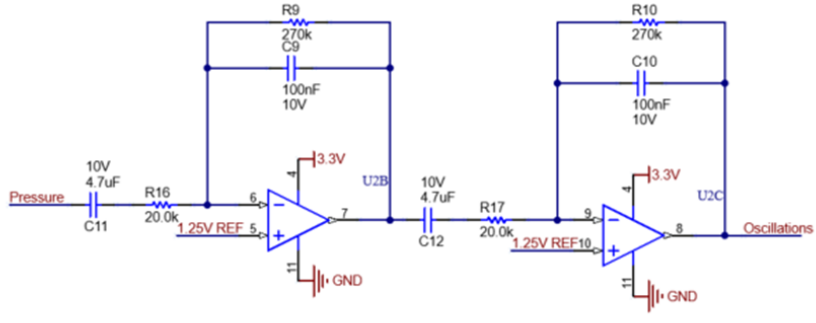 Figure 2-7 Two-Stage Band-Pass Circuit
The two-stage band pass was designed to prioritize, low-noise, stop-band attenuation, and component cost. In the best setup, an NP0/C0G, or at least X5R is preferred for improved tolerance over temperature and lower noise.