TIDUF82B August 2024 – May 2025 DRV8162 , INA241A , ISOM8710
- 1
- Description
- Resources
- Features
- Applications
- 6
- 1System Description
-
2System Overview
- 2.1 Block Diagram
- 2.2 Design Considerations
- 2.3 Highlighted Products
- 3Hardware, Software Test Requirements and Test Results
- 4Design and Documentation Support
- 5About the Authors
- 6Revision History
3.3.3 Digital PWM and Gate Voltage
In these tests, the propagation delay between the PWM signal and the MOSFET gate voltage is measured in a low-side channel first; and then the dead time between the high-side and low-side digital PWMs as well as the gate voltages of the MOSFETs are measured. Figure 3-19 shows the test setup.
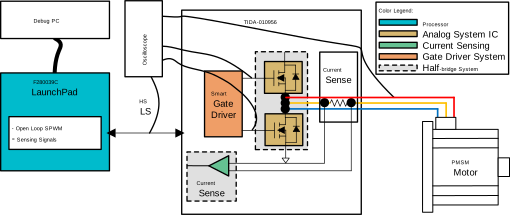 Figure 3-19 Test Setup for
the Digital PWM and Gate Voltage Measurements
Figure 3-19 Test Setup for
the Digital PWM and Gate Voltage MeasurementsThe system uses a 48V VIN in these tests and the motor is set to a fixed angle with open loop control. The signals are measured in Phase C and all signals are referenced to GND.
The propagation delay in turn-on and turn-off appear in Figure 3-20 and Figure 3-21.
 Figure 3-20 Propagation Delay in Turn-On
 Figure 3-21 Propagation Delay in Turn-off
The turn-on delay is measured at about 200ns and the turn-off delay is measured at about 70ns. The turn-on is postponed by about 130ns due to an extra dead time that is introduced with the DRV8162L, following the DT pin setting of a 3.3kΩ RDT connecting to GND.
Figure 3-22 and Figure 3-23 show the 200ns dead time of the PWM signals and the corresponding gate voltages when the half bridge is switching from low to high (CH2 for CL and CH3 for CH).
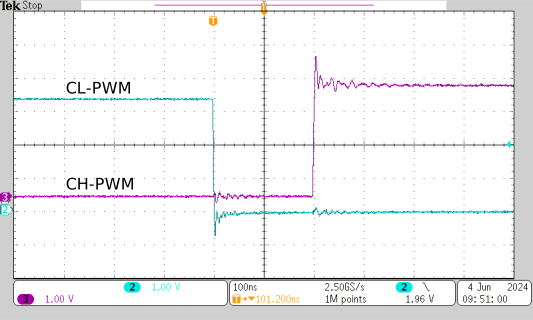 Figure 3-22 PWM
Inputs in Positive Shift, DT = 200ns
Figure 3-22 PWM
Inputs in Positive Shift, DT = 200ns Figure 3-23 Gate
Voltages in Positive Shift, DT = 343ns
Figure 3-23 Gate
Voltages in Positive Shift, DT = 343nsThe dead time between the high-side and the low-side gate voltages is expanded to about 340ns with the DRV8162L.
Figure 3-24 and Figure 3-25 show the half bridge is switching from high to low. The dead time is also expanded to about 340ns with the RDT setting.
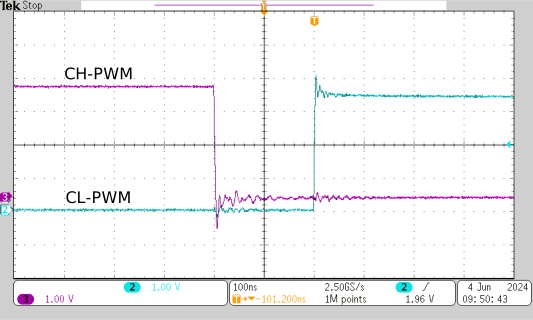 Figure 3-24 PWM
Inputs in Negative Shift,
Figure 3-24 PWM
Inputs in Negative Shift,DT = 200ns
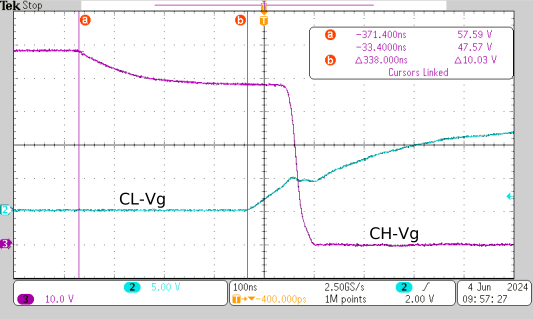 Figure 3-25 Gate
Voltages in Negative Shift,
Figure 3-25 Gate
Voltages in Negative Shift,DT = 338ns
This DRV8162L automatically inserts dead time and can vary between 20ns to 370ns, depending on the RDT value. See the data sheet for the details.