TIDUFA5 December 2024
- 1
- Description
- Resources
- Features
- Applications
- 6
- 1System Description
-
2System Overview
- 2.1 Block Diagram
- 2.2 Design Considerations
- 2.3
Highlighted Products
- 2.3.1 BQ25790 IIC Controlled, 1–4 Cell, 5A Buck-Boost Battery Charger
- 2.3.2 TPS3422 Low-Power, Push-Button Controllers With Configurable Delay
- 2.3.3 SN74LVC1G74 Single Positive-Edge-Triggered D-Type Flip-Flop With Clear and Preset
- 2.3.4 TPS259470 2.7V–23V, 5.5A, 28mΩ True Reverse Current Blocking eFuse
- 2.3.5 TPS54218 2.95V to 6V Input, 2A Synchronous Step-Down SWIFT Converter
- 2.3.6 TPS54318 2.95V to 6V Input, 3A Synchronous Step-Down SWIFT Converter
- 2.3.7 LM5158 2.2MHz, Wide VIN, 85V Output Boost, SEPIC, or Flyback Converter
- 2.3.8 TPS61178 20V Fully Integrated Sync Boost With Load Disconnect
- 2.3.9 LMZM23601 36V, 1A Step-Down DC-DC Power Module in 3.8mm × 3mm Package
- 2.3.10 TPS7A39 Dual, 150mA, Wide-VIN, Positive and Negative Low-Dropout (LDO) Voltage Regulator
- 2.3.11 TPS74401 3.0A, Ultra-LDO With Programmable Soft Start
- 2.3.12 TPS7A96 2A, Ultra-Low Noise, Ultra-high PSRR RF Voltage Regulator
- 2.3.13 LM3880 3-Rail Simple Power Sequencer With Fixed Time Delay
- 2.3.14 DAC53401 10-Bit, Voltage-Output DAC With Nonvolatile Memory
- 2.3.15 INA231 28V, 16-bit, I2C Output Current, Voltage, and Power Monitor With Alert in WCSP
-
3System Design Theory
- 3.1 Input Section
- 3.2 Designing SEPIC and Cuk Based High-Voltage Power Supply
- 3.3 Designing the Low-Voltage Power Supply
- 3.4 System Clock Synchronization
- 3.5 Power and Data Output Connector
- 3.6 System Current and Power Monitoring
- 4Hardware, Testing Requirements, and Test Results
- 5Design and Documentation Support
3.3.2 ±5V Transmit Supply Generation
Figure 3-16 shows the transmit ±5V rail schematic. The boost device TPS61178 boosts the USB voltage (4.25V to 5.5V) to 5.7V and the LMZM23601 device which is set up in inverting buck mode generates –5.3V. Both the positive and the negative outputs are fed to the dual low noise TPS7A39 LDO to generate ±5V at a maximum of 150mA per rail. The TPS61178 device is also useful in the situation where the high-voltage requirement is high (100V) or the system is powered using the 3.6V (1S battery) source. This stage can be used as an intermediate input to the high-voltage circuit. This can be enabled by setting the required output voltage using the resistor divider (R95 and R98), then removing R2 to disable the existing USB input to the high-voltage circuit and placing R3, 0Ω resistor as the input.
 Figure 3-16 ±5V Transmit Circuit
Schematic
Figure 3-16 ±5V Transmit Circuit
SchematicThe TPS61178 device also has a true load-disconnect feature (not implemented in the existing design). Placing an external P-FET between the output and the point of load, the device has a DISDRV pin which can be used to turn off the FET in case of any short conditions. This feature is particularly useful when using an intermediate boost stage to power the high-voltage circuit. The input to the high-voltage circuit can be completely cut off in case any output short occurs; therefore, protecting the circuitry. The user can implement the same in a design providing a more robust system. Figure 3-17 shows the implementation of the load disconnect in TPS61178. For detailed information on the FET selection and other aspects, see the application and implementation section of the device data sheet.
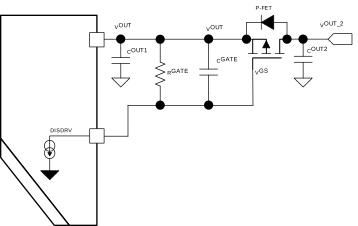 Figure 3-17 Load Disconnect FET Connected
in TPS61178
Figure 3-17 Load Disconnect FET Connected
in TPS61178