Related Documentation:
> Digital Still Camera
> News Releases
publications
> Technology Innovations
> Sine On Analog and Mixed-
Signal Catalog
trade shows
> Current Trade Shows
search news archives
> Search the News Archives
|
|
New Kodak mc3 Combines TI DSP and Kodak Imaging Science to Deliver Digital Video, Music and Pictures in One Package
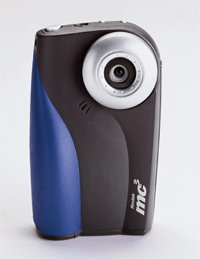 DALLAS (Feb. 13, 2001) - The new Kodak mc3 combines a single programmable digital signal processor (DSP) from Texas Instruments Incorporated (TI) (NYSE:TXN) and Kodak's imaging science to enable the delivery of digital video, pictures and music in one portable unit. The programmability of TI's DSP also provides the ability to upgrade the Kodak mc3 firmware, allowing it to record and play the latest audio and video formats today and tomorrow. The mc3, introduced yesterday at the DEMO 2001 conference and featured by TI and Kodak at the Photo Marketing Association International (PMA) trade show today, uses the same DSP core that has propelled TI to the lead in powering portable Internet audio and digital imaging products. (See www.ti.com/sc/digitalcamera for more details.)
"Texas Instruments' DSP technology is an integral part of our new mc3," said Willy Shih, president of Kodak's Digital and Applied Imaging group. "It has helped us to bring multimedia sharing and flexibility to a single, fun, easy-to-use unit."
TI's programmable single-chip solution for the digital camera market, the TMS320DSC21 DSP, delivers multiple imaging and audio functionality. With the DSC21 and Kodak digital science, the Kodak mc3 can record video at either 20 frames per second for highest resolution or 10 frames per second for virtually unlimited recording on its removable memory card. It also captures color still images in VGA resolution, which is ideal for transfer over the Internet, and can store 90 minutes of mp3 music on a 64 MB CompactFlash memory card. TI's DSC21 supports a full complement of interfaces for a microphone, speaker, audio output/headphone, video output and USB for uploading and downloading files.
"With the market's growing demand for multi-functional consumer electronics, the need for processing support in digital cameras is inevitable," said Ron Glaz, market analyst at IDC. "TI's DSC21 provides OEMs with technology that supports their ability to deliver a variety of digital, multimedia devices. The use of TI's programmable DSP in Kodak's mc3, is a prime example of the DSC21 capabilities."
The programmability of TI's DSPs also enables upgradability, so Kodak can offer continued support of the latest audio and video compression formats via software downloads at its mc3 user Web site at www.kodak.com/go/mcXchange. Kodak's mc3 will be sold with 16 MB of memory for $229 and 64 MB of memory for $299 and is scheduled to be available in retail stores in March.
"TI created the DSC21 to provide a flexible, single-chip solution that could power the latest in all types of digital imaging devices," said Raj Talluri, business manager of the Digital Still Camera business at TI. "The same chip that enables typical digital still camera functionality can also power multimedia multi-function devices like Kodak's mc3."
The DSC21 supports the broadest offering of popular digital audio and video formats including real-time MPEG1, MPEG4, JPEG, MJPEG, H.263 and mp3, as well as data communication standards such as IrDA, USB and RS-232.
# # #
|





