- Contact Us
- |
- TI Worldwide: United States
- |
- my.TI Login
Just-In-TimeThe following abstract summarizes the EDI Just-In-Time concept introduced by Texas Instruments to Siemens Corporate Logistic management in 2H95.Recognized as a leading edge procurement methodology, Siemens invited TI to highlight the program in a feature article for the June '96 edition of the "IUK Report". A similar article appears in the August '96 edition of the widely circulated German Magazine, "Logistik Heute". Leonhard Wiedemann is a WW Account Manager with Texas Instruments. Arthur Larres is the EDI Program Manager for Texas Instruments in Central Europe. Both authors are located in Freising, Germany. ELECTRONIC COMMERCEby Arthur Larres and Leonhard Wiedemann Texas Instruments Deutschland JUST IN TIME: EDI program opens new dimensions for industrial logisticsUntil a few years ago, more than two thirds of all business documents were exchanged in the form of paper, with all the weaknesses which inevitably result from this system, such as long processing time, high costs and potential errors. In the last three or four years, this situation has changed dramatically.The extension of public communications networks, the availability of Network transparent E-Mail systems, and the definition of standards with world-wide acceptance for the electronic exchange of data: all these factors have contributed decisively to changing traditional methods of transmitting information. The concept of a "global village" has become a reality in the last couple of years, as a result of the rapidly increasing usage of the Internet: an estimated 30-40 million users are now active with this network, either as private individuals (e.g. for E-Mail or "Web Surfing"), or for business purposes. The Internet was originally conceived as a network linking government establishments and universities in the USA. Enhanced by new applications such as the World Wide Web, it can now be accessed in almost every country on earth, and allows almost instantaneous round-the-clock global communications. Private and commercial network operators now provide cost-effective access to the Internet, and have contributed to its increasing and widespread acceptance. These developments have encouraged the rapid increase in Electronic Commerce, embracing applications such as Electronic Mail, Electronic Messaging and Electronic Data Interchange (EDI). EDI takes on a central significanceThe support of standards having international acceptance such as EDIFACT (Electronic Data Interchange for Administration, Commerce and Transport) allows the transmission of data world-wide, direct from computer to computer. The overriding goal here has been a dramatic reduction in transmission time, together with the elimination of errors as a result of human intervention.Every day, more and more organizations make use of this form of data transmission: industrial associations and market research institutes speak of increases between 30 and 40 percent per year (see Figure 1).
The 'traditional' processing of a purchase order - depending on product and order complexity - involves about 8-18 different transactions per item; many of these are repetitions, all must be manually entered, and the risk of errors is therefore considerable. In contrast, orders placed by means of EDI are entered fully automated on the same day, and customer requests are provided to the internal scheduling systems and further processed without loss of time, and without danger of incorrect data entry. The electronic transmission of business documents has a long tradition at Texas Instruments. More than 50% of all order items from customers in Europe are now processed electronically: that is, without any kind of manual intervention. Order acknowledgments and invoices are transmitted to customers as 'outbound' EDI documents, as well as delivery information which take account of the specific requirements of customers for each item are provided electronically as soon as the goods leave our central warehouse. Improved logistical planning in the inventory management systems is one of the direct benefits for the customer. Global corporations are very significant partners for us in these activities. Data is exchanged electronically with almost every one of their locations, and a wide variety of EDI messages have been installed by teams from both partners working together - an activity which is being continually refined, improved and extended.
TI's 'JUST IN TIME' (JIT) ProgramOne of the most significant extended developments at Texas Instruments has been the comprehensive and completely automatic integration of the EDI DELFOR (Delivery Forecast) message into all planning and production systems. This program is now in its fourth year of operation, and has been (and will continue to be) continuously improved. Already about a fifth of all orders in the USA are now processed in accordance with JIT concepts; a positive trend is also evident from data in Europe since the inception of this program in 1993/1994.TI believes its JIT philosophy, and the programs which result from it, to be world class, as has been confirmed by the reactions and comments of our JIT partners. An example here was the award to TI of the 'Crystal Bowl', the most highly esteemed prize of one of our largest European partners, '...for meeting or exceeding its highest performance values in our procurement program'. TI offers its JIT program to selected partners, for whom the most significant criteria (this is a quotation by Thomas St. Peter, TI Semiconductor Worldwide EDI Program Manager) are as follows: ... 'we attempt to align these extended services with trading partners that share TI's vision of a long-term, strategic relationship. Other factors qualifying a JIT/MR engagement include EDI capabilities (mandatory), MRP functionality, and business volumes'. (MR = Material Replenishment; MRP = Material Requirement Planning) The goal is the fulfillment of all significant customer requirements for a modern integrated material procurement program (see Figure 2).
The slogan of "the right product, in the right quantity, at the right time at the right place" defines the goals and it's realization through TI's JIT program. The key requirements of our JIT partners are
These requirements can not be met with conventional customer/supplier relationships. They require a fundamental integration of both business processes, together with the utilization of the successes and methods provided by Business Reengineering activities. The result is a freshly-defined and highly partnership-oriented business relationship (see Figure 3).
The relationship between the business partners can no longer be seen in isolation: it comes much closer to becoming an alliance, in which information (in this case, production data) is exchanged and made use of on the basis of a partnership agreement. The concept of a true Extended Enterprise applies : the supplier is the 'front end' to the production processes of the customer. He manufactures 'just in time', based on continually updated forecast information from the customer, which is supplied to him at regular intervals (for example, once a week), by means of EDI. The advantages of this close and binding business relationship for our customers are obvious, and are very clearly confirmed by comments we receive. Here are just two citations from the USA and from Europe: The CEO of a major peripheral products manufacturer praised: '... TI's delivery performance and lead-time reduction' (JIT program) as being 'the industry's best'; or again a large European manufacturer stated that: '... JIT programs (are) major ... satisfaction programs' and that ' TI ranked number 1'.
The direct effects on inventory levelsThe necessary inventory level for JIT defined products (the 'safety margin' inventory that is not necessarily added to the daily production requirements) is reduced, because the required quantities are delivered exactly for the day they are needed. As a result of the regular provision of the quantities required for production (transmitted by EDI), and the subsequent processing of the (unchanged) data in TI's planning and production systems, delivery of the correct quantities on the date, and at the time, requested by the customer can be precisely achieved.
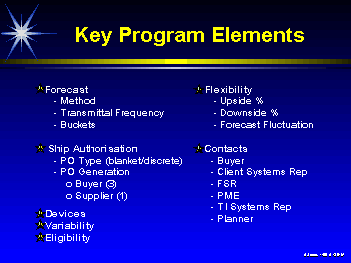
Changes to required quantitiesSince the quantity demands which TI receives from its JIT partners represent their actual production requirements at the moment of the EDI transmission, it is perfectly normal that there should be changes between two EDI transmissions, and account will be taken of them, provided that they conform to certain predefined guidelines. The magnitude of the change will decide whether manual intervention is necessary. In discussions with customers, the "normal quantities required per time period" of JIT products are agreed. Limits with percentages are also established, within which the required quantities can be changed and automatically accepted and processed by the planning and production systems. This "bandwidth" is individually defined for every single JIT product, and this provides the best possible degree of flexibility. Should there be changes of quantities which go outside the limits, an automatic check is then made to see whether the quantities required can in fact be supplied in accordance with the desired deadline. Only if this is not possible will the responsible Product Planner be informed, so that he can discuss the matter further with marketing or with the customer, who can then all work out together the best possible solution.Less paper, and no changes to ordersAs a result of the continuous updating of the customer's requirement by means of EDI transmissions, the quantities which TI needs to manufacture are always up to date. This has enormous advantages in comparison with the traditional method of order processing. Order changes are obviated: indeed, the order as such is effectively eliminated, since it is an intrinsic part of the EDI transmission. Comparisons made with previous experience have shown that, on average, each order item is changed 5 - 7 times. Here also the additional and significant rationalization offered by the JIT program provides further advantages for both partners.What then is required for supplier and customer to establish together a successful JIT business relationship? (see Figure 4).
Production requirements transmitted by EDIThe prerequisite here is that our partner must be in a position to communicate his requirements by means of a DELFOR Message, 92.1 Version, in accordance with EDIFACE/EDIFICE Standards. The transmission must be made regularly (normally, once per week), and include the last valid quantity requirements for JIT-defined products.It is essential that the 'Forecast' which is provided should be reliable and not subject to excessive variations, particularly in the last time periods before the expected delivery date. Of course, the further this delivery is in the future, the larger can (and will) these variations be; this is all perfectly normal, and is completely taken care of by TI's systems. The time periods for the forecast requirements should be realistic: that is, they should be in line with normal product delivery times. Thus, a planning window of 12 months would usually be too long, as the quantities would then be insufficiently accurate. In practice, a lead time of 12-18 weeks has been found to be adequate, but this may vary from product to product.
The configuration of the EDI transmissionTI uses the EDIFACT 'DELFOR' message in the Version 92.1, and from the EDI transmission extracts both planning figures and also the firm customer order. Much simplified, this means that there is a combined message which contains data both from the production and from the purchasing system of our partner. Order data, such as the purchase order number, will be part of the transmission which is sent within a time window before delivery which has been agreed in advance with the partner. It is also possible to dispense with the order number as a part of the transmission, and instead to establish a 'blanket' order; however, this option is often in conflict with the system capabilities of the customer.
Products and bandwidthsA joint agreement between TI and our JIT partners defines which products are involved, what forecast time periods should be covered, and how the variations in the bandwidth limits of the planning quantities of the customer should be defined. These points are covered separately for each individual product, thus allowing for a high degree of flexibility.Who decides all this, and how long does it take to implement?A JIT Team consists of representatives from TI and the customer, and includes members from purchasing and marketing, together with specialists from TI's product division and from the systems departments of both companies.As a rule, a new JIT partnership can be founded very quickly - in a matter of weeks after the successful conclusion of a test run; the precondition is, however, that the above mentioned criteria have been or can be fulfilled. It is recommended to begin by choosing a product which is required continually in large quantities, and which has relatively minor variations in volume. In Figure 5 which follows on the next page, we have attempted to represent diagramatically the process described above, covering forecast periods, bandwidths, and the intervention facilities which it provides to Planning etc.
The 'Rolling Forecast' for each time period fluctuates between transmissions within predetermined limits. These limits become narrower as the day for delivery approaches. This is also in accordance with the MRP data of the JIT partner, whose planning requirements become increasingly precise: that is, ever closer to the exact quantities needed for production. The Rolling Forecast automatically triggers manufacturing processes and changes in production, such that there is a continual material flow which is specific to each customer, and which adjusts itself to conform with the actual requirements. At a certain number of time periods before delivery (request date) a Purchase Order (PO) will be sent by the customer as part of the transmission; TI's systems then capture this PO and generate a Sales Order containing all necessary reference data. A few days in advance of the request date, a Packing List is printed and the goods are released for delivery. This advance time period can be defined individually depending on the product and the point of delivery. If the Forecast exceeds the predetermined upper limits, the system will automatically search other internal resources to meet the unexpected increase. If the desired quantity can be supplied, no manual intervention is necessary. If this is not the case, the Planner responsible for the product receives an E-Mail and will react accordingly.
The whole process is exception based supply management. If the Forecast is below the minimum limit, then an E-Mail message is dispatched; the Planner contacts the customer via marketing, in order to make sure that the figures which have been received are really in accordance with actual requirements, and have not been generated as a result of an incorrect input. SummaryThe EDI-JIT program at Texas Instruments is much more than just the transmission of purchasing transactions by means of EDI: it represents the electronic fusion of the customer's procurement system with the supplier's manufacturing process. It opens up completely new dimensions for industrial logistics by reducing inventory and administration costs, it shortens delivery times whilst at the same time significantly improves delivery performance.
|
Products | Applications | Design Support | Sample & Buy 
TI Worldwide | About TI | Contact Us | Investor Relations | Press Center | Corporate Social Responsibility | Careers | Tags | my.TI Login | All Searches | Site Map
© Copyright 1995-2008 Texas Instruments Incorporated. All rights reserved. Trademarks | Privacy Policy | Terms of Use






 the reduction of inventory costs by keeping
stock levels at an absolute minimum, which serves only to cover
very short term production requirements;
the reduction of inventory costs by keeping
stock levels at an absolute minimum, which serves only to cover
very short term production requirements;
 the ability of the supplier to react
adequately to short-term changes of demand on the part of the
customer, both increases and decreases;
the ability of the supplier to react
adequately to short-term changes of demand on the part of the
customer, both increases and decreases;
 the guaranteed fulfillment of the customer
request date; and
the guaranteed fulfillment of the customer
request date; and
 the avoidance of all superfluous and
unproductive transactions and procedures: that is, any that do
not directly and positively influence the production process.
the avoidance of all superfluous and
unproductive transactions and procedures: that is, any that do
not directly and positively influence the production process.