SBAS473F May 2009 – January 2025 ADS1013 , ADS1014 , ADS1015
PRODUCTION DATA
- 1
- 1 Features
- 2 Applications
- 3 Description
- 4 Device Comparison Table
- 5 Pin Configuration and Functions
- 6 Specifications
- 7 Detailed Description
- 8 Register Map
-
9 Application and Implementation
- 9.1 Application Information
- 9.2
Typical Application
- 9.2.1 Design Requirements
- 9.2.2
Detailed Design Procedure
- 9.2.2.1 Shunt Resistor Considerations
- 9.2.2.2 Operational Amplifier Considerations
- 9.2.2.3 ADC Input Common-Mode Considerations
- 9.2.2.4 Resistor (R1, R2, R3, R4) Considerations
- 9.2.2.5 Noise and Input Impedance Considerations
- 9.2.2.6 First-Order RC Filter Considerations
- 9.2.2.7 Circuit Implementation
- 9.2.2.8 Results Summary
- 9.2.3 Application Curves
- 9.3 Power Supply Recommendations
- 9.4 Layout
- 10Device and Documentation Support
- 11Revision History
- 12Mechanical, Packaging, and Orderable Information
Package Options
Mechanical Data (Package|Pins)
Thermal pad, mechanical data (Package|Pins)
- RUG|10
Orderable Information
9.1.7 Quick-Start Guide
This section provides a brief example of ADS101x communications. Hardware for this design includes: one ADS101x configured with an I2C address of 1001000b; a microcontroller with an I2C interface; discrete components such as resistors, capacitors, and serial connectors; and a 2V to 5V power supply. Figure 9-5 shows the basic hardware configuration.
The ADS101x communicate with the controller (microcontroller) through an I2C interface. The controller provides a clock signal on the SCL pin and data are transferred using the SDA pin. The ADS101x never drive the SCL pin. For information on programming and debugging the microcontroller being used, see the device-specific product data sheet.
The first byte sent by the controller is the ADS101x address, followed by the R/W bit that instructs the ADS101x to listen for a subsequent byte. The second byte is the Address Pointer register byte. The third and fourth bytes sent from the controller are written to the register indicated in register address pointer bits P[1:0]. See Figure 7-9 and Figure 7-10 for read and write operation timing diagrams, respectively. All read and write transactions with the ADS101x must be preceded by a START condition, and followed by a STOP condition.
For example, to write to the configuration register to set the ADS101x to continuous-conversion mode and then read the conversion result, send the following bytes in this order:
- Write to Config register:
- First byte: 10010000b (first 7-bit I2C address followed by a low R/W bit)
- Second byte: 00000001b (points to Config register)
- Third byte: 10000100b (MSB of the Config register to be written)
- Fourth byte: 10000011b (LSB of the Config register to be written)
- Write to Address Pointer register:
- First byte: 10010000b (first 7-bit I2C address followed by a low R/W bit)
- Second byte: 00000000b (points to Conversion register)
- Read Conversion register:
- First byte: 10010001b (first 7-bit I2C address followed by a high R/W bit)
- Second byte: the ADS101x responds with the MSB of the Conversion register
- Third byte: the ADS101x responds with the LSB of the Conversion register
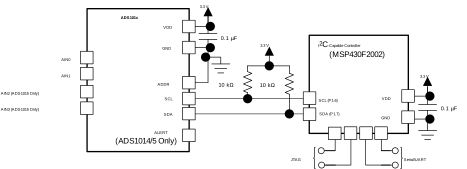 Figure 9-5 Basic Hardware Configuration