SBASB57 July 2025 AMC0330D
PRODMIX
- 1
- 1 Features
- 2 Applications
- 3 Description
- 4 Device Comparison Table
- 5 Pin Configuration and Functions
-
6 Specifications
- 6.1 Absolute Maximum Ratings
- 6.2 ESD Ratings
- 6.3 Recommended Operating Conditions
- 6.4 Thermal Information (D Package)
- 6.5 Thermal Information (DWV Package)
- 6.6 Power Ratings
- 6.7 Insulation Specifications (Basic Isolation)
- 6.8 Insulation Specifications (Reinforced Isolation)
- 6.9 Safety-Related Certifications (Basic Isolation)
- 6.10 Safety-Related Certifications (Reinforced Isolation)
- 6.11 Safety Limiting Values (D Package)
- 6.12 Safety Limiting Values (DWV Package)
- 6.13 Electrical Characteristics
- 6.14 Switching Characteristics
- 6.15 Timing Diagram
- 6.16 Insulation Characteristics Curves
- 6.17 Typical Characteristics
- 7 Detailed Description
- 8 Application and Implementation
- 9 Device and Documentation Support
- 10Revision History
- 11Mechanical, Packaging, and Orderable Information
Package Options
Mechanical Data (Package|Pins)
- DWV|8
Thermal pad, mechanical data (Package|Pins)
Orderable Information
8.2.2.1 Input Filter Design
Place an RC filter in front of the device to improve signal-to-noise performance of the signal path. Input noise with a frequency close to the ΔΣ modulator sampling frequency (typically 10MHz) is folded back into the low-frequency range by the modulator. The purpose of the RC filter is to attenuate high-frequency noise below the desired noise level of the measurement. In practice, a cutoff frequency that is two orders of magnitude lower than the modulator frequency yields good results.
Most voltage-sensing applications use high-impedance resistive dividers to scale down the input voltage. In this case, a single capacitor, as shown in Figure 8-2, is sufficient to filter the input signal. For (R1 + R2) >> RSNS, the cutoff frequency of the input filter is 1 / (2 × π × RSNS × C5). For example, RSNS = 10kΩ and C5 = 100pF results in a cutoff frequency of 160kHz.
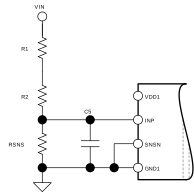 Figure 8-2 Input Filter