SNLS209M November 2005 – January 2017 DS90C124 , DS90C241
PRODUCTION DATA.
- 1 Features
- 2 Applications
- 3 Description
- 4 Revision History
- 5 Pin Configuration and Functions
- 6 Specifications
- 7 Parameter Measurement Information
- 8 Detailed Description
- 9 Applications and Implementation
- 10Power Supply Recommendations
- 11Layout
- 12Device and Documentation Support
- 13Mechanical, Packaging, and Orderable Information
Package Options
Mechanical Data (Package|Pins)
- PFB|48
Thermal pad, mechanical data (Package|Pins)
Orderable Information
6 Specifications
6.1 Absolute Maximum Ratings
over operating free-air temperature range (unless otherwise noted)(1)| MIN | MAX | UNIT | ||
| VCC | Supply voltage | –0.3 | 4 | V |
| LVCMOS/LVTTL input voltage | –0.3 | VCC + 0.3 | V | |
| LVCMOS/LVTTL output voltage | –0.3 | VCC + 0.3 | V | |
| LVDS receiver input voltage | –0.3 | 3.9 | V | |
| LVDS driver output voltage | –0.3 | 3.9 | V | |
| LVDS output short circuit duration | 10 | ms | ||
| TJ | Junction temperature | 150 | °C | |
| Tstg | Storage temperature | –65 | 150 | °C |
(1) Stresses beyond those listed under Absolute Maximum Ratings may cause permanent damage to the device. These are stress ratings only, which do not imply functional operation of the device at these or any other conditions beyond those indicated under Recommended Operating Conditions. Exposure to absolute-maximum-rated conditions for extended periods may affect device reliability.
6.2 ESD Ratings
| VALUE | UNIT | ||||
|---|---|---|---|---|---|
| V(ESD) | Electrostatic discharge | Human-body model (HBM), per AEC Q100-002(1) | ±8000 | V | |
| Charged-device model (CDM), per AEC Q100-011 | ±1250 | ||||
| RD = 330 Ω, CS = 150 pF | IEC, powered-up only contact discharge (RIN0+, RIN0-, RIN1+, RIN1-) | ±8000 | |||
| IEC, powered-up only air-gap discharge (RIN0+, RIN0-, RIN1+, RIN1-) | ±15000 | ||||
| RD = 330 Ω, CS = 150 and 330 pF | ISO10605 contact discharge (RIN0+, RIN0-, RIN1+, RIN1-) |
±8000 | |||
| ISO10605 air-gap discharge (RIN0+, RIN0-, RIN1+, RIN1-) |
±15000 | ||||
| RD = 2 kΩ, CS = 150 and 330 pF | ISO10605 contact discharge (RIN0+, RIN0-, RIN1+, RIN1-) |
±8000 | |||
| ISO10605 air-gap discharge (RIN0+, RIN0-, RIN1+, RIN1-) |
±15000 | ||||
(1) AEC Q100-002 indicates that HBM stressing shall be in accordance with the ANSI/ESDA/JEDEC JS-001 specification.
6.3 Recommended Operating Conditions
over operating free-air temperature range (unless otherwise noted)| MIN | NOM | MAX | UNIT | ||
|---|---|---|---|---|---|
| VCC | Supply voltage | 3 | 3.3 | 3.6 | V |
| Clock rate | 5 | 35 | MHz | ||
| Supply noise | ±100 | mVP-P | |||
| TA | Operating free-air temperature | −40 | 25 | 105 | °C |
6.4 Thermal Information
| THERMAL METRIC(1) | DS90C241-Q1 DS90C124-Q1 |
UNIT | |
|---|---|---|---|
| TFB (TQFP) | |||
| 48 PINS | |||
| RθJA | Junction-to-ambient thermal resistance | 67.5 | °C/W |
| RθJC(top) | Junction-to-case (top) thermal resistance | 15.1 | °C/W |
| RθJB | Junction-to-board thermal resistance | 33.4 | °C/W |
| ψJT | Junction-to-top characterization parameter | 0.4 | °C/W |
| ψJB | Junction-to-board characterization parameter | 33 | °C/W |
(1) For more information about traditional and new thermal metrics, see the Semiconductor and IC Package Thermal Metrics application report.
6.5 Electrical Characteristics
over recommended operating supply and temperature ranges (unless otherwise noted)| PARAMETER | TEST CONDITIONS | MIN | TYP | MAX | UNIT | ||
|---|---|---|---|---|---|---|---|
| LVCMOS AND LVTTL DC SPECIFICATIONS | |||||||
| VIH | High-level voltage | Tx: DIN[23:0], TCLK, TPWDNB, DEN, TRFB, DCAOFF, DCBOFF, and VODSEL; and Rx: RPWDNB, RRFB, and REN |
2 | VCC | V | ||
| VIL | Low-level input voltage | Tx: DIN[23:0], TCLK, TPWDNB, DEN, TRFB, DCAOFF, DCBOFF, and VODSEL; and Rx: RPWDNB, RRFB, and REN |
GND | 0.8 | V | ||
| VCL | Input clamp voltage | ICL = −18 mA, Tx: DIN[23:0], TCLK, TPWDNB, DEN, TRFB, DCAOFF, DCBOFF, and VODSEL; and Rx: RPWDNB, RRFB, and REN(1) |
−0.8 | −1.5 | V | ||
| IIN | Input current | VIN = 0 V or 3.6 V | Tx: DIN[23:0], TCLK, TPWDNB, DEN, TRFB, DCAOFF, DCBOFF, and VODSEL | −10 | ±5 | 10 | µA |
| Rx: RPWDNB, RRFB, and REN | −20 | ±5 | 20 | ||||
| VOH | High-level output voltage | IOH = −4 mA, Rx: ROUT[23:0], RCLK, and LOCK | 2.3 | 3 | VCC | V | |
| VOL | Low-level output voltage | IOL = 4 mA, Rx: ROUT[23:0], RCLK, and LOCK | GND | 0.33 | 0.5 | V | |
| IOS | Output short circuit current | VOUT = 0 V, Rx: ROUT[23:0], RCLK, and LOCK(1) | −40 | −70 | −110 | mA | |
| IOZ | TRI-STATE output current | RPWDNB, REN = 0 V, VOUT = 0 V or 2.4 V, Rx: ROUT[23:0], RCLK, and LOCK |
−30 | ±0.4 | 30 | µA | |
| LVDS DC SPECIFICATIONS | |||||||
| VTH | Differential threshold high voltage | VCM = 1.2 V, Rx: RIN+ and RIN− | 50 | mV | |||
| VTL | Differential threshold low voltage | Rx: RIN+ and RIN− | −50 | mV | |||
| IIN | Input current | VIN = 2.4 V, VCC = 3.6 V or 0 V, Rx: RIN+ and RIN− | ±200 | µA | |||
| VIN = 0 V, VCC = 3.6 V, Rx: RIN+ and RIN− | ±200 | ||||||
| VOD | Output differential voltage (DOUT+) – (DOUT−) |
RL = 100 Ω, without pre-emphasis, Tx: DOUT+ and DOUT− (see Figure 12) | VODSEL = L | 250 | 400 | 600 | mV |
| VODSEL = H | 450 | 750 | 1200 | ||||
| ΔVOD | Output differential voltage unbalance | RL = 100 Ω, without pre-emphasis, Tx: DOUT+ and DOUT− | 10 | 50 | mV | ||
| VOS | Offset voltage | RL = 100 Ω, without pre-emphasis, Tx: DOUT+ and DOUT− | 1 | 1.25 | 1.5 | V | |
| ΔVOS | Offset voltage unbalance | RL = 100 Ω, without pre-emphasis, Tx: DOUT+ and DOUT− | 1 | 50 | mV | ||
| IOS | Output short circuit current | DOUT = 0 V, DIN = H, TPWDNB, DEN = 2.4 V, Tx: DOUT+ and DOUT− |
VODSEL = L | −2 | −8 | mA | |
| DOUT = 0 V, DIN = H, TPWDNB, DEN = 2.4 V, Tx: DOUT+ and DOUT− |
VODSEL = H | −7 | −13 | ||||
| IOZ | TRI-STATE output current | TPWDNB, DEN = 0 V, DOUT = 0 V or 2.4 V, Tx: DOUT+ and DOUT− |
−15 | ±1 | 15 | µA | |
| SERIALIZER OR DESERIALIZER SUPPLY CURRENT – DVDDx, PVDDx, AND AVDDx PINS (Digital, PLL, and Analog VDDs) | |||||||
| ICCT | Serializer (Tx) total supply current (includes load current) | RL = 100 Ω, RPRE = OFF, VODSEL = H/L, f = 35 MHz, and checker-board pattern (see Figure 3) | 40 | 65 | mA | ||
| RL = 100 Ω, RPRE = 6 kΩ, VODSEL = H/L, f = 35 MHz, and checker-board pattern (see Figure 3) | 45 | 70 | mA | ||||
| Serializer (Tx) total supply current (includes load current) | f = 35 MHz, RL = 100 Ω, RPRE = OFF, and VODSEL = H/L |
40 | 65 | mA | |||
| f = 35 MHz, RL = 100 Ω, RPRE = 6 kΩ, VODSEL = H/L, and random pattern | 45 | 70 | mA | ||||
| ICCTZ | Serializer (Tx) supply current power-down | TPWDNB = 0 V (all other LVCMOS inputs = 0 V) | 800 | µA | |||
| ICCR | Deserializer (Rx) total supply current (includes load current) | CL = 8-pF LVCMOS output, f = 35 MHz, and checker-board pattern (see Figure 4) | 85 | mA | |||
| Deserializer (Rx) total supply current (includes load current) | CL = 8-pF LVCMOS output, f = 35 MHz, and random pattern | 80 | mA | ||||
| ICCRZ | Deserializer (Rx) supply current power-down | RPWDNB = 0 V (all other LVCMOS inputs = 0 V, RIN+/ RIN– = 0 V) |
50 | µA | |||
(1) Specification is ensured by characterization and is not tested in production.
6.6 Timing Requirements – Serializer
over recommended operating supply and temperature ranges (unless otherwise noted)| MIN | TYP | MAX | UNIT | |||
|---|---|---|---|---|---|---|
| tTCP | Transmit clock period (see Figure 7) | 28.6 | T | 200 | ns | |
| tTCIH | Transmit clock high time | 0.4T | 0.5T | 0.6T | ns | |
| tTCIL | Transmit clock low time | 0.4T | 0.5T | 0.6T | ns | |
| tCLKT | TCLK input transition time (see Figure 6) | 3 | 6 | ns | ||
| tJIT | TCLK input jitter(1) | 33 | ps (RMS) | |||
(1) tJIT (at BER of 10e-9) specifies the allowable jitter on TCLK. tJIT not included in TxOUT_E_O parameter.
6.7 Switching Characteristics – Serializer
over recommended operating supply and temperature ranges (unless otherwise noted)| PARAMETER | TEST CONDITIONS | MIN | TYP | MAX | UNIT | |
|---|---|---|---|---|---|---|
| tLLHT | LVDS Low-to-High transition time | RL = 100 Ω, CL = 10 pF to GND, and VODSEL = L (see Figure 5) | 0.6 | ns | ||
| tLHLT | LVDS High-to-Low transition time | RL = 100 Ω, CL = 10 pF to GND, and VODSEL = L (see Figure 5) | 0.6 | ns | ||
| tDIS | DIN[23:0] setup to TCLK | RL = 100 Ω and CL = 10 pF to GND(1) | 5 | ns | ||
| tDIH | DIN[23:0] hold from TCLK | RL = 100 Ω and CL = 10 pF to GND(1) | 5 | ns | ||
| tHZD | DOUT± HIGH to TRI-STATE delay | RL = 100 Ω and CL = 10 pF to GND (see Figure 8)(2) |
15 | ns | ||
| tLZD | DOUT± LOW to TRI-STATE delay | RL = 100 Ω and CL = 10 pF to GND (see Figure 8)(2) |
15 | ns | ||
| tZHD | DOUT± TRI-STATE to HIGH delay | RL = 100 Ω and CL = 10 pF to GND (see Figure 8)(2) |
200 | ns | ||
| tZLD | DOUT± TRI-STATE to LOW delay | RL = 100 Ω and CL = 10 pF to GND (see Figure 8)(2) |
200 | ns | ||
| tPLD | Serializer PLL lock time | RL = 100 Ω (see Figure 9) | 10 | ms | ||
| tSD | Serializer delay | RL = 100 Ω, VODSEL = L, and TRFB = H (see Figure 10) |
3.5T + 2.85 | 3.5T + 10 | ns | |
| RL = 100 Ω, VODSEL = L, and TRFB = L (see Figure 10) |
3.5T + 2.85 | 3.5T + 10 | ns | |||
| TxOUT_E_O | TxOUT_Eye_Opening (respect to ideal) | 5 MHz to 35 MHz (see Figure 11)(1)(3)(4) | 0.75 | UI(5) | ||
(1) Specification is ensured by characterization and is not tested in production.
(2) When the serializer output is tri-stated, the deserializer loses PLL lock. Resynchronization must occur before data transfer.
(3) tJIT (at BER of 10e-9) specifies the allowable jitter on TCLK. tJIT not included in TxOUT_E_O parameter.
(4) TxOUT_E_O is affected by pre-emphasis value.
(5) UI – Unit Interval; equivalent to one ideal serialized data bit width. The UI scales with frequency.
6.8 Switching Characteristics – Deserializer
over recommended operating supply and temperature ranges (unless otherwise noted)| PARAMETER | TEST CONDITIONS | MIN | TYP | MAX | UNIT | ||
|---|---|---|---|---|---|---|---|
| tRCP | Receiver out clock period | tRCP = tTCP and RCLK pin(1) | 28.6 | 200 | ns | ||
| tRDC | RCLK duty cycle | RCLK pin | 45% | 50% | 55% | ||
| tCLH | LVCMOS low-to-high transition time | CL = 8 pF (lumped load); ROUT[23:0], LOCK, and RCLK pins (see Figure 13)(1) | 2.5 | 3.5 | ns | ||
| tCHL | LVCMOS high-to-low transition time | CL = 8 pF (lumped load); ROUT[23:0], LOCK, and RCLK pins (see Figure 13)(1) | 2.5 | 3.5 | ns | ||
| tROS | ROUT[7:0] setup data to RCLK (Group 1) | ROUT[7:0] pins (see Figure 17) | 0.4 × tRCP | (29/56) × tRCP | ns | ||
| tROH | ROUT[7:0] hold data to RCLK (Group 1) | ROUT[7:0] pins (see Figure 17) | 0.4 × tRCP | (27/56) × tRCP | ns | ||
| tROS | ROUT[15:8] setup data to RCLK (Group 2) | ROUT[15:8] and LOCK pins (see Figure 17) | 0.4 × tRCP | 0.5 × tRCP | ns | ||
| tROH | ROUT[15:8] hold data to RCLK (Group 2) | ROUT[15:8] and LOCK pins (see Figure 17) | 0.4 × tRCP | 0.5 × tRCP | ns | ||
| tROS | ROUT[23:16] setup data to RCLK (Group 3) | ROUT[23:16] pins (see Figure 17) |
0.4 × tRCP | (27/56) × tRCP | ns | ||
| tROH | ROUT[23:16] hold data to RCLK (Group 3) | ROUT[23:16] pins (see Figure 17) |
0.4 × tRCP | (29/56) × tRCP | ns | ||
| tHZR | HIGH to TRI-STATE delay | ROUT[23:0], RCLK, and LOCK pins (see Figure 15) | 3 | 10 | ns | ||
| tLZR | LOW to TRI-STATE delay | ROUT[23:0], RCLK, and LOCK pins | 3 | 10 | ns | ||
| tZHR | TRI-STATE to HIGH delay | ROUT[23:0], RCLK, and LOCK pins | 3 | 10 | ns | ||
| tZLR | TRI-STATE to LOW delay | ROUT[23:0], RCLK, and LOCK pins | 3 | 10 | ns | ||
| tDD | Deserializer delay | RCLK pin (see Figure 14) | [4+(3/56)]T + 5.9 | [4+(3/56)]T + 14 | ns | ||
| tDRDL | Deserializer PLL lock time from power down | See Figure 16(1)(2) | 5 MHz | 5 | 50 | ms | |
| 35 MHz | 5 | 50 | |||||
| RxIN_TOL_L | Receiver input tolerance (left) | 5 MHz to 35 MHz (see Figure 18)(1)(3) |
0.25 | UI(4) | |||
| RxIN_TOL_R | Receiver input tolerance (right) | 5 MHz to 35 MHz (see Figure 18)(1)(3) |
0.25 | UI(4) | |||
(1) Specification is ensured by characterization and is not tested in production.
(2) The deserializer PLL lock time (tDRDL) may vary depending on input data patterns and the number of transitions within the pattern.
(3) RxIN_TOL is a measure of how much phase noise (jitter) the deserializer can tolerate in the incoming data stream before bit errors occur. It is a measurement in reference with the ideal bit position. See AN-1217 How to Validate BLVDS SER/DES Signal Integrity Using an Eye Mask (SNLA053) for details.
(4) UI – Unit Interval; equivalent to one ideal serialized data bit width. The UI scales with frequency.
6.9 Typical Characteristics
Figure 1 and Figure 2 are scope shots with PCLK = 5 MHz measured out of the DS90C241 DOUT± with pre-emphasis OFF and pre-emphasis ON using a 1010... pattern on the DIN[23:0] inputs. The scope was triggered on the input PCLK.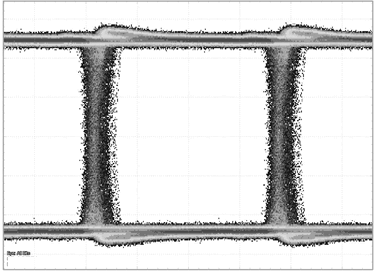 Figure 1. DS90C241 DOUT± Eye Diagram at 5 MHz
Without Pre-Emphasis
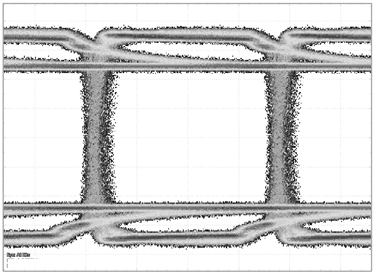 Figure 2. DS90C241 DOUT± Eye Diagram at 5 MHz
With Pre-Emphasis ON