SBOSA43A June   2021  – June 2025 TMCS1100-Q1

PRODUCTION DATA  

  1.   1
  2. Features
  3. Applications
  4. Description
  5. Device Comparison
  6. Pin Configuration and Functions
  7. Specifications
    1. 6.1  Absolute Maximum Ratings
    2. 6.2  ESD Ratings
    3. 6.3  Recommended Operating Conditions
    4. 6.4  Thermal Information
    5. 6.5  Power Ratings
    6. 6.6  Insulation Specifications
    7. 6.7  Safety-Related Certifications
    8. 6.8  Safety Limiting Values
    9. 6.9  Electrical Characteristics
    10. 6.10 Typical Characteristics
      1. 6.10.1 Insulation Characteristics Curves
  8. Parameter Measurement Information
    1. 7.1 Accuracy Parameters
      1. 7.1.1 Sensitivity Error
      2. 7.1.2 Offset Error and Offset Error Drift
      3. 7.1.3 Nonlinearity Error
      4. 7.1.4 Power Supply Rejection Ratio
      5. 7.1.5 Common-Mode Rejection Ratio
      6. 7.1.6 Reference Voltage Rejection Ratio
      7. 7.1.7 External Magnetic Field Errors
    2. 7.2 Transient Response Parameters
      1. 7.2.1 Slew Rate
      2. 7.2.2 Propagation Delay and Response Time
      3. 7.2.3 Current Overload Parameters
      4. 7.2.4 CMTI, Common-Mode Transient Immunity
    3. 7.3 Safe Operating Area
      1. 7.3.1 Continuous DC or Sinusoidal AC Current
      2. 7.3.2 Repetitive Pulsed Current SOA
      3. 7.3.3 Single Event Current Capability
  9. Detailed Description
    1. 8.1 Overview
    2. 8.2 Functional Block Diagram
    3. 8.3 Feature Description
      1. 8.3.1 Current Input
      2. 8.3.2 Input Isolation
      3. 8.3.3 High-Precision Signal Chain
        1. 8.3.3.1 Temperature Stability
        2. 8.3.3.2 Lifetime and Environmental Stability
        3. 8.3.3.3 Frequency Response
        4. 8.3.3.4 Transient Response
      4. 8.3.4 External Reference Voltage Input
      5. 8.3.5 Current-Sensing Measurable Ranges
    4. 8.4 Device Functional Modes
      1. 8.4.1 Power-Down Behavior
  10. Application and Implementation
    1. 9.1 Application Information
      1. 9.1.1 Total Error Calculation Examples
        1. 9.1.1.1 Room Temperature Error Calculations
        2. 9.1.1.2 Full Temperature Range Error Calculations
    2. 9.2 Typical Application
      1. 9.2.1 Design Requirements
      2. 9.2.2 Detailed Design Procedure
    3. 9.3 Power Supply Recommendations
    4. 9.4 Layout
      1. 9.4.1 Layout Guidelines
      2. 9.4.2 Layout Example
  11. 10Device and Documentation Support
    1. 10.1 Device Support
      1. 10.1.1 Development Support
    2. 10.2 Documentation Support
      1. 10.2.1 Related Documentation
    3. 10.3 Receiving Notification of Documentation Updates
    4. 10.4 Support Resources
    5. 10.5 Trademarks
    6. 10.6 Electrostatic Discharge Caution
    7. 10.7 Glossary
  12. 11Revision History
  13. 12Mechanical, Packaging, and Orderable Information

Package Options

Refer to the PDF data sheet for device specific package drawings

Mechanical Data (Package|Pins)
  • D|8
Thermal pad, mechanical data (Package|Pins)
Orderable Information

Frequency Response

The TMCS1100-Q1 signal chain has a spectral response atypical of a linear analog system due to the discrete time sampling. The 250kHz sampling interval implies an effective Nyquist frequency of 125kHz, which limits spectral response to below this frequency. Higher frequency content than this frequency is aliased down to lower spectrums.

The TMCS1100-Q1 bandwidth is defined by the –3dB spectral response of the entire signal chain which is constrained by the sampling frequency. Normalized gain and phase plots across frequency are shown below in Figure 8-7 and Figure 8-8, all variants have the same bandwidth and phase response. Signal content beyond the 3dB bandwidth level still has significant fundamental frequency transmissions through the signal chain, but at increasing distortion levels
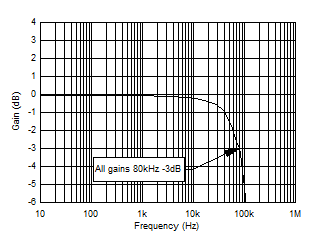
TMCS1100-Q1 Normalized Gain, All VariantsFigure 8-7 Normalized Gain, All Variants
TMCS1100-Q1 Normalized Phase, All VariantsFigure 8-8 Normalized Phase, All Variants