SLVS149C June 2003 – September 2015 TPS65010
PRODUCTION DATA.
- 1 Features
- 2 Applications
- 3 Description
- 4 Revision History
- 5 Pin Configuration and Functions
- 6 Specifications
-
7 Detailed Description
- 7.1 Overview
- 7.2 Functional Block Diagram
- 7.3
Feature Description
- 7.3.1
Battery Charger
- 7.3.1.1 Autonomous Power Source Selection
- 7.3.1.2 Temperature Qualification
- 7.3.1.3 Battery Preconditioning
- 7.3.1.4 Battery Charge Current
- 7.3.1.5 Battery Voltage Regulation
- 7.3.1.6 Charge Termination and Recharge
- 7.3.1.7 Sleep Mode
- 7.3.1.8 PG Output
- 7.3.1.9 Thermal Considerations for Setting Charge Current
- 7.3.2 Step-Down Converters, VMAIN and VCORE
- 7.3.3 Low-Dropout Voltage Regulators
- 7.3.4 Undervoltage Lockout
- 7.3.5 Power-Up Sequencing
- 7.3.6 System Reset and Control Signals
- 7.3.7 Vibrator Driver
- 7.3.1
Battery Charger
- 7.4 Device Functional Modes
- 7.5 Programming
- 7.6
Register Maps
- 7.6.1 CHGSTATUS Register (Address: 01h—Reset: 00h)
- 7.6.2 REGSTATUS Register (Address: 02h—Reset: 00h)
- 7.6.3 MASK1 Register (Address: 03h—Reset: FFh)
- 7.6.4 MASK2 Register (Address: 04h—Reset: FFh)
- 7.6.5 ACKINT1 Register (Address: 05h—Reset: 00h)
- 7.6.6 ACKINT2 Register (Address: 06h—Reset: 00h)
- 7.6.7 CHGCONFIG Register Address: 07h—Reset: 1Bh
- 7.6.8 LED1_ON Register (Address: 08h—Reset: 00h)
- 7.6.9 LED1_PER Register (Address: 09h—Reset: 00h)
- 7.6.10 LED2_ON Register (Address: 0Ah—Reset: 00h)
- 7.6.11 LED2_PER (Register Address: 0Bh—Reset: 00h)
- 7.6.12 VDCDC1 Register (Address: 0Ch—Reset: 72h/73h)
- 7.6.13 VDCDC2 Register (Address: 0Dh—Reset: 68h/78h)
- 7.6.14 VREGS1Register (Address: 0Eh—Reset: 88h)
- 7.6.15 MASK3 Register (Address: 0Fh—Reset: 00h)
- 7.6.16 DEFGPIO Register Address: (10h—Reset: 00h)
- 8 Application and Implementation
- 9 Power Supply Recommendations
- 10Layout
- 11Device and Documentation Support
- 12Mechanical, Packaging, and Orderable Information
Package Options
Mechanical Data (Package|Pins)
- RGZ|48
Thermal pad, mechanical data (Package|Pins)
- RGZ|48
Orderable Information
6 Specifications
6.1 Absolute Maximum Ratings
over operating free-air temperature range unless otherwise noted(1)(2)| MIN | MAX | UNIT | |
|---|---|---|---|
| Input voltage on VAC pin with respect to AGND | 20 | V | |
| Input voltage range on all other pins except AGND/PGND pins with respect to AGND | –0.3 | 7 | V |
| HBM and CBM capabilities at pins VIB, PG, and LED2 | 1 | kV | |
| Current at AC, VBAT, VINMAIN, L1, PGND1 | 1800 | mA | |
| Peak current at all other pins | 1000 | mA | |
| Continuous power dissipation | See Dissipation Ratings | ||
| Operating free-air temperature, TA | –40 | 85 | °C |
| Maximum junction temperature, TJ | 125 | °C | |
| Lead temperature 1,6 mm (1/16 inch) from case for 10 seconds | 260 | °C | |
| Storage temperature, Tstg | –65 | 150 | °C |
(1) Stresses beyond those listed under Absolute Maximum Ratings may cause permanent damage to the device. These are stress ratings only, which do not imply functional operation of the device at these or any other conditions beyond those indicated under Recommended Operating Conditions. Exposure to absolute-maximum-rated conditions for extended periods may affect device reliability.
(2) The TPS65012 is housed in a 48-pin QFN PowerPAD™ package with exposed leadframe on the underside.
6.2 ESD Ratings
| VALUE | UNIT | |||
|---|---|---|---|---|
| V(ESD) | Electrostatic discharge | Human body model (HBM), per ANSI/ESDA/JEDEC JS-001, all pins(1) | 1000 | V |
| Charged device model (CDM), per JEDEC specification JESD22-C101, all pins(2) | 1000 | V | ||
(1) JEDEC document JEP155 states that 500-V HBM allows safe manufacturing with a standard ESD control process.
(2) JEDEC document JEP157 states that 250-V CDM allows safe manufacturing with a standard ESD control process.
6.3 Recommended Operating Conditions
| MIN | NOM | MAX | UNIT | ||
|---|---|---|---|---|---|
| V(AC) | Supply voltage from AC adapter | 4.5 | 5.5 | V | |
| V(USB) | Supply voltage from USB | 4.4 | 5.25 | V | |
| V(BAT) | Voltage at battery charger | 2.5 | 4.2 | V | |
| CI(AC) | Input capacitor at AC input | 1 | µF | ||
| CI(USB) | Input capacitor at USB input | 1 | µF | ||
| CI(BAT) | Input capacitor at VBAT output | 0.1 | µF | ||
| VI(MAIN),VI(CORE),VCC | Input voltage range step-down convertors | 2.5 | 6.0 | V | |
| VO(MAIN) | Output voltage range for main step-down convertor |
2.5 | 3.3 | V | |
| VI(CORE) | Output voltage range for core step-down convertor |
0.85 | 1.6 | ||
| VI(LDO1), VI(LDO2) | Input voltage range for LDOs | 1.8 | 6.5 | V | |
| VO(LDO1-2) | Output voltage range for LDOs | 0.9 | VI(LDO1-2) | V | |
| IO(L1) | Maximum output current at L1 | 1000 | mA | ||
| L(L1) | Inductor at L1 (1) | 6.8 | µH | ||
| CI(VCC) | Input capacitor at VCC(1) | 1 | µF | ||
| CI(MAIN) | Input capacitor at VINMAIN (1) | 22 | µF | ||
| CI(CORE) | Input capacitor at VINCORE (1) | 10 | µF | ||
| CO(1) | Output capacitor at VMAIN (1) | 22 | µF | ||
| IO(L2) | Maximum output current at L2 | 400 | mA | ||
| L(L2) | Inductor at L2 (1) | 10 | µH | ||
| CO(2) | Output capacitor at VCORE (1) | 10 | µF | ||
| CI(1-2) | Input capacitor at VINLDO1, VINLDO2 (1) | 1 | µF | ||
| CO(1-2) | Output capacitor at VLDO1-2 (1) | 2.2 | µF | ||
| IO(LDO1,2) | Maximum output current at VLDO1,2 | 200 | mA | ||
| TA | Operating ambient temperature | -40 | 85 | °C | |
| TJ | Operating junction temperature | -40 | 125 | °C | |
| R(CC) | Resistor from VI(main),VI(core) to VCC used for filtering, CI(VCC) = 1 µF | 10 | 100 | Ω | |
(1) See Application and Implementation section for more information
6.4 Thermal Information
| THERMAL METRIC(1) | TPS65010 | UNIT | |
|---|---|---|---|
| RGZ (VQFN) | |||
| 48 PIN | |||
| RθJA | Junction-to-ambient thermal resistance | 27.0 | °C/W |
| RθJC(top) | Junction-to-case (top) thermal resistance | 14.3 | °C/W |
| RθJB | Junction-to-board thermal resistance | 4.6 | °C/W |
| ψJT | Junction-to-top characterization parameter | 0.2 | °C/W |
| ψJB | Junction-to-board characterization parameter | 4.6 | °C/W |
| RθJC(bot) | Junction-to-case (bottom) thermal resistance | 1 | °C/W |
(1) For more information about traditional and new thermal metrics, see the Semiconductor and IC Package Thermal Metrics application report, SPRA953.
6.5 Electrical Characteristics
VI(MAIN) = VI(CORE) = VCC = VI(LDO1) = VI(LDO2) = 3.6 V, TA = -40°C to 85°C, typical values are at TA = 25°C battery charger specifications are valid in the range 0°C < TA < 85°C unless otherwise noted| PARAMETER | TEST CONDITIONS | MIN | TYP | MAX | UNIT | ||
|---|---|---|---|---|---|---|---|
| CONTROL SIGNALS: LOW_PWR, SCLK, SDAT (INPUT) | |||||||
| VIH | High level input voltage | IIH = 20 µA (1) | 2 | VCC | V | ||
| VIL | Low level input voltage | IIL = 10 µA | 0 | 0.8 | V | ||
| IIB | Input bias current | 0.01 | 1.0 | µA | |||
| CONTROL SIGNALS: PB_ONOFF, HOT_RESET, BATT_COVER | |||||||
| VIH | High level input voltage | IIH = 20 µA(1) | 0.8 VCC | 6 | V | ||
| VIL | Low level input voltage | IIL = 10 µA | 0 | 0.4 | V | ||
| R(pb_onoff) | Pulldown resistor at PB_ONOFF | 1000 | kΩ | ||||
| R(hot_reset) | Pullup resistor at HOT_RESET, connected to VCC |
1000 | kΩ | ||||
| R(batt_cover) | Pulldown resistor at BATT_COVER | 2000 | kΩ | ||||
| t(glitch) | De-glitch time at all 3 pins | 38 | 56 | 77 | ms | ||
| t(batt_cover) | Delay after t(glitch) (PWRFAIL goes low) before supplies are disabled when BATT_COVER goes low. | 1.68 | 2.4 | 3.2 | ms | ||
| CONTROL SIGNALS: MPU_RESET, PWRFAIL, RESPWRON, INT, SDAT (OUTPUT) | |||||||
| VOH | High level output voltage | 6 | V | ||||
| VOL | Low level output voltage | IIL = 10 mA | 0 | 0.3 | V | ||
| td(mpu_nreset) | Duration of low pulse at MPU_RESET | 100 | µs | ||||
| td(nrespwron) | Duration of low pulse at RESPWRON after VLDO1 is in regulation | CHGCONFIG<7> = 0(Default) | 800 | 1000 | 1200 | ms | |
| CHGCONFIG<7> = 1 | 49 | 69 | 89 | ||||
| td(uvlo) | Time between UVLO going active (PWRFAIL going low) and supplies being disabled | 1.68 | 2.4 | 3.2 | ms | ||
| td(overtemp) | Time between chip overtemperature condition being recognized (PWRFAIL going low) and supplies being disabled | 1.68 | 2.4 | 3.2 | ms | ||
| SUPPLY PIN: VCC | |||||||
| I(Q) | Operating quiescent current | VI = 3.6 V, current into Main + Core + VCC | 58 | µA | |||
| IO(SD) | Shutdown supply current | VI = 3.6 V, BATT_COVER = GND, Current into Main + Core + VCC |
15 | 25 | µA | ||
| VMAIN STEP-DOWN CONVERTER | |||||||
| VI | Input voltage range | 2.5 | 6.0 | V | |||
| IO | Maximum output current | 1000 | mA | ||||
| IO(SD) | Shutdown supply current | BATT_COVER = GND | 0.1 | 1 | µA | ||
| rDS(on) | P-channel MOSFET on-resistance | VI(MAIN) = VGS = 3.6 V | 110 | 210 | mΩ | ||
| Ilkg(p) | P-channel leakage current | V(DS) = 6.0 V | 1 | µA | |||
| rDS(on) | N-channel MOSFET on-resistance | VI(MAIN) = VGS = 3.6 V | 110 | 200 | mΩ | ||
| Ilkg(N) | N-channel leakage current | V(DS) = 6.0 V | 1 | µA | |||
| IL | P-channel current limit | 2.5 V< VI(MAIN) < 6.0 V | 1.4 | 1.75 | 2.1 | A | |
| fS | Oscillator frequency | 1 | 1.25 | 1.5 | MHz | ||
| VO(MAIN) | Fixed output voltage | 2.5 V | VI(MAIN) = 2.7 V to 6.0 V; IO = 0 mA | 0% | 3% | ||
| VI(MAIN) = 2.7 V to 6.0 V; 0 mA ≤ IO ≤ 1000 mA |
3% | 3% | |||||
| 2.75 V | VI(MAIN) = 2.95 V to 6.0 V; IO = 0 mA | 0% | 3% | ||||
| VI(MAIN) = 2.95 V to 6.0 V; 0 mA ≤ IO ≤ 1000 mA |
3% | 3% | |||||
| 3.0 V | VI(MAIN) = 3.2 V to 6.0 V; IO = 0 mA | 0% | 3% | ||||
| VI(MAIN) = 3.2 V to 6.0 V; 0 mA ≤ IO ≤ 1000 mA |
3% | 3% | |||||
| 3.3 V | VI(MAIN) = 3.5 V to 6.0 V; IO= 0 mA | 0% | 3% | ||||
| VI(MAIN) = 3.5 V to 6.0 V; 0 mA ≤ IO ≤ 1000 mA |
3% | 3% | |||||
| Line regulation | VI(MAIN) = VO(MAIN) + 0.5 V (min. 2.5 V) to 6.0 V, IO = 10 mA | 0.5 | %/V | ||||
| Load regulation | IO = 10 mA to 1000 mA | 0.12 | %/A | ||||
| R(VMAIN) | VMAIN discharge resistance | 400 | Ω | ||||
| VCORE STEP-DOWN CONVERTER | |||||||
| VI | Input voltage range | 2.5 | 6.0 | V | |||
| IO | Maximum output current | 400 | mA | ||||
| IO(SD) | Shutdown supply current | BATT_COVER = GND | 0.1 | 1 | µA | ||
| rDS(on) | P-channel MOSFET on-resistance | VI(CORE) = VGS = 3.6 V | 275 | 530 | mΩ | ||
| Ilkg(p) | P-channel leakage current | VDS = 6.0 V | 0.1 | 1 | µA | ||
| rDS(on) | N-channel MOSFET on-resistance | VI(CORE) = VGS = 3.6 V | 275 | 500 | mΩ | ||
| Ilkg(N) | N-channel leakage current | VDS = 6.0 V | 0.1 | 1 | µA | ||
| IL | P-channel current limit | 2.5 V< VI(CORE) < 6.0 V | 600 | 700 | 900 | mA | |
| fS | Oscillator frequency | 1 | 1.25 | 1.5 | MHz | ||
| VO(CORE) | Fixed output voltage | 0.85 V | VI(CORE) = 2.5 V to 6.0 V; IO= 0 mA, CO= 22 µF |
0% | 3% | ||
| VI(CORE) = 2.5 V to 6.0 V; 0 mA ≤ IO ≤ 400 mA, CO= 22 µF |
3% | 3% | |||||
| 1.0 V | VI(CORE) = 2.5 V to 6.0 V; IO= 0 mA, CO = 22 µF |
0% | 3% | ||||
| VI(CORE) = 2.5 V to 6.0 V; 0 mA ≤ IO ≤ 400 mA, CO= 22 µF |
3% | 3% | |||||
| 1.1 V | VI(CORE) = 2.5 V to 6.0 V; IO = 0 mA, CO= 22 µF |
0% | 3% | ||||
| VI(CORE) = 2.5 V to 6.0 V; 0 mA ≤ IO ≤ 400 mA, CO= 22 µF |
3% | 3% | |||||
| 1.2 V | VI(CORE) = 2.5 V to 6.0 V; IO = 0 mA | 0% | 3% | ||||
| VI(CORE) = 2.5 V to 6.0 V; 0 mA ≤ IO ≤ 400 mA | 3% | 3% | |||||
| 1.3 V | VI(CORE) = 2.5 V to 6.0 V; IO= 0 mA | 0% | 3% | ||||
| VI(CORE) = 2.5 V to 6.0 V; 0 mA ≤ IO ≤ 400 mA |
3% | 3% | |||||
| 1.4 V | VI(CORE) = 2.5 V to 6.0 V; IO= 0 mA | 0% | 3% | ||||
| VI(CORE) = 2.5 V to 6.0 V; 0 mA ≤ IO ≤ 400 mA |
3% | 3% | |||||
| 1.5 V | VI(CORE) = 2.5 V to 6.0 V; IO = 0 mA | 0% | 3% | ||||
| VI(CORE) = 2.5 V to 6.0 V; 0 mA ≤ IO ≤ 400 mA |
3% | 3% | |||||
| 1.6 V | VI(CORE) = 2.5 V to 6.0 V; IO = 0 mA | 0% | 3% | ||||
| VI(CORE) = 2.5 V to 6.0 V; 0 mA ≤ IO ≤ 400 mA |
3% | 3% | |||||
| Line regulation | VI(CORE) = VO(MAIN) + 0.5 V (min. 2.5 V) to 6.00 V, IO = 10 mA |
1 | %/V | ||||
| Load regulation | IO = 10 mA to 400 mA | 0.002 | %/mA | ||||
| R(VCORE) | VCORE discharge resistance | 400 | Ω | ||||
| VLDO1 AND VLDO2 LOW-DROPOUT REGULATORS | |||||||
| VI | Input voltage range | 1.8 | 6.5 | V | |||
| VO | LDO1 output voltage range | 0.9 | VINLDO1 | V | |||
| Vref | Reference voltage | 485 | 500 | 515 | mV | ||
| VO | LDO2 output voltage range | 1.8 | 3.0 | V | |||
| IO | Maximum output current | Full-power mode | 200 | mA | |||
| Low-power mode | 30 | mA | |||||
| I(SC) | LDO1 and LDO2 short-circuit current limit | VLDO1 = GND, VLDO2 = GND | 650 | mA | |||
| Dropout voltage | IO= 200 mA, VINLDO1,2 = 1.8 V | 300 | mV | ||||
| Total accuracy | ±3% | ||||||
| Line regulation | VINLDO1,2 = VLDO1,2 + 0.5 V (min. 2.5 V) to 6.5 V, IO = 10 mA |
0.75 | %/V | ||||
| Load regulation | IO = 10 mA to 200 mA | 0.011 | %/mA | ||||
| Regulation time | Load change from 10% to 90% | 0.1 | ms | ||||
| Low-power mode | 0.1 | ||||||
| I(QFP) | LDO quiescent current (each LDO) | Full-power mode | 16 | 30 | µA | ||
| I(QLPM) | LDO quiescent current (each LDO) | Low-power mode | 12 | 18 | µA | ||
| IO(SD) | LDO shutdown current (each LDO) | 0.1 | 1 | µA | |||
| Ilkg(FB) | Leakage current feedback | 0.01 | 0.1 | µA | |||
(1) If the input voltage is higher than VCC, an additional input current, limited by an internal 10-k resister, flows.
6.6 Battery Charger Electrical Characteristics
VO(REG) + V(DO-MAX) ≤ V(CHG) = V(AC) or V(USB), I(TERM) < IO≤ 1 A, 0°C < TA< 85°C| PARAMETER | TEST CONDITIONS | MIN | TYP | MAX | UNIT | ||
|---|---|---|---|---|---|---|---|
| V(AC) | Input voltage range | 4.5 | 5.5 | V | |||
| V(USB) | Input voltage range | 4.35 | 5.25 | V | |||
| ICC(VCHG) | Supply current | V(CHG) > V(CHG)min | 1.2 | 2 | mA | ||
| ICC(SLP) | Sleep current | Sum of currents into VBAT pin, V(CHG) < V(SLP-ENTRY), 0°C≤ TJ ≤ 85°C |
2 | 5 | µA | ||
| ICC(STBY) | Standby current | Current into USB pin | 45 | µA | |||
| Current into AC pin | 200 | 400 | |||||
| VOLTAGE REGULATOR | |||||||
| VO | Output voltage | V(CHG)min ≥ 4.5 V | 4.15 | 4.20 | 4.25 | V | |
| VDO | Dropout voltage (V(AC) - VBAT) | VO(REG) + V(DO-MAX) ≤ V(CHG), IO(OUT) = 1 A |
500 | 800 | mV | ||
| Dropout voltage (V(USB) - VBAT) | VO(REG) + V(DO-MAX)≤ V(CHG), IO(OUT) = 0.5 A |
300 | 500 | mV | |||
| Dropout voltage (V(USB) - VBAT) | VO(REG) + V(DO-MAX) ≤ V(CHG), IO(OUT) = 0.1 A |
100 | 150 | mV | |||
| CURRENT REGULATION | |||||||
| IO(AC) | Output current range for AC operation(1) | VCHG ≥ 4.5V, VI(OUT) > V(LOWV), V(AC) - VI(BAT)> V(DO-MAX) |
100 | 1000 | mA | ||
| V(SET) | Output current set voltage for AC operation at ISET pin. 100% output current I2C register CHGCONFIG<4:3> = 11 | Vmin ≥ 4.5V, VI(BAT) > V(LOWV), V(AC) - VI(BAT) > V(DO-MAX) | 2.45 | 2.50 | 2.55 | V | |
| 75% output current I2C register CHGCONFIG<4:3> = 10 | 1.83 | 1.91 | 1.99 | V | |||
| 50% output current I2C register CHGCONFIG<4:3> = 01 | 1.23 | 1.31 | 1.39 | V | |||
| 32% output current I2C register CHGCONFIG<4:3> = 00 | 0.76 | 0.81 | 0.86 | V | |||
| KSET | Output current set factor for ac operation | 100 mA < IO < 1000 mA | 310 | 330 | 350 | mA | |
| 10 mA < IO < 100 mA | 300 | 340 | 380 | ||||
| IO(USB) | Output current range for USB operation | V(CHG)min ≥ 4.35 V, VI(BAT) > V(LOWV), V(USB) - VI(BAT)> V(DO-MAX),
I2C register CHGCONFIG<2> = 0 |
80 | 100 | mA | ||
| V(CHG)min ≥ 4.5 V, VI(BAT) > V(LOWV), VUSB - VI(BAT) > V(DO-MAX),
I2C register CHGCONFIG<2> = 1 |
400 | 500 | mA | ||||
| R(ISET) | Resistor range at ISET pin | 825 | 8250 | Ω | |||
| PRECHARGE CURRENT REGULATION, SHORT-CIRCUIT CURRENT, AND BATTERY DETECTION CURRENT | |||||||
| V(LOWV) | Precharge to fast-charge transition threshold, voltage on VBAT pin. |
V(CHG)min ≥ 4.5V | 2.8 | 3.0 | 3.2 | V | |
| Deglitch time | V(CHG)min ≥ 4.5 V, VI(OUT) decreasing below threshold; 100-ns fall time, 10-mV overdrive | 250 | 375 | 500 | ms | ||
| I(PRECHG) | Precharge current (2) | 0 ≤ VI(OUT) < V(LOWV), t < t(PRECHG) | 10 | 100 | mA | ||
| I(DETECT) | Battery detection current | 200 | µA | ||||
| V(SET-PRECHG) | Voltage at ISET pin | 0 ≤ VI(OUT) < V(LOWV), t < t(PRECHG) | 240 | 255 | 270 | mV | |
| CHARGE TAPER AND TERMINATION DETECTION | |||||||
| I(TAPER) | Taper current detect range (3) | VI(OUT) > V(RCH), t < t(TAPER) | 10 | 100 | mA | ||
| V(SET_TAPER) | Voltage at ISET pin for charge TAPER detection | VI(OUT) > V(RCH), t < t(TAPER) | 235 | 250 | 265 | mV | |
| V(SET_TERM) | Voltage at ISET pin for charger termination detection(4) |
VI(OUT) > V(RCH) | 11 | 18 | 25 | mV | |
| Deglitch time for I(TAPER) | V(CHG)min ≥ 4.5V, charging current increasing or decreasing above and below; 100-ns fall time, 10-mV overdrive |
250 | 375 | 500 | ms | ||
| Deglitch time for I(TERM) | V(CHG)min ≥ 4.5 V, charging current decreasing below;100-ns fall time, 10-mV overdrive | 250 | 375 | 500 | ms | ||
| TEMPERATURE COMPARATOR | |||||||
| V(LTF) | Low (cold) temperature threshold | 2.475 | 2.50 | 2.525 | V | ||
| V(HTF) | High (hot) temperature threshold | 0.485 | 0.5 | 0.515 | V | ||
| I(TS) | TS current source | 95 | 102 | 110 | µA | ||
| Deglitch time for temperature fault | 250 | 375 | 500 | ms | |||
| BATTERY RECHARGE THRESHOLD | |||||||
| V(RCH) | Recharge threshold | V(CHG)min≥ 4.5 V | VO(REG) -0.115 | VO(REG) -0.1 | VO(REG) -0.085 | V | |
| Deglitch time | V(CHG)min ≥ 4.5 V, VI(OUT) decreasing below threshold; 100 ns fall time, 10 mV overdrive |
250 | 375 | 500 | ms | ||
| TIMERS | |||||||
| t(PRECHG) | Precharge timer | V(CHG)min ≥ 4.5 V | 1500 | 1800 | 2160 | sec | |
| t(TAPER) | Taper timer | V(CHG)min ≥ 4.5 V | 1500 | 1800 | 2160 | sec | |
| t(CHG) | Charge timer | V(CHG)min ≥ 4.5 V | 15000 | 18000 | 21600 | sec | |
| SLEEP AND STANDBY | |||||||
| V(SLP-ENTRY) | Sleep-mode entry threshold, PG output = high | 2.3 V ≤ VI(OUT) ≤ VO(REG) | V(CHG) ≤ VI(OUT) +150 mV | V | |||
| V(SLP_EXIT) | Sleep-mode exit threshold,PG output = low | 2.3 V ≤ VI(OUT) ≤ VO(REG) | V(CHG) ≥ VI(OUT)
+190 mV |
V | |||
| Deglitch time for sleep mode entry and exit | AC or USB decreasing below threshold; 100-ns fall time, 10-mV overdrive | 200 | 375 | 500 | ms | ||
| t(USB_DEL) | Delay between valid USB voltage being applied and start of charging process from USB | 375 | ms | ||||
| CHARGER POWER-ON-RESET, UVLO, AND V(IN) RAMP RATE | |||||||
| V(CHGUVLO) | Charger undervoltage lockout | V(CHG) decreasing | 2.27 | 2.5 | 2.75 | V | |
| Hysteresis | 27 | mV | |||||
| V(CHGOVLO) | Charger overvoltage lockout | V(AC) increasing | 6.6 | V | |||
| Hysteresis | 0.5 | V | |||||
| CHARGER OVERTEMPERATURE SUSPEND | |||||||
| T(suspend) | Temperature at which charger suspends operation |
145 | °C | ||||
| T(hyst) | Hysteresis of suspend threshold | 20 | °C | ||||
| LOGIC SIGNALS DEFMAIN, DEFCORE, PS_SEQ, IFLSB | |||||||
| VIH | High level input voltage | IIH = 20 µA | VCC-0.5 | VCC | V | ||
| VIL | Low level input voltage | IIL = 10 µA | 0 | 0.4 | V | ||
| IIB | Input bias current | 0.01 | 1.0 | µA | |||
| LOGIC SIGNALS GPIO1-4 | |||||||
| VOL | Low level output voltage | IOL = 1 mA, configured as an open-drain output | 0.3 | V | |||
| VOH | High level output voltage | Configured as an open-drain output | 6 | V | |||
| VIL | Low level input voltage | 0 | 0.8 | V | |||
| VIH | High level input voltage | 2 | VCC (5) | V | |||
| II | Input leakage current | 1 | µA | ||||
| rDS(on) | Internal NMOS | VOL = 0.3 V | 150 | Ω | |||
| LOGIC SIGNALS PG, LED2 | |||||||
| VOL | Low level output voltage | IOL = 20 mA | 0.5 | V | |||
| VOH | High level output voltage | 6 | V | ||||
| VIBRATOR DRIVER VIB | |||||||
| VOL | Low level output voltage | IOL = 100 mA | 0.3 | 0.5 | V | ||
| VOH | High level output voltage | 6 | V | ||||
| THERMAL SHUTDOWN | |||||||
| T(SD) | Thermal shutdown | Increasing junction temperature | 160 | °C | |||
| UNDERVOLTAGE LOCK OUT | |||||||
| V(UVLO) | Undervoltage lockout threshold | V(UVLO) 2.5 V | Filter resistor = 10R in series with VCC, VCC decreasing |
-3% | 3% | ||
| V(UVLO) 2.75 V | -3% | 3% | |||||
| V(UVLO) 3.0 V | -3% | 3% | |||||
| Default value | V(UVLO) 3.25 V | -3% | 3% | ||||
| V(UVLO_HYST) | UVLO comparator hysteresis | VCC rising | 150 | 200 | mV | ||
| POWER GOOD | |||||||
| VMAIN, VCORE, VLDO1, VLDO2 decreasing |
-12% | -10% | -8% | ||||
| VMAIN, VCORE, VLDO1, VLDO2 increasing |
-7% | -5% | -3% | ||||
(1) 
(2) 
(3) 
(4) 
(5) If the input voltage is higher than VCC an additional current, limited by an internal 10-kΩ resistor, flows.
6.7 Serial Interface Timing Requirements
| MIN | MAX | UNIT | ||
|---|---|---|---|---|
| fMAX | Clock frequency | 400 | kHz | |
| twH(HIGH) | Clock high time | 600 | ns | |
| twL(LOW) | Clock low time | 1300 | ns | |
| tR | DATA and CLK rise time | 300 | ns | |
| tF | DATA and CLK fall time | 300 | ns | |
| th(STA) | Hold time (repeated) START condition (after this period the first clock pulse is generated) | 600 | ns | |
| th(DATA) | Setup time for repeated START condition | 600 | ns | |
| th(DATA) | Data input hold time | 0 | ns | |
| tsu(DATA) | Data input setup time | 100 | ns | |
| tsu(STO) | STOP condition setup time | 600 | ns | |
| t(BUF) | Bus free time | 1300 | ns |
6.8 Dissipation Ratings
See (1).| AMBIENT TEMPERATURE | MAX POWER DISSIPATION FOR Tj= 125°C(2) | DERATING FACTOR ABOVE TA = 55°C |
|---|---|---|
| 25°C | 3 W | 30 mW/°C |
| 55°C | 2.1 W | 30 mW/°C |
(1) The TPS65010 is housed in a 48-pin QFN package with exposed leadframe on the underside. This 7 mm × 7 mm package exhibits a thermal impedance (junction-to-ambient) of 33 K/W when mounted on a JEDEC high-k board.
(2) Consideration needs to be given to the maximum charge current when the assembled application board exhibits a thermal impedance which differs significantly from the JEDEC high-k board.
6.9 Typical Characteristics
Table 1. Table of Graphs
| FIGURE | ||
|---|---|---|
| Efficiency | vs Output current | Figure 1, Figure 2, Figure 3, Figure 4 |
| Quiescent current | vs Input voltage | Figure 5 |
| Switching frequency | vs Temperature | Figure 6 |
| Output voltage | vs Output current | Figure 7, Figure 8 |
| LDO1 Output voltage | vs Output current | Figure 9 |
| LDO2 Output voltage | vs Output current | Figure 10 |
| Line transient response (main) | Figure 11 | |
| Line transient response (core) | Figure 12 | |
| Line transient response (LDO1) | Figure 13 | |
| Line transient response (LDO2) | Figure 14 | |
| Load transient response (main) | Figure 15 | |
| Load transient response (core) | Figure 16 | |
| Load transient response (LDO1) | Figure 17 | |
| Load transient response (LDO2) | Figure 18 | |
| Output Voltage Ripple (PFM) | Figure 19 | |
| Output Voltage Ripple (PWM) | Figure 20 | |
| Startup timing | Figure 21 | |
| Dropout voltage | vs Output current | Figure 22, Figure 23 |
| PSRR (LDO1 and LDO2) | vs Frequency | Figure 24 |
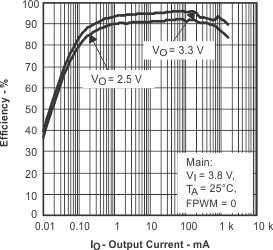 Figure 1. Efficiency vs Output Current
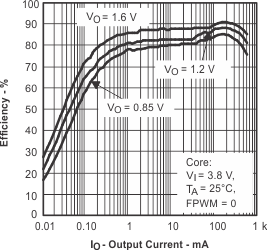 Figure 3. Efficiency vs Output Current
 Figure 5. Quiescent Current vs Input Voltage
 Figure 7. LD01 Output Voltage vs Output Current
 Figure 9. LDO1 Output Voltage vs Output Current

 Figure 13. Line Transient Response (LDO1)
 Figure 15. Line Transient Response (CORE)
 Figure 17. Line Transient Response (LDO1)
 Figure 19. Output Ripple (PFM)
 Figure 21. Startup Timing
 Figure 23. Dropout Voltage vs Output Current
 Figure 2. Efficiency vs Output Current
 Figure 4. Efficiency vs Output Current
 Figure 6. Switching Frequency vs Temperature
 Figure 8. LD01 Output Voltage vs Output Current
 Figure 10. LDO2 Output Voltage vs Output Current
 Figure 12. Line Transient Response (CORE)
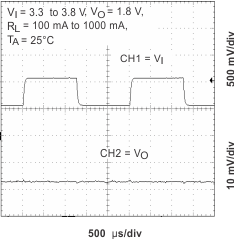 Figure 14. Line Transient Response (LDO2)
 Figure 16. Line Transient Response (MAIN)
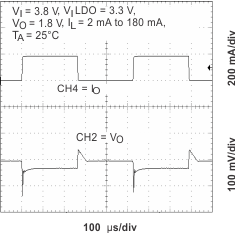 Figure 18. Line Transient Response (LDO2)
 Figure 20. Output Ripple (PWM)
 Figure 22. Dropout Voltage vs Output Current
 Figure 24. PSRR (LDO1, LDO2) vs Frequency