SLLA272D February 2008 – May 2021
3 Network Topology
The RS-485 standards suggests that its nodes be networked in a daisy-chain, also known as party line or bus topology (see Figure 3-1. In this topology, the participating drivers, receivers, and transceivers connect to a main cable trunk via short network stubs. The interface bus can be designed for full-duplex or half-duplex transmission (see Figure 3-2).
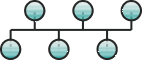 Figure 3-1 RS-485 Bus Structure
The full-duplex implementation requires two signal pairs, (four wires), and full-duplex transceivers with separate bus access lines for transmitter and receiver. Full-duplex allows a node to simultaneously transmit data on one pair while receiving data on the other pair.
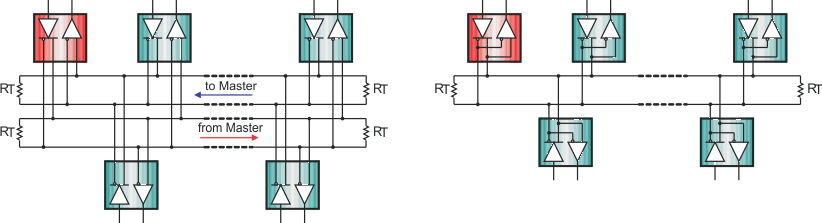 Figure 3-2 Full-Duplex and Half-Duplex Bus
Structures in RS-485
Figure 3-2 Full-Duplex and Half-Duplex Bus
Structures in RS-485In half-duplex, only one signal pair is used, requiring the driving and receiving of data to occur at different times. Both implementations necessitate the controlled operation of all nodes via direction control signals, such as Driver/Receiver Enable signals, to ensure that only one driver is active on the bus at any time. Having more than one driver accessing the bus at the same time leads to bus contention, which, at all times, must be avoided through software control.