SBOA409A May 2020 – October 2020 INA381-Q1
4 Pin Failure Mode Analysis (Pin FMA)
This section provides a Failure Mode Analysis (FMA) for the pins of the INA381-Q1. The failure modes covered in this document include the typical pin-by-pin failure scenarios:
- Pin short-circuited to Ground (see Table 4-2)
- Pin open-circuited (see Table 4-3)
- Pin short-circuited to an adjacent pin (see Table 4-4)
- Pin short-circuited to Supply (see Table 4-5)
Table 4-2 through Table 4-5 also indicate how these pin conditions can affect the device as per the failure effects classification in Table 4-1.
| Class | Failure Effects |
|---|---|
| A | Potential device damage that affects functionality |
| B | No device damage, but loss of functionality |
| C | No device damage, but performance degradation |
| D | No device damage, no impact to functionality or performance |
Figure 4-1 shows the INA381-Q1 pin diagram. For a detailed description of the device pins please refer to the Pin Configuration and Functions section in the INA381-Q1 data sheet.
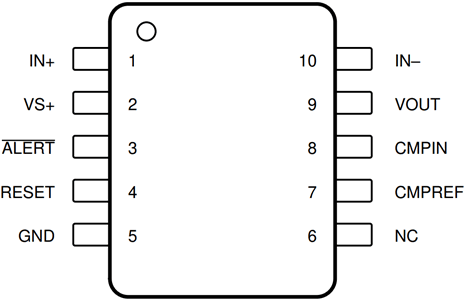 Figure 4-1 Pin Diagram
Following are the assumptions of use and the device configuration assumed for the pin FMA in this section:
- TA = -40°C to +125°C
- VS = 5 V
- VIN+ = 12 V
- CMPREF = 2 V.
| Pin Name | Pin No. | Description of Potential Failure Effect(s) | Failure Effect Class |
|---|---|---|---|
| IN+ | 1 | In high-side configuration, a short from the bus supply to GND will occur. High current will flow from bus supply to ground. In low side configuration, input pins are shorted. | B |
| VS+ | 2 | Power supply shorted to ground | B |
| ALERT | 3 | ALERT output is stuck low | B |
| RESET | 4 | If intended connection is not GND, functionality will be affected. | D if RESET=GND by design; B otherwise |
| GND | 5 | Normal Operation | D |
| NC | 6 | Normal Operation | D |
| CMPREF | 7 | ALERT output is stuck low | B |
| CMPIN | 8 | ALERT output is stuck high | B |
| VOUT | 9 | Output shorts to ground. When left in this configuration for a long time, under high supplies self heating could cause dice junction temperature to exceed 150 degrees Celsius. | B |
| IN- | 10 | In high-side configuration, a short from the bus supply to GND will occur. High current will flow from bus supply to ground. In low side configuration, normal operation | B for High side or D for low side |
| Pin Name | Pin No. | Description of Potential Failure Effect(s) | Failure Effect Class |
|---|---|---|---|
| IN+ | 1 | Differential input voltage is not well defined | B |
| VS+ | 2 | No power supply to device. Device may be biased through inputs. Output will be close to GND. | B |
| ALERT | 3 | Pin can be left open if not needed | D if ALERT=open by design; B otherwise |
| RESET | 4 | Comparator mode is not defined | B |
| GND | 5 | GND is floating. Output will be incorrect as it is no longer referenced to GND. | B |
| NC | 6 | Normal Operation | D |
| CMPREF | 7 | Comparator threshold is not defined. | B |
| CMPIN | 8 | Comparator input is not defined | B |
| VOUT | 9 | Output can be left open, there is no effect on the IC. | B |
| IN- | 10 | Differential input voltage is not well defined. | B |
| Pin Name | Pin No. | Shorted to | Description of Potential Failure Effect(s) | Failure Effect Class |
|---|---|---|---|---|
| IN+ | 1 | VS+ | In high-side configuration, a short from the bus supply to VS will occur. High current will flow from bus supply to VS or vice versa. Device could be damaged. | A for High side or B for low side |
| VS+ | 2 | ALERT | ALERT is stuck high or unpredictable. | B |
| ALERT | 3 | RESET | ALERT is unpredictable. | B |
| RESET | 4 | GND | If intended connection is not GND, functionality will be affected. | D if RESET=GND by design; B otherwise |
| GND | 5 | NC | Normal Operation. | D |
| NC | 6 | CMPREF | Normal Operation. | D |
| CMPREF | 7 | CMPIN | Comparator input pins are shorted. | B |
| CMPIN | 8 | VOUT | Normal Operation. | D |
| VOUT | 9 | IN- | In high-side configuration, a short from the bus supply to VOUT will occur. Device could be damaged . In low side configuration, power supply is shorted to GND. | A for High side or B for low side |
| IN- | 10 | IN+ | Input differential voltage=0V. | C |
| Pin Name | Pin No. | Description of Potential Failure Effect(s) | Failure Effect Class |
|---|---|---|---|
| IN+ | 1 | In high-side configuration, a short from the bus supply to VS will occur. High current will flow from bus supply to VS or vice versa. Device could be damaged. | A for High side or B for low side |
| VS+ | 2 | Normal operation | D |
| ALERT | 3 | ALERT is stuck high or unpredictable. | B |
| RESET | 4 | If intended connection is not VS, functionality will be affected. | D if RESET=VS by design; B otherwise |
| GND | 5 | Power supply shorted to GND | B |
| NC | 6 | Normal operation | D |
| CMPREF | 7 | ALERT is stuck high. | B |
| CMPIN | 8 | ALERT is stuck low. | B |
| VOUT | 9 | Output shorts to supply. When left in this configuration for a long time, under high supplies self heating could cause dice junction temperature to exceed 150 degrees Celsius. | B |
| IN- | 10 | In high-side configuration, a short from the bus supply to VS will occur. High current will flow from bus supply to VS or vice versa. Device could be damaged. | A for High side or B for low side |