SBOA597 November 2024 OPA928
2.2 Using the Coulombmeter to Determine IB
Even if the feedback terminal has no connection to the current source, there is a small current flow from the non-ideal input terminal of the op amp. The small current flow into or out from the input terminals is called input bias current (IB). IB is important to understand because it contributes to error in a system, and many times needs to be calibrated out for application circuits.
 Figure 2-3 Components of Measured Current
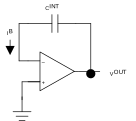 Figure 2-4 Model of Input Bias Current Integration
When not using the external current source, the feedback capacitor and integration capacitor (CINT), integrates the charge of IB alone. This architecture is commonly called the self-integration circuit. The sign of the current is determined by the direction of the bias current at the input terminal. A positive sign means the current is flowing into the op amp. A negative sign indicates input bias current flows out from the terminal.
 Figure 2-5 Model of input Bias Current Integration for Negative IB
 Figure 2-6 Negative Slope of Vout Versus Time Indicates IB < 0
The magnitude of the input bias current varies depending on the process technology, the design of the op-amp, and the operating conditions, such as supply voltage, common-mode voltage, and temperature. For most CMOS op-amps, the input bias current is in the range of picoamperes. However, some precision op-amps designed for low IB have input bias currents measured in atto-Amperes.
One of the alternative solutions is called the Ammeter. The circuit is simply an amplifier configured with a large feedback resistor. The challenge for the ammeter circuit is the need for extremely high resistance to measure low levels (for example, femtoamperes or fA) of current. When it comes to low IB measurement, it is not practical to use multiple resistors such as 1TΩ in series to measure sub-femtoampere. The primary disadvantages are large thermal noise and thermal EMF that needs to be calibrated out.
For this reason, the budget-wise coulombmeter is the most practical approach, opposed to a high-resistance ohmmeter or ammeter that uses large feedback resistor. For the Ammeter, large resistors (>1 TΩ) can cost >$1000 to measure 1 [femtoampere] with a multimeter reading of 1mV. Additionally, the thermal noise is almost 100mV for a 1TΩ resistor, so the resolution is poor unless it is averaged for a long period of time. The large feedback resistor can also require a feedback capacitor to stabilize the amplifier. This results in time constants of a few seconds if the input terminal has capacitance of a few pF, and can take tens of seconds to settle.
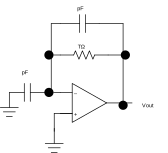 Figure 2-7 Ammeter with a Large Feedback Resistor
For the coulombmeter, a capacitor that is tens of pF can be purchased for less than $1. Charges on the 33pF capacitor to measure 1fA with a voltage change on the multimeter of 1mV over 33sec.
Coulomb meter
I = dV/dt x F
1fA = 1mV / 33sec x 33pF
Settling time: tens of seconds
Cost of a 33pF capacitor is < $1
Ammeter
I = V / R
1fA = 1mV / 1TΩ
Settling time: tens of seconds
Cost of a 1TΩ resistor > $1000
With that, a coulombmeter is more practical for very small current measurements over a long integration time.
| Coulombmeter | Ammeter | |
|---|---|---|
| Thermal noise | Undetectable | Large |
| Speed | Long integration time | Long data averaging time |
| Parts cost | Capacitor <$1 | Resistor >$1000 |