SDAA156 October 2025
1 Body
Introduction
Environmental sustainability and energy security are two major drivers that are accelerating the demand for more energy-efficient and cost-effective power converters. Modern power converters are ever-shaping the application landscape for energy generation, storage, and distribution. The common system challenges in these applications are the increasing level of power density, efficient bidirectional operation, and cost reduction. This application brief highlights the emerging bi-directional GaN (BDG) High Electron Mobility Transistor (HEMT) technology and the potential to revolutionize the power industry, especially in applications that require bidirectional operation, high power density and cost reduction. A few power topologies that can benefit from BDG are T-Type, Vienna Rectifier, Heric, and direct matrix converters. These topologies are commonly used in high-power industrial and automotive end equipment such as electrical vehicle (EV) chargers, solar inverters, and traction inverters. The next few sections discuss how TI's BDG HEMTs are used in the T-Type converter design (TIDA-01606) and achieve approximately 98% peak efficiency for AC to DC operation. Test results are presented to highlight the performance of TI BDG.
Designing the BDG Daughtercard for TIDA-01606 T-Type Converter Board
The TIDA-01606 is a SiC-based 11kW, bidirectional three-phase, three-level, T-type converter. For benchmark, the peak efficiency of this SiC-based design is 98.6% (at 4.5kW load). There are three pairs of back-to-back (common drain in this example) SiC FETs (650V, 60mΩ) for the T-type middle switches. By leveraging monolithic TI BDG technology, users can replace these six discrete SiC FETs with three BDG HEMTs, as shown in Figure 1. For more details on the original SiC TIDA-01606 design including schematics and design guide, see TIDA-01606.
 Figure 1 Simplified T-Type Converter (TIDA-01606) Block Diagram with Bidirectional GaN HEMTs for the Inner Switches
To replace the back-to-back switches, three BGD daughtercards have been designed that can be assembled right onto the main TIDA-01606 motherboard. The assembly is shown in Figure 2. Note that the BDG has top-side cooling heatsinks.
 Figure 2 TIDA-01606 Board with BDG Daughtercards Assembled as Denoted by the Red Arrows
Test Results
The efficiency, power factor (PF), and current total harmonic distortion (iTHD) of the BDG-based T-type converter are tested. Experimental waveforms for PFC operation at 3.8kW are shown in Figure 3. The input AC phase voltage is 230Vrms and the output is 800 VDC. The switching frequency was set to 90kHz with 150ns of deadtime. The deadtime setting was on the conservative side due to the nature of the daughtercard plugin, which added additional propagation delays. The peak efficiency achieved was 97.9% at 3.8kW. At high load levels (especially higher current for example >3A), expect the conduction losses to dominate over switching losses. The efficiency, Power Factor (PF), and iTHD performance data are shown in Figure 4, Figure 5, and Figure 6 respectively.
 Figure 3 Example PFC Waveforms Operating at 3.8kW
Scope signals: CH1: AC input phase voltage VP1 (blue), CH2 : Output VDC scaled 500:1 (turquoise),CH3 : AC input current (red)
 Figure 4 Efficiency for PFC Mode, 230 VAC Input, 800 VDC Output
 Figure 5 Power Factor for PFC Mode, 230 VAC Input, 800 VDC Output
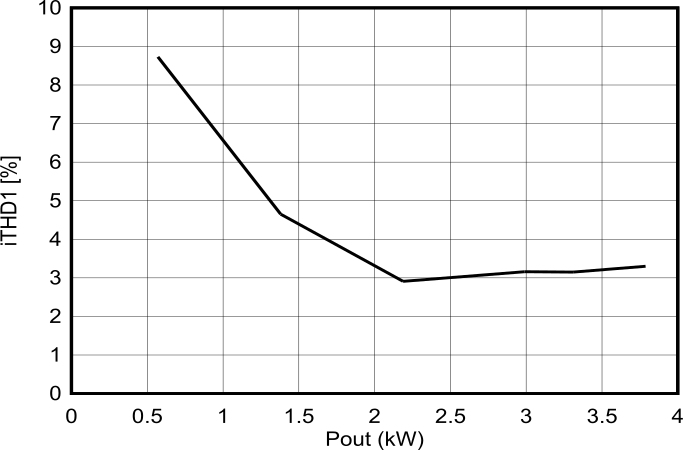 Figure 6 iTHD1 for PFC Mode, 230 VAC Input, 800 VDC Output
Conclusion
BDG is making significant strides in the power converters in recent years and is expected to be one of the cornerstones for commercial GaN products. In this application brief, an example application of BDG in T-type converter and provide some preliminary data to support the potential role of BDG in some key bidirectional power converter applications was highlighted. BGD is likely to add even more value for bidirectional converters that operate closer to single MHz range (for example, a direct matrix converter).